Essay
By Noam Backner
A Buddha on the Red Sea
A locally carved statue from Roman Egypt illuminates the maritime connections between the Mediterranean and India.
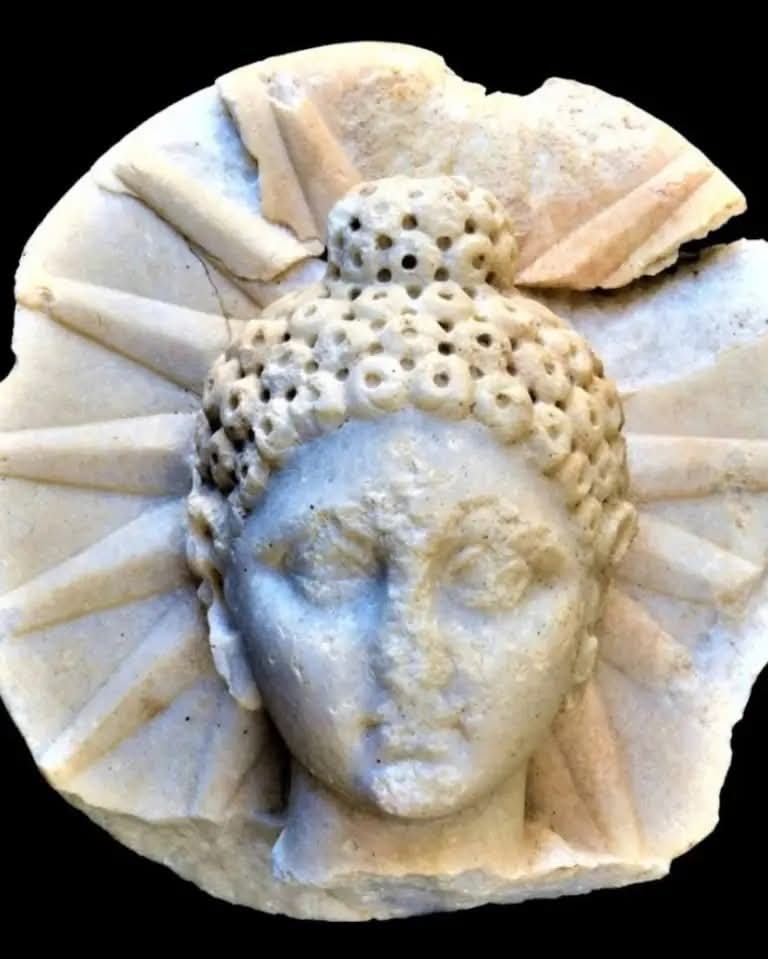
Shakyamuni Buddha. Roman Egypt. Marmara marble. First century CE (?)
In a hyperconnected world that lately seems to be coming apart at the seams, it may be worth remembering that, to some extent, things have always been this way. The roads linking place to place are subject to tides of connection and retreat, memory and forgetting, shaped by place and circumstance, time and sovereign power.
Occasionally, there are flickers, small and large, of connections that once existed and no longer do. The marble Buddha of Egyptian Berenike is one particularly striking spark: the product of routes that briefly came into view, then disappeared again.
Remote but strategically situated, the port city of Berenike Troglodytica began as a Hellenistic outpost for shipping African elephants for warfare. Its favorable coastal position, proximity by land to the mines of Nubia and East Africa, and access by sea to the monsoon routes later made it a distinctive melting pot linking the Mediterranean basin, the African interior and the vast reaches of the Indian Ocean.
Despite the great distances and hostile terrain, Berenike served as a forward trading post for Ptolemaic Egypt, and later the Roman Empire, connecting it with the coasts of Arabia, Iran and eventually the Indian subcontinent and beyond. Its remoteness did not prevent the settlement from sustaining a substantial population of diverse origins. Alongside a core of Greco-Egyptian residents were Semitic peoples, Palmyrenes, Arabs and perhaps a number of Jews. There is also evidence for the presence of Gauls and Germanic people—and, most important for our purposes, Tamils from southern India.
These last, active participants in the extensive trade between the Mediterranean and the Indian coast, left in the sands not only a substantial cargo of teak, a generous offering of pepper and a Tamil inscription in Brahmi script, but also an impressive Buddha statue: the westernmost example made outside Afghanistan until the modern era.
In many respects, this distinguished Buddha is entirely ‘one of ours’. It was carved locally by Mediterranean artists using fine marble from the celebrated quarries of Proconnesus, south of modern Istanbul.
The statue of Shakyamuni Buddha, uncovered in 2022, carefully preserves important features of the Buddhist artistic canon: the posture, the curl-covered cranial protuberance, elongated earlobes and, of course, a radiant halo. All are defining attributes of the Buddha and his qualities. Yet the design of the sun halo around his head and subtle stylistic details of his face have no known parallel, not even in Gupta or Gandharan art, themselves deeply influenced by Hellenistic culture. This appears to be a local interpretation of Buddhist sculpture, surely modeled on examples brought to Egypt’s shores by Indian seafarers.
The western marble Buddha is not the only example of material culture of Indian origin at Berenike. Alongside remains of mats, pottery, sails and Asian macaques, other finds indicate a long-established Indian community on the African coast and active participation in local religious worship, albeit, as usual, in its own way and for its own purposes. In addition to the marble Buddha and fragments of several other Buddhist statues, excavations in or near the Temple of Isis revealed a later Sanskrit inscription and a stone stele combining Roman elements with deities originating in the early Vedic world.
The discovery of a Shakyamuni Buddha—one of the most recognizable figures of ‘Eastern’ culture—not merely far into the West, but as a product of local craftsmanship, is naturally exciting for anyone interested in Buddhist archaeology, or indeed archaeology more generally. Beyond the obvious fascination of the find, this statue and others like it deepen our understanding of the complexity of contact between the regions of the ancient world.
Whether these objects emerging from the sands will be joined by new insights into the depth of intellectual exchanges between East and West remains too early to say. But their value as waymarks, resurfacing to reveal faded connections between places that time has forgotten, is beyond doubt.
Continue the conversation
A question, a correction, a source I should know about? Write to me privately — I read every note.
Send a noteField dispatches
New essays and journey announcements, a few times a year.