Essay
By Noam Backner
Botany and Revival on China’s Streets
Ginkgo and dawn redwood bring ancient lineages into China’s changing urban gardens.
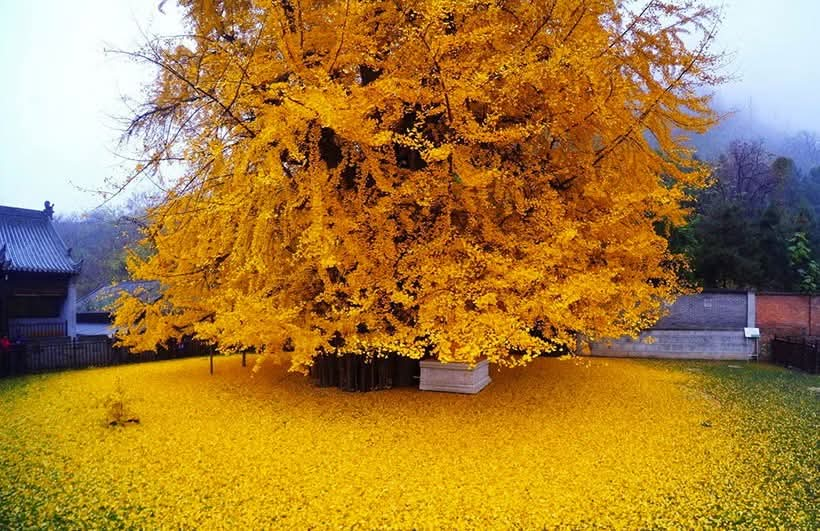
The Chinese urban landscape today is marked by considerable attention to gardening. This includes, of course, not only the requisite tree-lined avenues and well-tended flowerbeds, but also the creation of public gardens of various sizes for the benefit of local residents. More than once I have been surprised by a new garden’s ability to appear overnight, with mature trees, sometimes ten meters tall or more, miraculously “sprouting” to establish the garden’s outline, later joined by shrubs and flowers, ornamental ponds, and inanimate features.
Among the most conspicuous signs of autumn in Chinese cities are the ginkgo biloba trees turning gold along the avenues and deep inside the gardens. The two-lobed ginkgo (Ginkgo biloba), a relict tree species that, despite its appearance, is more closely related to other gymnosperms such as conifers, cycads, and ephedras, belongs to a plant division that has largely dwindled since the end of the Cretaceous. It survived as a single species in a number of isolated sites in central, eastern, and southern China.
Thanks to the ginkgo’s resilience, longevity, and distinctive beauty, the tree survived in cultivation and was spread by people throughout China, and later in Korea and Japan. Planting it beside country roads, temples, and monasteries became extremely common over the past thousand years. Ginkgo trees migrated back to the Western world from the eighteenth century onward, arousing great interest and prompting extensive planting in botanical gardens and, later, public spaces. They became one of the best-loved and most recognizable street trees in Western cities, known for their considerable resistance to pollution and disease, and especially for the golden autumn foliage they produce as the seasons turn.
Back in China, ginkgo trees, known in Chinese as “silver apricot” (yin xing) for their seeds covered in orange, waxy flesh, provide the edible seeds known as “white nuts.” These are usually roasted after the flesh, which reeks of old butter thanks to the presence of butyric acid, has been thoroughly cleaned away, and are an ingredient in cooked dishes, porridges, and sweets. Thanks to their distinctive, ever-changing appearance, ginkgo trees are also popular in the art of bonsai (Chinese: penjing), or as shaped trees with a sculptural appearance. These allow their admirers to enjoy the trees’ virtues without committing to their eventual size and height: a ginkgo can reach some fifty meters and the venerable age of around three thousand years.
Another “living fossil” that has enjoyed a significant revival in Chinese urban gardening, after being rediscovered in the 1940s, is the dawn redwood (Metasequoia glyptostroboides). It is the relatively modest-sized Asian cousin of the two American redwood species, with which it shares a common ancestry. The dawn redwood was discovered during the Second World War along the slopes of the upper Yangtze, studied after the war, and its seeds distributed to important collections in Western countries. Like ginkgo trees, dawn redwoods are now widely used in Chinese urban planting, thanks to their rapid growth, ease of vegetative propagation, and suitability for a variety of soils, including heavy soils. However, because the parent stock used in cultivation in China originated from only about three individual trees, a lack of genetic variation was a problem—one that appears, in the meantime, to have been resolved by collecting additional seeds from the original populations in central China.
Stories of growth “against the flow of traffic,” and of the rescue of rare tree populations, are always moving, even if one can argue that the overall survival of a healthy ecological environment matters more than saving a few species impressive to the human eye. And yet, as parallel cases involving the rescue and breeding of the giant panda have shown, restoring and reconnecting habitats around a keystone species sometimes allows the entire ecosystem to recover, at least in part.
The Chinese urban landscape is admittedly a disturbed landscape, like any urban environment. But to the layperson’s eye, at least, it seems that the significant improvement in vegetation cover, soil, and air quality in Chinese cities over the past generation is allowing birds, arthropods, amphibians, and other creatures to return on a scale unprecedented in comparison with the second half of the twentieth century.
Continue the conversation
A question, a correction, a source I should know about? Write to me privately — I read every note.
Send a noteField dispatches
New essays and journey announcements, a few times a year.