Essay
By Noam Backner
Camel Milk Ice Cream
A Chinese ice-cream rating meets camel milk: an ancient desert food, northern frontier economies, and the marketing of the "new frontier".
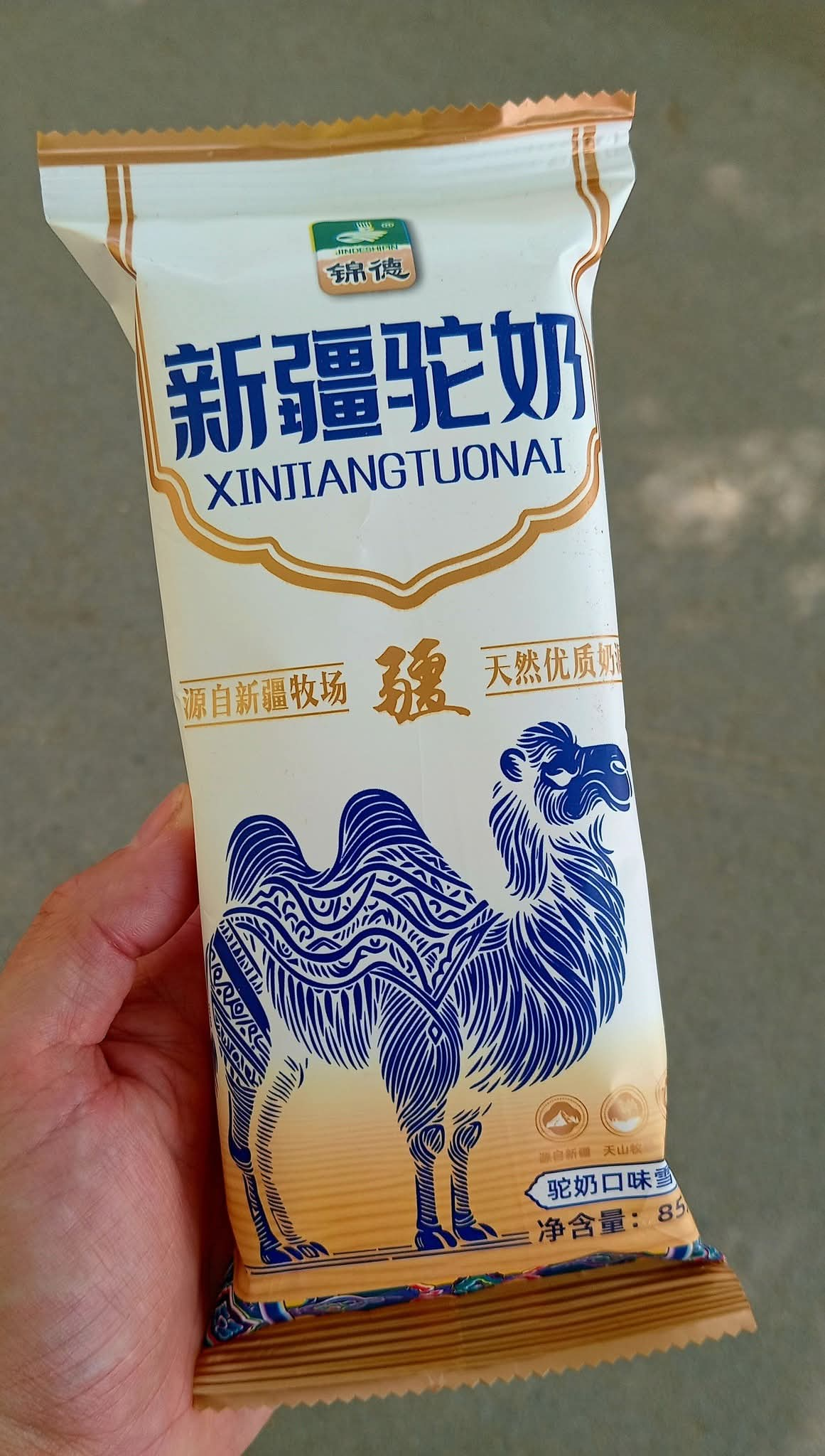
There hasn't been a Chinese ice-cream rating here for a long while, certainly not since I switched to a bigu diet (Insta channel coming soon — keto people, eat dust). But if the chance has come up to combine it with the second most popular corner here, then why not.
Camel milk has been consumed by desert and steppe societies for thousands of years, and because it is difficult to preserve for later consumption, it was mostly confined to those geographical zones.
In northern China, an ancient ecological contact line, camels and their products were considered a symbol of foreignness, yet they were very much present in the commercial and economic life of the north for 1,000 years and more, while camel milk was regarded as a rich, fortifying product.
In modern China the industry has developed significantly, especially in recent years, as the ancient reputation of camel milk is matched with policies for developing the periphery and the needs of the state at large. Within this framework, ongoing research is being conducted to improve China's camel dairy sector, almost entirely concentrated in the north-western border regions.
While fresh camel milk is hardly consumed today — alongside the production of shubat (Mongolian: khoormog), fermented camel milk for local consumption — most of China's camel milk yield goes into dried milk powder, which is sold at high prices throughout the country, again as a nourishing product that supports digestion.
I admit I bought this camel ice cream mainly for its beautiful packaging, but since we've already sunk our teeth into it, we can report that it did not impress beyond what was expected.
The high price of camel milk means that the ice cream, as expected, contained mostly cow's milk and only about 3% camel milk powder — which of course takes nothing away from the cheerful marketing of the product as "camel milk ice cream from the new frontier", in a way not unfamiliar to food producers anywhere else.
The ice cream did strongly recall, and not by chance, the classic Chinese milk-cake ice creams (nai gao), those white blocks in vintage paper wrappers known to every Chinese man and woman from the simple childhood of old. On the other hand — and perhaps this is my personal disappointment at the low camel percentage — above every bite hovered certain aftertastes, perhaps from a not especially successful cocktail of emulsifiers.
Camel milk ice cream Overall score: 9.5 Price: 8 yuan
Continue the conversation
A question, a correction, a source I should know about? Write to me privately — I read every note.
Send a noteField dispatches
New essays and journey announcements, a few times a year.