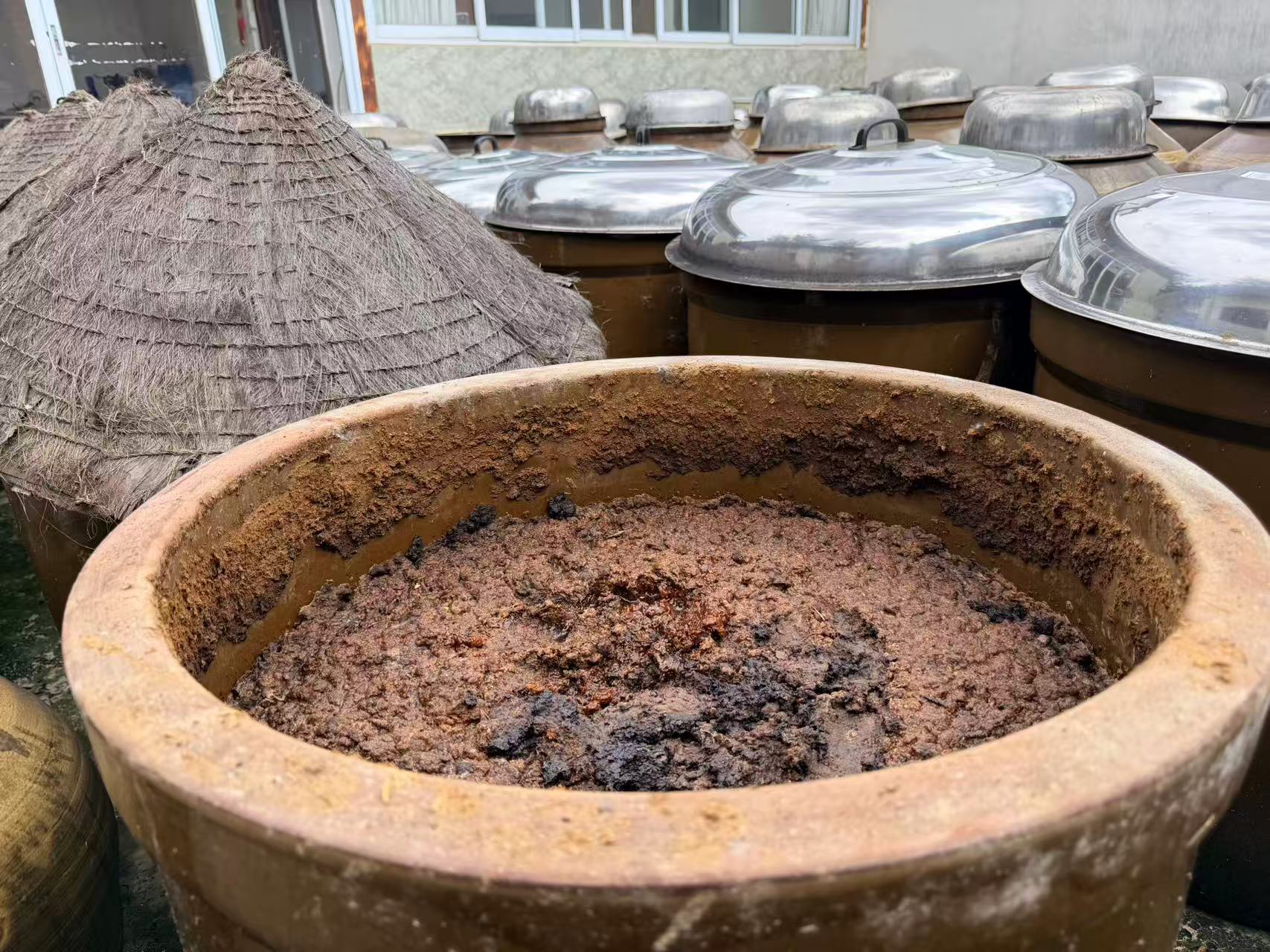
One of the more intriguing insights of the modern age, an age that began with a loud fanfare of hygiene, is how closely we are bound to microorganisms, and how much we depend on them to exist. This is not only because they are central to photosynthesis and to the processes of decomposition and recycling in natural systems, but also because they bear directly on our existence as living beings. The gut microbiota, (at least) equal in number to the human cells in our bodies, is responsible for digestive processes critical to our survival, and also for balancing the body's hormonal, immune and nervous systems, in a way that casts healthy doubt on the very question of human agency.
Further up the digestive tract, there is a solid possibility that fermented, microbe-rich foods do their part to enrich, thicken and structurally reshape the gut biota, and in turn make a distinctive contribution to the body's resilience in health and in sickness. While processing and preservation carried out in partnership with bacteria, molds and other microorganisms are known across the world, and involve some of the oldest domestication processes on earth, there is reason to believe that the Chinese, as usual, do it more thoroughly and more variously than most of the world's cultures.
Naturally, there is little way to determine when Chinese fermentation culture began, but we know that fermented drinks formed a significant part of the social, ceremonial and ritual life of the Yellow River cultures. Analysis of residues from Neolithic sites in northern China points to mixtures of grains, honey and hawthorn fruit used to make alcohol around the sixth millennium BCE, and perhaps even earlier. And while distillation, certainly the kind responsible for Chinese "vodka," or baijiu, matured in China only under the Mongol Empire, with distilling technology imported from the West, alcohol in its various forms has been the chief social lubricant from the cradle of Chinese civilization to the present day.
Another by-product of the alcohol industry is, of course, vinegar: one of the classic Chinese "seven necessities," a food preservative in its own right, and one of the main flavorings of Chinese cooking, alongside soy sauce, sesame oil, and seasonings of greater or lesser antiquity such as garlic, ginger and American chili. China has a fine range of vinegars, differing in raw materials, region of origin, method and length of aging, and intended use. White rice vinegars are not unlike the light vinegar familiar in modern Western kitchens, but others, especially the "black" vinegars made from a range of grains such as barley and sorghum along with other ingredients, the best known being Zhenjiang vinegar and Shanxi aged vinegar, carry deeper and even sweeter undertones, comparable to Western balsamic. Yet another kind, "red" vinegar, uses a fiery red rice as the fermentation starter, before the secondary breakdown into acetic acid and further aging of the finished vinegar.
Red rice is the product of a mold of the species Monascus purpureus. The breakdown of proteins and starches in which it takes part eases secondary processes such as alcoholic fermentation and, as mentioned, vinegar making, but it also gives the products the mold's distinctive red color. The pigment the mold secretes is also used to color various foods and in Chinese medicine, and modern research suggests its products may improve cholesterol and blood sugar levels in the human body.
As a technological and culinary product, red rice falls under the category of qu (曲): various fermentation starters, parallel to Japanese koji. These molds, among them Aspergillus, Saccharomyces and others, specialize in breaking down proteins from legumes and grains, and the pronounced umami of the resulting products has been a cornerstone of Chinese culinary practice for generations, in the making of soy sauce, bean pastes (doujiang) and salted soybeans (douchi). These ancient fermented products are irreplaceable ingredients in the flavor complex unique to Chinese cuisine. They were also an important nutritional resource in a famine-hardened China, allowing salt to be "stretched" and that precious resource to be used wisely.
And if China's umami-laden fermented products have become modern household staples in most of the world's kitchens, a few still seem to get "lost in translation" beyond China's borders. China is certainly also the source of Japanese natto (in Chinese, na dou), the slimy product of Bacillus subtilis. But a rather uniquely Chinese, and controversial, product is the notorious "stinky tofu," made by exposing slabs of tofu to a merciless assault by a series of bacteria, yeasts and molds of the genera Actinomucor, Rhizopus, Saccharomyces, Lactobacillus and others.
It is easy to understand why stinky tofu in its various versions, some of which certainly tend to give off the scent of an open sewer on a hot summer night, is a hard product to digest outside Chinese culture. Yet its offshoot, furu, or doufu ru, is one of the finest fermented products in the world. Long aging in the company of salt, spices and red chili turns it into a deep umami bomb, a superb complement to white rice, steamed buns and even stir-fried vegetables, in a way not fundamentally different from a well-aged Western cheese.
Over the past hundred years Chinese cuisine has become one of the most beloved in the world, and not for nothing. Its skill at combining flavors, aromas and textures, while honoring each ingredient even as part of the dish as a whole, has made it an especially rich and joyful feast for the palate. And yet all these ingredients, even the finest to be found, would amount to nothing without the molecular breakdown products of countless yeasts, molds and bacteria, on which, let us remember, the world stands.
Happy digesting.
Continue the conversation
A question, a correction, a source I should know about? Write to me privately — I read every note.
Send a noteField dispatches
New essays and journey announcements, a few times a year.