Essay
By Noam Backner
Slaves of the Long River
Trade, metal convoys, and the boat haulers whose punishing labor carried the Yangtze’s commerce through the Three Gorges.
The Chang Jiang, true to its name, is the longest river in China—and in all Asia.
Drawing on a vast catchment, mostly in the peaks of the eastern Tibetan plateau and partly fed by rivers in Sichuan and northern Yunnan, the Chang Jiang—hereafter the Yangtze, its more familiar name—extends for more than 6,000 kilometers through the Hengduan Mountains and along the edges of the Sichuan basin. It then descends through the towering, dramatic landscape of the Three Gorges, slows among the plains and lakes of central China, and finally pours into the East China Sea beside Shanghai's glittering shores.
For generations, the Sichuan basin, through which the upper Yangtze passes, was known as an inexhaustible source of agricultural abundance and a coveted prize during the turmoil between dynasties. Trade on the Yangtze received a substantial boost in the eighteenth century, when the recovery of Sichuan's devastated population and an intensive revival of commercial activity went hand in hand with the emergence of institutions needed for long-distance shipping.
The bustling trade flowing out of the Sichuan basin was squeezed through some 200 kilometers of the turbulent Three Gorges passage, toward the lower Yangtze, the plains of Hubei, and beyond. It depended on a stratified society whose face was turned to the river and whose back rested against the towering cliffs.
The river people were a heterogeneous gathering of trades: woodworkers and bamboo weavers, navigators and oarsmen, innkeepers and operators of teahouses, brothels, and opium dens, along with other people on society's margins. Especially during the winter low-water season, they undertook everything required to register, pack, load, crew, and dispatch the boats with their creaking cargoes.
To a Chinese state that favored the settled and the taxable, these wandering bands of river people were, naturally, the worst kind of rabble. The aristocracy of river commerce likewise met with open contempt from the bureaucratic elite. It was at least well rewarded in more worldly currency, as the finely carved buildings dotting the historic river towns—from Chongqing in the west to Suzhou in the east—made clear.
The Yangtze's beasts of burden, from the modest wuban boat to the enormous ma chuan wei, differed in shape, capacity, and sometimes the cargoes they carried. Grain, textiles, pottery, and salt often formed the bulk of their loads, joined by local products such as medicinal herbs and Sichuanese tree wax. Opium became increasingly important during the nineteenth century, when Sichuan was its principal growing region in China.
Particular importance attached to the metals trade. It helped drive the expansion of the state apparatus into China's wild west and was central to imperial administration: copper and silver, the foundations of the traditional Chinese economy, were mined chiefly in remote Yunnan. From there they trickled—if luck held—all the way to the coinage of the imperial treasury in distant Beijing. Southwestern China's harsh, jagged terrain made mining and transporting metals a bureaucratic nightmare. “Steep in the mountains, muddy in the rain” was the daily lot of the southwestern caravan men. River transport down the Yangtze therefore offered a distinct advantage for heavy cargoes. Metal shipments were, in fact, almost the only goods subject to close government management and supervision throughout most of the period in question. The ever-suspicious officials kept their eyes on the registration, tracking, and protection of this precious freight, even when a shipwreck sent it to the bottom of the raging river and it had to be recovered. Unauthorized salvagers and their helpers faced the threat of beheading.
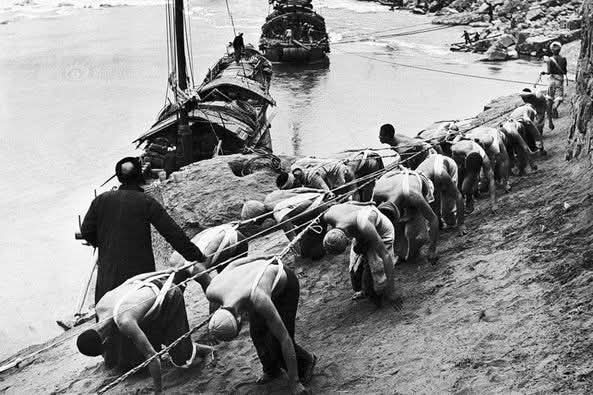
Of all the river people, from prosperous navigators to the lowliest stitchers of leather packaging, probably none were more downtrodden than the boat haulers. Drawn from late imperial China's burgeoning population, these ragged, hungry men were mostly seasonal workers with no employment outside the summer's fieldwork. They streamed out of the mountain and valley villages draining into the great dragon's basin and built settlements of misery beneath bamboo matting. Scantily dressed, if dressed at all, and often living from hand to mouth, they gathered along the river, particularly where the mighty banks had collapsed to form treacherous rapids. There they waited for boats returning upstream toward Sichuan.
Downstream navigation required little expenditure of energy: chiefly an experienced captain's hand, a navigator's sharp eye, and the practiced rhythm of good oarsmen. The return upstream was another matter entirely. Some sixty rapids of varying severity awaited vessels making their way from Yichang to their home port in Chongqing. In theory, boats were supposed to carry most of the men required for the return journey. In practice, hauling them up the steep rapids required twice, sometimes four times, the number aboard. A single boat might need hundreds of haulers, advancing at only a few kilometers an hour at best.
These human beasts of burden from the riverbanks, mostly bands of the destitute drawn from the lowest ranks of river society, were harnessed to the task. Usually equipped with no more than a harness and ropes of woven bamboo—a strong material notorious for cutting into living flesh when its fibers frayed—scores of men inched heel to toe along the sandy banks. Elsewhere they bent low, crawling like a human serpent across slippery stone slopes or through passages cut into the rock at the expense of a wealthy patron.
The last and usually weakest link in the hierarchy of river people, seasonal haulers did not even enjoy the protection of local organizations. Guilds and secret societies regulated the worlds of both legitimate and illicit commerce, but these men remained outside their shelter, at the mercy of profiteers, brutal working conditions, and starvation wages. Their pay often barely covered the daily calories needed to stay alive.
“Multitudes of boat haulers, fastened to the vessel, are like a string of beads moving to the beat of the gong.
Lead and copper from Yunnan and Guizhou are shipped within days; their splendid singing rivals the splendor of fine robes.”
As the ornate verse above illustrates, our ability to understand the Yangtze's forgotten world is limited. We rely on literary works, local documents, and foreign observers, most of whom viewed the old river society from outside. The sweeping changes that thundered along the river, its rapids, and its ports during the twentieth century erased most of the arrangements that had governed its rhythm for generations. In their place came the faster tempo of diesel engines, immense waterworks, and complex electrical grids, changing its face beyond recognition and beyond return.
The Yangtze's length, topographical complexity, and position within China's geography enabled the ancient water dragon to draw into itself the tensions between central government and provinces, center and margins, north and south, east and west, and different ethnic groups. To a large extent, these tensions have never ceased to shape China and its turbulent internal dynamics, stretching from Shanghai's ports in the east to the peaks of the Qinghai plateau in the west. Like water flowing down from the mountains to the great sea, they may never cease.
Continue the conversation
A question, a correction, a source I should know about? Write to me privately — I read every note.
Send a noteField dispatches
New essays and journey announcements, a few times a year.