Essay
By Noam Backner
Spots and Stripes: The Çintamani and the Emblem of Power
How a leopard-and-tiger motif travelled from Timur's coins to Ottoman silks and Iznik tiles.
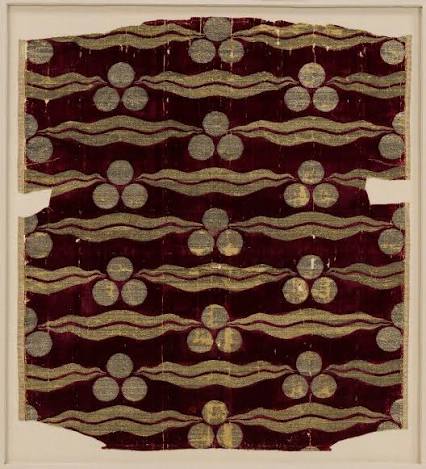
The motif known to scholars as çintamani — a cluster of circles arranged in a triangle, sometimes accompanied by wavy lines — is familiar today from Ottoman-era textiles and carpets, and also, among online nationalists of the pan-Turkic variety, as the supposed flag of the Timurid empire in Central Asia.
Earlier studies held that the symbol was a direct descendant of the Buddhist "wish-fulfilling jewel" (cintā-maṇi), carried westward during the Mongol conquest of Central Asia and Iran. In recent decades, however, the case for a Buddhist origin has weakened, and the prevailing tendency now is to give the Timurid emblem a fairly distinctly Central Asian source. Even so, as is often the way with visual motifs, a symbolic influence from the Tantric art of the thirteenth century perhaps cannot be ruled out entirely.
In this reading the symbol — together with its fitting Turko-Persian name, pelengi — stands for the spots of a leopard interwoven with the stripes of a tiger; and the hybrid pelt of these apex predators had, for generations, signified masculine strength, earthly might, and totemic standing across the steppe.
During the fourteenth century the spotted emblem crystallized into a kind of official tamga of Timur the Lame and his house; the device is known from Timurid coins of the period. It was also recorded by the Castilian ambassador Ruy González de Clavijo, who took the trouble to note that the three circles signified Timur's sovereignty over three quarters of the known world.
From the Timurids the çintamani-pelengi passed on to the Ottoman lands, where it became an unofficial emblem of sovereignty (much, perhaps, as sable furs were among the European nobility). The pattern was woven into sultanic dress and worked onto carpets and other precious objects, including the famous Iznik tiles.
In the end the çintamani-pelengi lost its symbolic tie to Timurid and early Ottoman sovereignty and survived as a decorative element shared across the whole of Ottoman material culture, from metalwork to mother-of-pearl inlaid furniture.
The çintamani-pelengi thus forms a rather elegant bridge between the political legitimacy of Central Asia and that of the Mediterranean shores — and a reminder that lasting power may spring from heavenly wisdom or from earthly might, and, for the skilled ruler, from both at once.
Continue the conversation
A question, a correction, a source I should know about? Write to me privately — I read every note.
Send a noteField dispatches
New essays and journey announcements, a few times a year.