Essay
By Noam Backner
The Exiles of the Yellow River
The Salar people’s journey from Samarkand, their life beside the Yellow River, and the memories of Sufi rebellion that linger in China’s borderlands.
In a year no one quite remembers, the people of a Turkic tribe set out from the outskirts of Samarkand.
Why they left their ancestral pastures is a matter of disagreement, even among themselves. What is known is that they crossed the cool Zarafshan River and the freezing passes of the Heavenly Mountains, driving their fat-tailed sheep through the dust between the Kunlun Mountains and the fearsome Taklamakan.
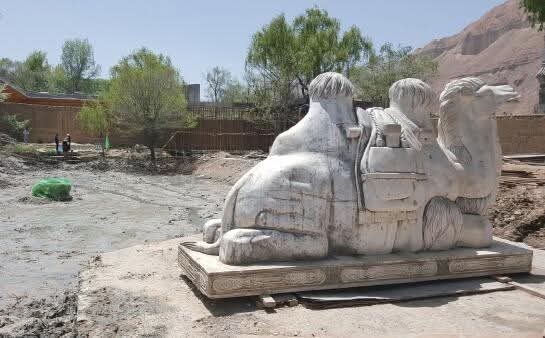
Some say they followed a white camel. Others say they left in haste, carrying a little soil from blessed Samarkand in a leather pouch.
Some tell of a clear spring where the camel stopped to drink and turned to stone—or where it died.
Others add that they drove in their tent pegs where the soil matched, precisely, the earth in that Samarkandi leather pouch.
It must be said that the little territory they chose, with its parched soil and sparse, forlorn hills, seems a dismal choice. Only the erstwhile camel knows why. Yet there they have remained ever since, rooted like a withering thistle near the headwaters of the Yellow River, on the approach to Tibet.
The Salars are an odd bird, even within the ethnic patchwork surrounding them. They live one ridge north of the crossroads between China and the Islamic world, between Mongolia and Tibet, hemmed in on every side by fragments of peoples like themselves.
Muslim Mongols and Tibetanized Mongols, all of whom have forgotten the taste of mare's milk; Bonan bladesmiths with blackened hands, and Yellow Yugurs whose future is veiled in mist. Around them, an endless, reddish, dusty sea of Han and Hui, Tu people and Kazakhs from the north, and Amdo-speaking Tibetans.
The Salars have a curious Turkic tongue, and their linguistic kin live far to the west, beyond seas of sand, grass, and cloud: in Ashgabat, Baku, and splendid Istanbul.
There the Salars have lived for at least six hundred years, alone upon the stony hills, jealously guarding the solitary patch of land granted them by the Creator's grace and one dying camel.
Six hundred years of scant pasture, of plowing cracked loess soil, piloting leaky ferries across the Yellow River, and driving mules loaded with grain and coarse hides toward the holy city below.
It was from there—from the Mecca of Tibet's foothills, with its mosques, Sufi tombs, and smoky alleys—that the call went out, in a halting sacred language heavily seasoned with Chinese.
A call to the terrible uprising that drew the Muslims of the frontier, and the hardy Salars in particular, into a struggle against the dynasty. Its echoes shook the high heavens and the distant Dragon Throne itself:
“Husband, do you hear? And Su*, do you? You trouble the emperor; he'll deal with you yet! You bring only trouble—a crime most grave. When his anger rises, your days will be cut short. The emperor's men burn hot as the sun; you Salars are clouds that dissolve and are gone. When the sun rises, the cloud must yield. Has that not sunk into your wretched head?”
Much water has since flowed down the Yellow River. The echoes of rebellion have faded, and with them the sufferings of the entire twentieth century.
Yet the Salars still live on their stony hills, still share a Hongta cigarette. In their distant tongue they talk of a new truck, machine parts, and this season's scant snowfall. Sometimes they bring out the holy Qur'an, whispered to be the oldest in all China, said to have flowed from the pen of the finest scribe of lost Samarkand.
They tell the story of the miraculous camel and the blessed bag of earth. And the sun sets over the sources of the Yellow River.
* Su Forty-Three (苏四十三) was a Sufi religious leader of the Jahriyya branch of the Naqshbandiyya. Under his leadership, a rebellion broke out that developed into a broader uprising among the predominantly Muslim population of northwestern China in the nineteenth century. The revolt began after the Qing dynasty intervened in the internal struggles of the various Sufi groups and attempted to suppress branches considered innovative or controversial. The Muslim uprising joined a long succession of local and regional revolts across the empire, among the many factors that brought about the dynasty's final collapse in 1911.
In the photographs: - A boy holding a camel bone used for memorizing Qur'anic verses. - Ferries on the Yellow River; piloting them was once a traditional Salar occupation. - An early-twentieth-century photograph of a Salar man. - Xunhua County, home today to roughly half of China's approximately 150,000 Salars. - Tombs in Linxia, China's “Little Mecca” and its most important Muslim center, not far from Xunhua. - Old Qur'ans brought from Central Asia during the Salar migration.
Continue the conversation
A question, a correction, a source I should know about? Write to me privately — I read every note.
Send a noteField dispatches
New essays and journey announcements, a few times a year.