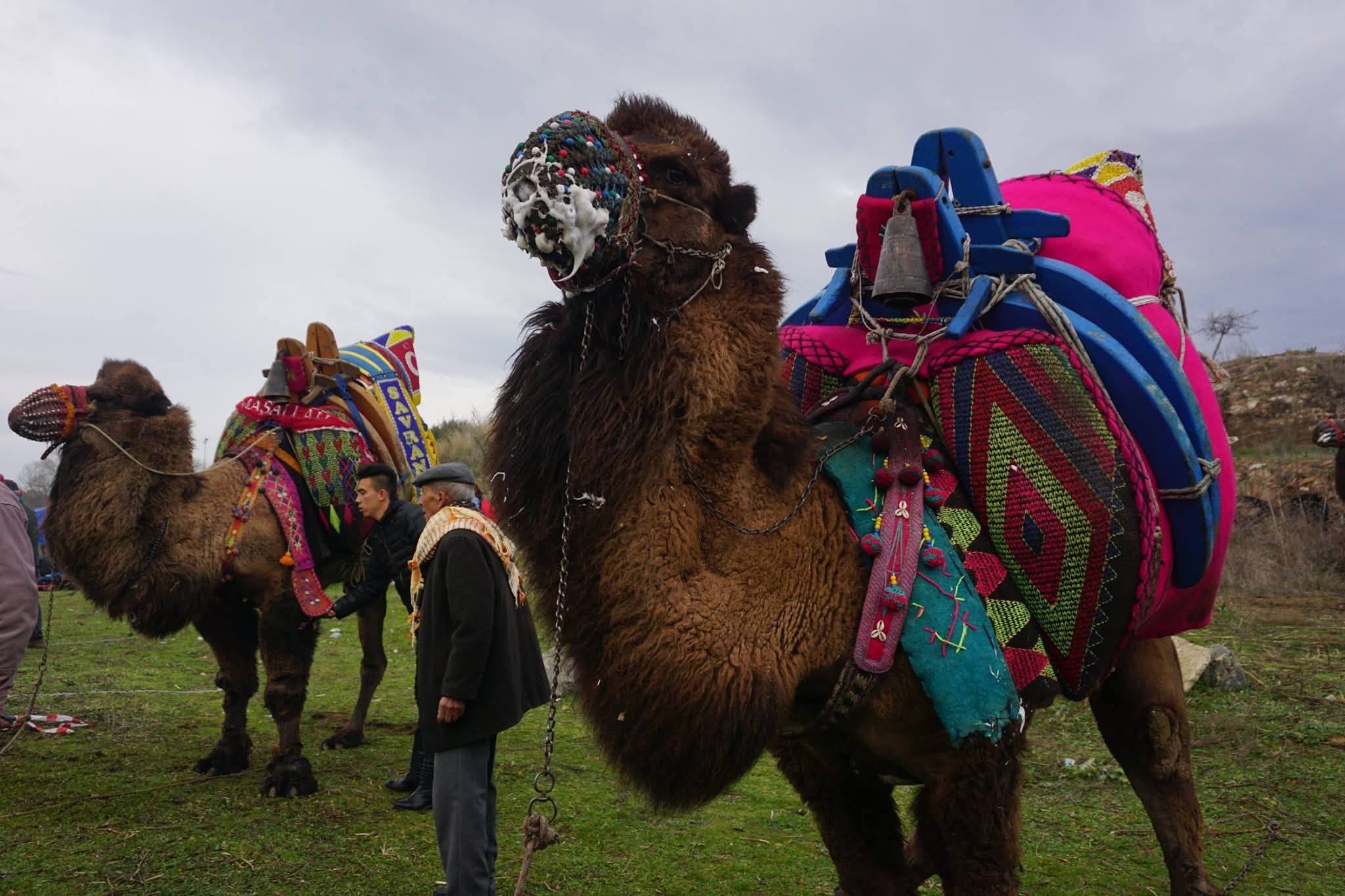
Even as a calf, Siyavash was clearly exceptional in size.
At a year and three months, his head already rose above Arkan's broad shoulder. He could rest his heavy chin on his proud owner's shoulder and hum with surprising gentleness whenever he wanted more barley or a scratch at some irritating spot on his brick-thick skull.
Like many in his position, Arkan was reluctant to reveal Siyavash's origins: who had sold him the camel, or how it had entered the country. As is usually the case, however, the reddish giant seems to have come from eastern Iran, Afghanistan, or perhaps a specialist Turkmen breeder. Occasionally, they say, camels like him still arrive from the yards of the Yörük, among the last people of the Anatolian mountains to retain a partly nomadic life.
Nine years had passed since Siyavash came to Arkan's yard. Through the hot summers that followed, he had trained in pushing and strengthened his resolve in preparation for the day he would be called upon. And now, much larger than either his single-humped mother or his Bactrian father, bearing on his enormous back the name of a hero from the ancient Iranian epic, the Shahnameh, Siyavash cut through the morning mist toward the arena, his head against the grey sky and his broad feet deep in the mud.
Although Arabian and Bactrian camels are generally associated today with entirely different climates—hot and cold deserts respectively—their ranges appear to have overlapped much more in the past, under different climatic conditions. Crossing these two charming beasts was a deliberate, thoroughly practical undertaking. The hybrid (Camelus bactrianus × Camelus dromedarius), known as a bukht, or tülü in Turkish, has ideal qualities for hauling loads and working. Stronger and taller than either parent, these camels are especially valuable for their agreeable temperament.
The impressive qualities of hybrid camels even earned a mention in a hadith concerned, of all things, with women's modesty. Women are cautioned against piling fabrics and turban-like wrappings onto their hair until their heads "resemble the humps of the bukht"—a reference to the considerable size of those humps.
These hybrids are usually fertile, but the sources agree that, unlike the first generation, the offspring of further crosses are weak, rather bad-tempered, astonishingly stupid creatures, dangerous to themselves and their owners alike.
The hybrid camel's usefulness, good nature, and considerable value as a pack animal on trade routes led various Central Asian peoples to specialize in camel breeding. The Turks appear to have been among the leaders in the field. One Turkic tribe that made this work its livelihood was the Seljuks, who kept mixed herds on the steppes north of the Caspian Sea.
Research suggests that cooling across Central Asia in the ninth and tenth centuries killed off the Seljuks' Arabian camel herds and forced them south into the Samanid and Ghaznavid kingdoms. There they became involved in warfare—and ultimately, almost by accident, founded the Seljuk Empire, which ruled in splendour from the borders of China to Anatolia.
A trace of the Seljuk fondness for hybrid camels remained among their direct descendants, the Ottoman sultans, who kept tülü camels in their armies. The most distinguished of these carried the enormous drums that cheered the Janissary regiments on their way to the gates of Vienna. It is said that when one of these humped veterans went completely deaf from the pounding it had endured in military service, it was declared a ghazi—a holy warrior—and granted the right to roam Istanbul at will, nibbling delicacies in the markets of the Bosphorus.
Meanwhile, in the dusty camel arena, the descendants of the Seljuks prepare for the next bouts, clad in leather coats, enveloped in smoke and raki, with drums thundering around them.
At last the cazgır, the event's announcer, calls Siyavash's name. He lumbers into the arena, his ceremonial trappings, adorned with shells and tassels, slashing a streak of colour across the grey January sky.
At the edge of the arena, Kara Murat is already strutting in his own finery. His eyes almost bulge from their sockets with vigilance; frothy saliva streams from his nostrils as his thick lips quiver. Slightly smaller, but far more experienced than his oversized opponent, Kara Murat is a genuine veteran of the camel arenas. At twelve years or more, however, his best years seem to be behind him. To the alarming blare of zurna horns and the pounding of drums, the rivals are led toward the centre in ever-tightening circles.
As the enormous wrestlers first make contact, the attendants retreat to a safe distance. Siyavash and Black Murat slam bodily into each other, necks intertwined, each seeking a breach in the fortified wall of flesh facing him.
Camel wrestling draws on the mating behaviour of wild camels, whose males compete for territory and the right to mate with the females. In these dust-filled struggles, males frenzied by the rut shove with their bodies and necks, trying to bite their opponents' legs and ears until one submits and flees toward the empty steppe on the horizon.
Modern wrestling follows the same ancient principle, but with enough restraint to prevent serious injury. The camels are generally muzzled, and a many-legged team of sturdy attendants is responsible for separating the combatants if their enthusiasm becomes excessive.
For long minutes the titans struggle. Siyavash seems to have the upper hump, pressing his "Black" opponent toward the edge of the arena. Then the dark-coated veteran twists nimbly, withdraws a little, and slips his neck beneath his giant rival's. With a taut, muscular lock, he lifts Siyavash's forequarters toward the sky, leaving his front legs dangling in the air. A classic camel-wrestling move.
Arkan catches his breath. His lips whisper an unholy mixture of prayer and colourful curses as the giant camel's hind legs buckle and he falls onto his side in the arena dust. Like the tragic hero whose name he bears, he lies in the dirt beneath the oppressive hand of fate, which weighs upon man and beast alike.
In the ancient pages of the Shahnameh, Prince Siyavash and the other figures of Iranian mythology who died in the epic struggle between Iran and Turan move in circles, through ever-smaller manoeuvres that collapse inward under the pressure of time and the arbitrariness of fate. They are crushed into oblivion beneath the endlessly turning wheel of heaven.
Our Siyavash, by contrast—thanks to his devoted owner, local custom, and the arena's rules—is destined to rise again from the dust, shake himself with a single frothy snort, and leave that round arena beneath the heavens with his hump held high and his broad feet stepping firmly.
To fight another day.
Continue the conversation
A question, a correction, a source I should know about? Write to me privately — I read every note.
Send a noteField dispatches
New essays and journey announcements, a few times a year.