Essay
By Noam Backner
Tibet and Its Boundaries
Geography, language, religion, and political borders define overlapping Tibets—each offering a different way into the plateau’s history and culture.
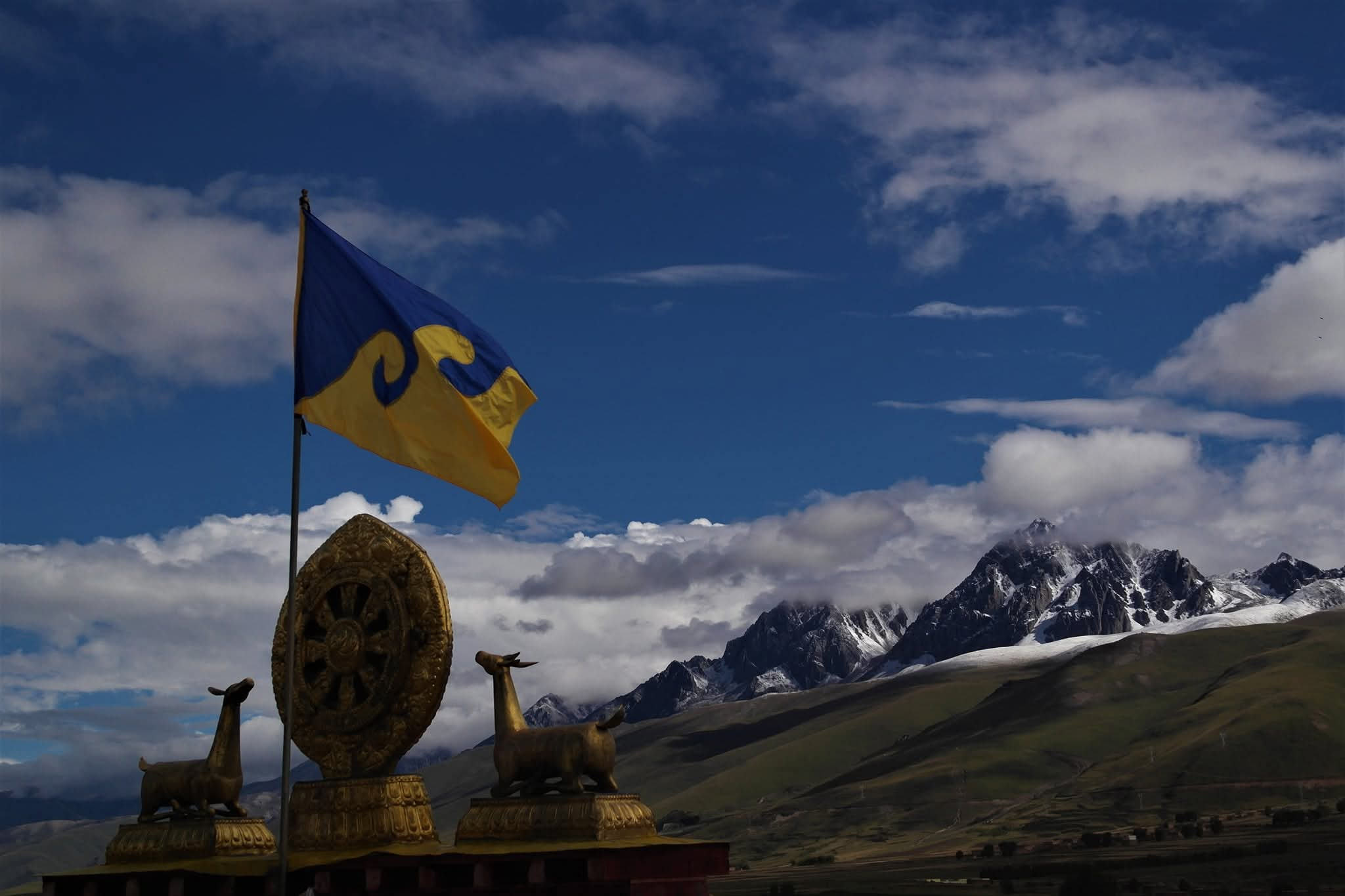
Historical Tibet is defined by the elevation of its plateau, by the peoples who speak Tibetan languages and dialects, and by the broad reach of its religious and cultural influence. The Tibetan languages encompass not only the principal dialects of Lhasa (or Tsang), Amdo, and Kham, but also related languages spoken in Bhutan, Nepal, Ladakh, and Pakistan. Some are critically endangered.
Despite the otherworldly, somewhat remote, and tranquil image associated with Tibet's peaks, the plateau has been a meeting place for several regions. It linked the Indian subcontinent, China, and Iran through trade and cultural exchange, while also serving as an enduring arena of conflict—among Tibetans themselves and between Tibetans and their neighbors.
Indeed, for some two centuries, before Buddhism was adopted as the state religion, Tibetans were known as fearsome warriors. They cut the trade routes between China and the West for long stretches, appointed a Tibetan governor in Kabul, and even briefly occupied the Chinese capital, Chang'an, in the middle of the eighth century.
Relations between the Tibetan and Chinese states have therefore been complex, marked by extensive political, religious, and cultural ties. Foreign matchmakers frequently intervened: first the Mongols, then the Manchus, who sought to bring Chinese and Tibetans into the same bed under a broad, unifying vision for Inner Asia.
The collapse of Asia's old political orders bequeathed a weighty dowry along the northern and western borders of the Chinese Republic and, later, the People's Republic of China. The need to “stretch the skin of the nation over the skeleton of the empire” ultimately led to the seizure of Tibet by the Chinese Red Army, beginning in 1950.
The annexation of most of historical Tibet to the People's Republic marked a dramatic turn in Tibetan history and in that of the wider world. Waves of refugees making their way through the Himalayas brought not only the establishment of a Tibetan leadership in exile on the Indian side of the range, but also the transformation of tantric Buddhism into a genuinely global phenomenon.
Despite the waves of destruction suffered by Tibetan culture during the years of occupation and China's Cultural Revolution of the 1970s, Tibetan Buddhism has largely maintained its standing and vitality, even on the Chinese side of the border. Rebuilt monasteries, complex but sometimes productive relations with the contemporary Chinese state, and a significant increase in Han Chinese adherents have enabled Tibetan Buddhist institutions to regain something of their former splendor, while inevitably confronting the challenges of the present and the modern economy.
As a cultural and historical region contained within the modern state, Tibet today is divided among the vast administrative regions of Xizang and Qinghai and the smaller provinces of Gansu, Sichuan, and Yunnan. The dominant region of Ü-Tsang, with Lhasa at its heart, makes up most of Xizang. The extensive region of Amdo, renowned for its scholarship, is centered on Qinghai and Gansu. Kham, with its martial reputation, lies partly in western Sichuan and northern Yunnan.
All these regions are Tibetan—and, in a broader sense, “Tibet”—by virtue of their history, culture, and language. Despite differences in topography, economy, and society, they all hold the treasures of Tibetan culture: monasteries, centers of study and practice, sacred mountains, and pilgrimage sites. They also encompass the immense wild spaces that have made Tibet a symbol of the awe-inspiring solitude at the heart of spiritual practice.
Since the question has been raised, visiting today's Tibetan regions may mean taking an organized, relatively expensive trip to the political heart of historical Tibet: Lhasa, Ü-Tsang, and their surroundings. Such a journey also involves a permit and certain restrictions. Alternatively, the eastern and northern plateau offer a fairly accessible, certainly freer and less expensive route. These regions can be reached readily from Zhongdian (Shangri-La) in Yunnan, from Lanzhou and Xining in the north, or from Chengdu, within a reasonable drive of the trading towns of Tagong, Litang, and their surroundings.
A journey through any of these regions offers at least an initial acquaintance with one of the richest and most complex societies to have emerged in greater Asia. It may also offer an opening for wistful reflection on the transience of all things—and, conversely, on absolute freedom, beyond any law, wall, or sovereign.
Happy wandering.
Continue the conversation
A question, a correction, a source I should know about? Write to me privately — I read every note.
Send a noteField dispatches
New essays and journey announcements, a few times a year.