Essay
By Noam Backner
Tofu
Those who dislike tofu have perhaps simply not eaten it properly — from yuba and frozen tofu to Yunnan's fermented lufu.
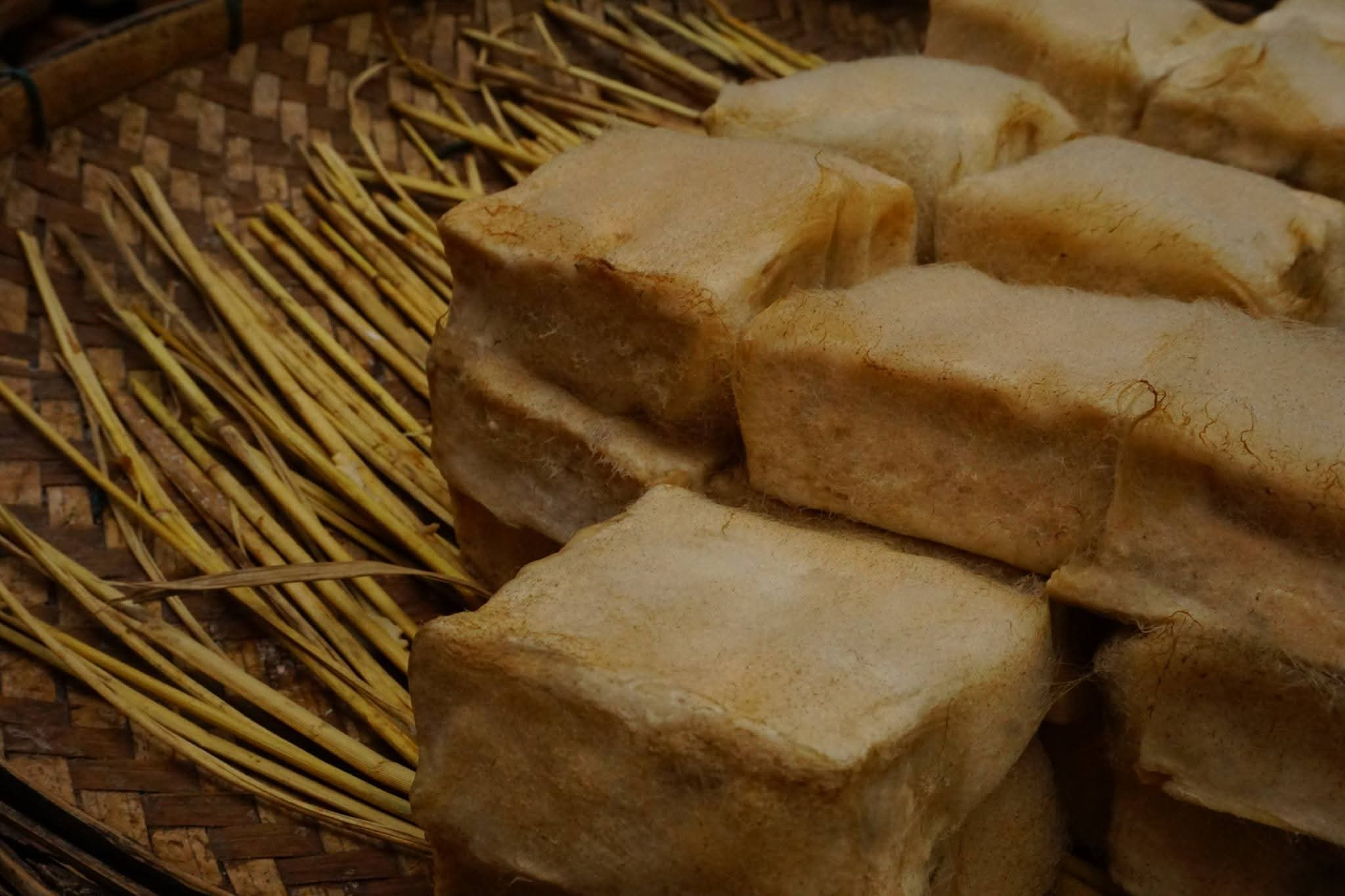
Tofu is a controversial food in the West. One might even boldly argue that those who don't like it have simply not eaten it properly.
The point here is not to dismiss the matter of "there's no accounting for taste," but to recall that tofu is a fairly neutral block of plant protein (plus a little fat and carbohydrate), and that with proper preparation—which in any case removes any vegetal smell—it yields dishes of varied flavor and texture, as far apart as heaven and earth.
The claim also rests on the understanding that China has a whole array of tofu types—soft and firm, dried and smoked, and more—and these respond differently to methods of preparation, to their capacity to absorb flavor, and to contact with the other ingredients they will share the plate with.
Thus, to my mind at least, yuba (tofu skin) in a spicy sauce with leek is fundamentally different from a clear soup with dong doufu (tofu frozen so that it forms cavities that soak up hot liquid), and both are entirely different from "home-style" tofu—probably my favorite vegetarian dish in China, when made properly—and none of these is anything like the stars of Yunnan: baojiang tofu, cloud-soft inside, and the local spicy "lufu" (卤腐).
The latter, probably a complete alien in the Chinese tofu galaxy, is to me true magic: moldy tofu, furred with mold, undergoes a second aging in the company of oil, salt, chili and spices, until it reaches a complete, richly flavored metamorphosis that can only be compared to a properly ripened blue cheese.
This metamorphosis—a proud descendant of the Daoist alchemical games that may have contributed to the invention of tofu in the first place—reminds us that one can take a fickle, sensitive and short-lived substance and, with a little biochemistry and a bit of ingenuity, grant it something resembling eternal life, or at least enrich the palate with a range of flavors usually reserved for animal products alone.
And although in China tofu is by no means reserved for vegetarians, and flagship dishes such as mapo doufu reach perfection only with minced meat, it is hard to ignore the Buddhist heritage that apparently contributed to the development of tofu culture and its status. The ability to produce mock, meat-like dishes (alongside similar materials such as konjac and seitan) without crossing the strict boundaries of the Mahayana represents the pinnacle of Chinese Buddhist cuisine.
And perhaps, like that pure, impartial block of protein that takes on the background colors of myriad phenomena, tofu serves as a ready image of the human mind itself—if only so that we may close with the charming story of a frustrated monk in the mountains of Yunnan:
Ben Wu was coming down from Mount Jizu, the Chicken Foot Mountain in the east. As he walked, head bowed and consumed by that frustration reserved for seekers of liberation, he suddenly heard from the courtyard of one of the houses:
"The Zhang family's tofu, the Li family's tofu, On the pillow at night you dream of a thousand paths; in the morning all that remains is to grind the beans (for tofu)."
And so the venerable monk Ben Wu understood what is worth understanding. And returned to the mountain.
Continue the conversation
A question, a correction, a source I should know about? Write to me privately — I read every note.
Send a noteField dispatches
New essays and journey announcements, a few times a year.