Essay
By Noam Backner
Bones of Fortune
Since the dawn of humanity, we have loved to play—a testament to our nature as social beings driven by imagination, learning, and the thrill of luck.
Since the dawn of humanity, we have loved to play. It is a fundamental confirmation of our existence as social beings, capable of imagination, learning, and a fascination with luck.
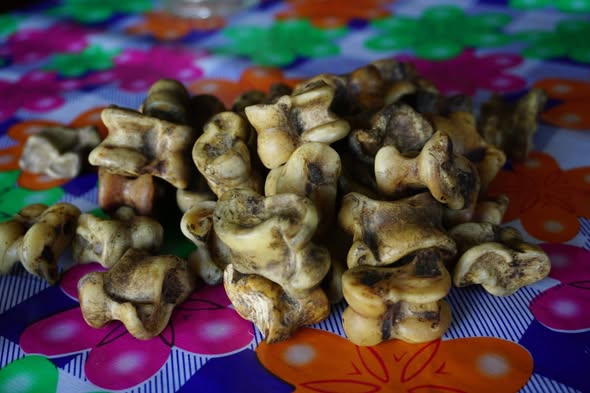
Shortly after humans became themselves, some ten thousand years ago, they were joined by sheep. Thus, the human need for play and the lamb’s utility were united, and knucklebones were born.
The talus bones of sheep—and occasionally goats or other livestock—are among the earliest known gaming implements. They traveled wherever hooves and herdsmen went. Consequently, caches of these ankle bones have been found across the Old World, from the Mediterranean basin to the far reaches of China.
Their shape, density, and convenient weight made them intuitive tools. Requiring almost no processing, they were put to a variety of uses: as dice, divination tools, lucky charms, bridges for stringed instruments, and even, in certain cases, a form of currency.
As a game, the bone’s geometry—its tendency to land on one of four distinct sides—gave rise to numerous styles of play, some relying on pure luck, others on skill, and many on a combination of both.
While these bones remained common in the West until the 20th century, the shift in leisure culture, industrialization, and our increasing distance from the slaughterhouse led to their near-total disappearance from industrialized societies.
Yet anyone who has visited the Mongolian, Tibetan, or Turkic regions, or the fringes of the Iranian world, has surely encountered children playing with small piles of these squared-off ankle bones.
Knucklebone games (known as shagai in Mongolian; ashik, oshok, or chuko in Turkic; bojol in Persian; theka in Tibetan; and gachuha in Manchu) generally involve tossing several bones onto the ground, where the faces they land on determine the score or the game’s momentum.
In pastoral and nomadic societies, each face represents a different animal. The most common are the sheep, goat, horse, and camel (or sometimes the donkey). The horse is usually the winning face or the highest scorer; as one of the narrower sides, it is statistically harder to land than the goat or sheep.
A few variations:
Horse Racing:
Ten bones are placed in a row. Each player has an additional bone at the start of the line. Five bones are tossed, and for every “horse” that appears, the player advances their piece. The first to reach the end of the row wins.
Tekche:
My personal favorite. Each player tosses ten bones. The goal is to move as many as possible into your “bank” by flicking one bone against another with your thumb and index finger. A bone can only be struck by another of the same “animal” type. A miss or an incorrect hit ends the turn. The player who collects all the bones wins.
“Five Stones”:
The classic game, played with bones instead of stones. Local variations abound.
“How Many in Hand”:
A simple betting game where players guess the number of bones hidden in an opponent's hand. A correct guess wins the bones. This is often paired with shots of airag or cheap baijiu.
In the images:
- Playing theka in a Tibetan village, Qinghai Plateau. - Jean-Baptiste-Siméon Chardin’s 1734 painting of a girl playing knucklebones. - The gogo and the apricot. - Boys playing knucklebones (Korea?). - A Kazakh jetigen (seven-stringed instrument). - A bronze offering in the shape of a knucklebone weighing dozens of kilograms; found in Iran, likely Mediterranean in origin. - Roman Republic coins featuring the image of a knucklebone.


Related writing
Essay
Between Mysticism and Revolution: The Poetry of Khomeini
On Persian verse, mystical insight, and the fine line between spiritual transcendence and political authority.
Field Note
The Ginger Garden
On gardening, rhizomes, and a small botanical obsession in a Dali courtyard.
Essay
Rivers and Lakes
“When the springs dry up, the fish huddle together, gasping to keep one another moist; it would be better if they could forget each other in the rivers and lakes.” (Zhuangzi)