Essay
By Noam Backner
The Ashura She-Camel
On the Shiization of Safavid Iran, the ritual camel sacrifice in Isfahan, and the nexus of religious mourning, public violence, and sovereign power.
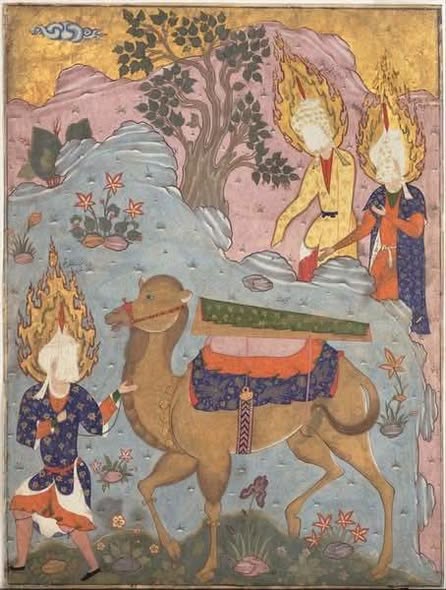
The Shiization of Iran was a long-term project whose essence lay in the rapid breaking of bones and the slow mending of the land’s social tissue. It allowed the Safavid elite to overhaul Iran’s cultural cargo, rewiring rival segments of the population into a binding ethos that radiated from the heart of Isfahan to the bellicose edges of the empire.
Building on the Shiite tradition of mourning the fallen House of Ali, the 16th-century Ashura ceremonies allowed the Safavids to complete their transformation. They evolved from a formidable but loose coalition of Turkmen tribes, Kurdish highlanders, and Caucasian auxiliaries—bolstered by the spiritual authority of a Sufi order at its zenith—into the rulers of a hegemonic empire with a clear, adversarial, and all-encompassing ideology.
Within this framework, and beyond the ecstatic public mourning that uniquely characterizes the month of Muharram, these colorful days were marked by other, stranger events.
Alongside the public processions and the obligatory dramatization of the tragedy at Karbala, Muharram featured the lighting of flares, the distribution of ritual foods by Sufi orders, and, inevitably, bear-baiting and nocturnal wine-drinking in the gardens of the elite.
On the day following Ashura, a fine she-camel—brought from the East, the Shah’s own stables, or, as legend had it, the distant fields of Mecca—was lavishly decorated.
Adorned with blue fabric, fresh flowers, carpets, bells, and bundles of greenery, she was paraded through the alleys of Isfahan, escorted by an armed guard and a single, distinguished mullah.
By the time she reached the city gates at dawn, this "camel-bride" had gathered a following of suitors: armed men, guild members, and Sufi initiates. They trailed her and her guardians to a cemetery outside the walls, near the Zayandeh River.
Once the entourage reached the open field, the bridal veil was stripped away. The camel’s legs were bound, and her head was pressed to the hard earth, facing the distant Kaaba.
After a brief prayer, as the city’s dignitaries circled her, the sovereign or his representative gave the signal. A ceremonial spear was thrust into the heart of the formerly sanctified beast, and she was beheaded.
At that moment, all restraint vanished. The carcass was hacked into pieces—six, twelve, or more. Her head was snatched up and passed from hand to hand before being displayed at the gates of the Shah’s palace, while cuts of meat were distributed among the city quarters. There, the meat was either eaten immediately or preserved as a talisman to be kept until the next year’s sacrifice.
Opinions on the origins of this Safavid ritual are divided, though it is generally seen as a composite. Early Islamic sacrificial customs were likely infused with the heterodox practices of the tribal groups that formed the Safavid movement’s original power base.
These diverse traditions were absorbed into a broader symbolic architecture: the tension between renewal and death, searing grief and ecstatic celebration. It was all neatly packaged in the shadow-dance between the sacred and the profane that characterizes Twelver Shiism—a duality that may well stem from pre-Islamic Iranian traditions.
As if this were not enough, the scuffles over the camel meat frequently degenerated into ritualized riots between the two dominant urban factions of the era: the Haydaris and the Ni’matullahis.
Named for 14th-century Sufi saints, these two groups were intricate networks of blood ties, professions, and political interests. They formed the bedrock of the bazaar economy in early Safavid Iran and remained influential for centuries.
Their enmity was ostensibly spiritual, yet despite the Sufi mysticism in their veins, their rivalry usually stemmed from earthly tensions. These exploded periodically—often during the visceral days of Ashura—into street battles that began with slings and clubs and ended with axes and spears, leaving the dead to rot in the dusty streets.
To the modern ear, wary of explicit bacchanalia, this Safavid wallowing in ritual death might evoke a mix of horror and exotic fascination. Yet mass events designed for the venting of impulses, fenced-in violence, and carnal release were once routine fixtures beneath the walls of civilization and in the wild spaces just beyond them.
Whether we view the Safavid Ashura as the cynical tool of a skilled ruler or an authentic expression of religious sentiment beyond the reach of modern rationalism, choosing one over the other feels like a lukewarm compromise.
Beyond the metaphysical debates, the camel sacrifice and the nocturnal battles were expressions of civic release and political restraint. They were tools for yoking a formerly Sunni Iran to an emerging Shiite orthodoxy, while simultaneously drawing the sting from the nomadic scorpion.
By binding these forces in the Maidan of Isfahan, the Safavid dynasty realized its vision with remarkable success—shaping the walls of the Persian garden and the shadows that linger beyond them to this very day.
Related writing
Essay
Between Mysticism and Revolution: The Poetry of Khomeini
On Persian verse, mystical insight, and the fine line between spiritual transcendence and political authority.
Field Note
The Ginger Garden
On gardening, rhizomes, and a small botanical obsession in a Dali courtyard.
Essay
Rivers and Lakes
“When the springs dry up, the fish huddle together, gasping to keep one another moist; it would be better if they could forget each other in the rivers and lakes.” (Zhuangzi)