Essay
By Noam Backner
The Yarkand Sarai and the Kashmir Route
A merchant’s inn in Srinagar offers a window into the caravan network that once linked Kashmir, Ladakh, Yarkand, and the Tarim Basin.
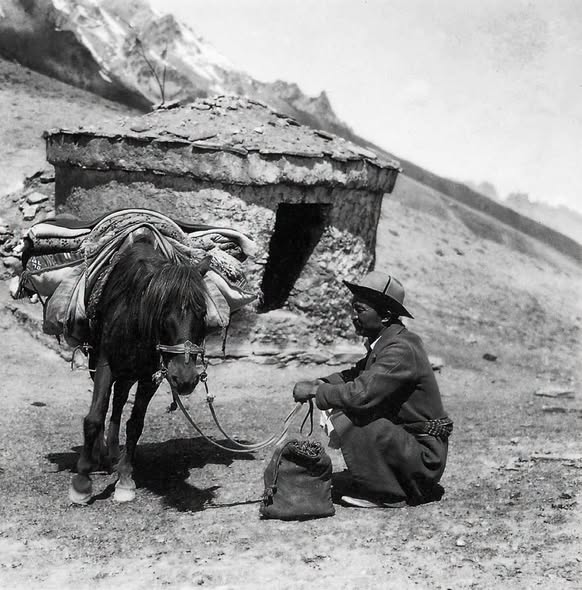
These photographs of the Yarkand Sarai—a merchant’s inn in Srinagar—are compelling for the glimpse they offer into a vanishing trade route that once connected the Punjab and the Kashmir Valley to the Tarim Basin in western China. They also document a common, if rarely recorded, form of temporary tent that was once a fixture for merchants, shepherds, and wayfarers alike.
This particular style of tent, still found today in the mountains of Iran, utilizes insulating felt sheets (far warmer than the drafty, freezing rooms of the stone inn) and the traditional steppe roof crown, the famous tunduk. However, it lacks the heavy poplar lattice that defines the archetypal yurt.
For centuries, the Kashmir-Leh-Yarkand route linked northern India with the oases of the Tarim Basin, traversing formidable mountain ranges and vast stretches where fuel and fodder were scarce.
The route served as a primary trade axis between Hindustan, Tibet, and Central Asia since at least the 13th century—and likely much earlier, dating back to when the monk Xuanzang’s famous elephant drowned further north on an even older path.
The viability of this 1,200-kilometer road relied on a chain of complementary support zones: Kashmir provided food and labor; Ladakh served as a commercial hub and a collection point for essential fodder; and Nubra occasionally supplied the Bactrian camels uniquely adapted to the cold aridity of Central Asia.
Nevertheless, the primary pack animals were usually agile horses and mules, and sometimes dzo (a yak-cow hybrid). Purebred yaks were less common—perhaps because they are essentially mice in bison’s clothing.
British sources, which sometimes refer to the path as the "Treaty Road" following trade agreements between Kashmir and the Raj, emphasize that fodder management was the decisive factor. Much of a caravan’s capacity was dedicated to sheer self-preservation, carrying its own food, fuel, and supplies.
The trade of that era—whether in pashmina, tea, or hashish—was not, of course, conducted between "Indians" and "Chinese," identities that remain fluid and complex in these regions to this day. A man might be Kashmiri by origin yet conduct his correspondence in literary Persian, trade in Central Asian Turkic, and chat freely with Ladakhi caravan drivers, never feeling he had crossed a boundary in a world already defined by religious ties and distinct regional landscapes.
The system relied on a sophisticated network of intermediaries, agents, and caravan managers in the service of major trading houses.
Alongside them worked money changers, interpreters, livestock breeders, and innkeepers. A mirror image of the Yarkand merchants' inn in Kashmir existed in the form of parallel Punjabi and Kashmiri institutions in the heart of the Tarim cities.
The consolidation of nation-states, the Partition of India, and the subsequent militarization of borders between the subcontinent and China transformed these frontier zones into hazardous security areas, dismantling networks of movement that were centuries old. A living artery was reduced to a rigid border line; the space connecting Kashmir, Leh, Yarkand, and Kashgar fractured into separate national worlds, gradually losing the memory of their shared mountain mosaic.
Perhaps the ultimate example of the seismic shift that struck the mountain spine in those years is captured by an inscription at a museum site, commemorating the patriarch of a local Kashmiri trading dynasty:
"Dedicated to the life and times of 'Munshi' Aziz Bhat: pioneer, merchant, founder of the sarai, collector, patriot, husband, and father. May his memory be a blessing."
Related writing
Field Note
The Ginger Garden
On gardening, rhizomes, and a small botanical obsession in a Dali courtyard.
Essay
Rivers and Lakes
“When the springs dry up, the fish huddle together, gasping to keep one another moist; it would be better if they could forget each other in the rivers and lakes.” (Zhuangzi)
Essay
The Humid South: Miasma, Body, and Space in Southern China
On the perception of the Chinese South as an ecological and metaphysical frontier—and how a landscape of danger became the empire’s economic and intellectual engine.