Essay
By Noam Backner
Buddhism: The Soul of the Land
A Chan nun, a meat dumpling, a Tibetan lama and a bold-eyed abbot: notes on Buddhism's many faces in China today.
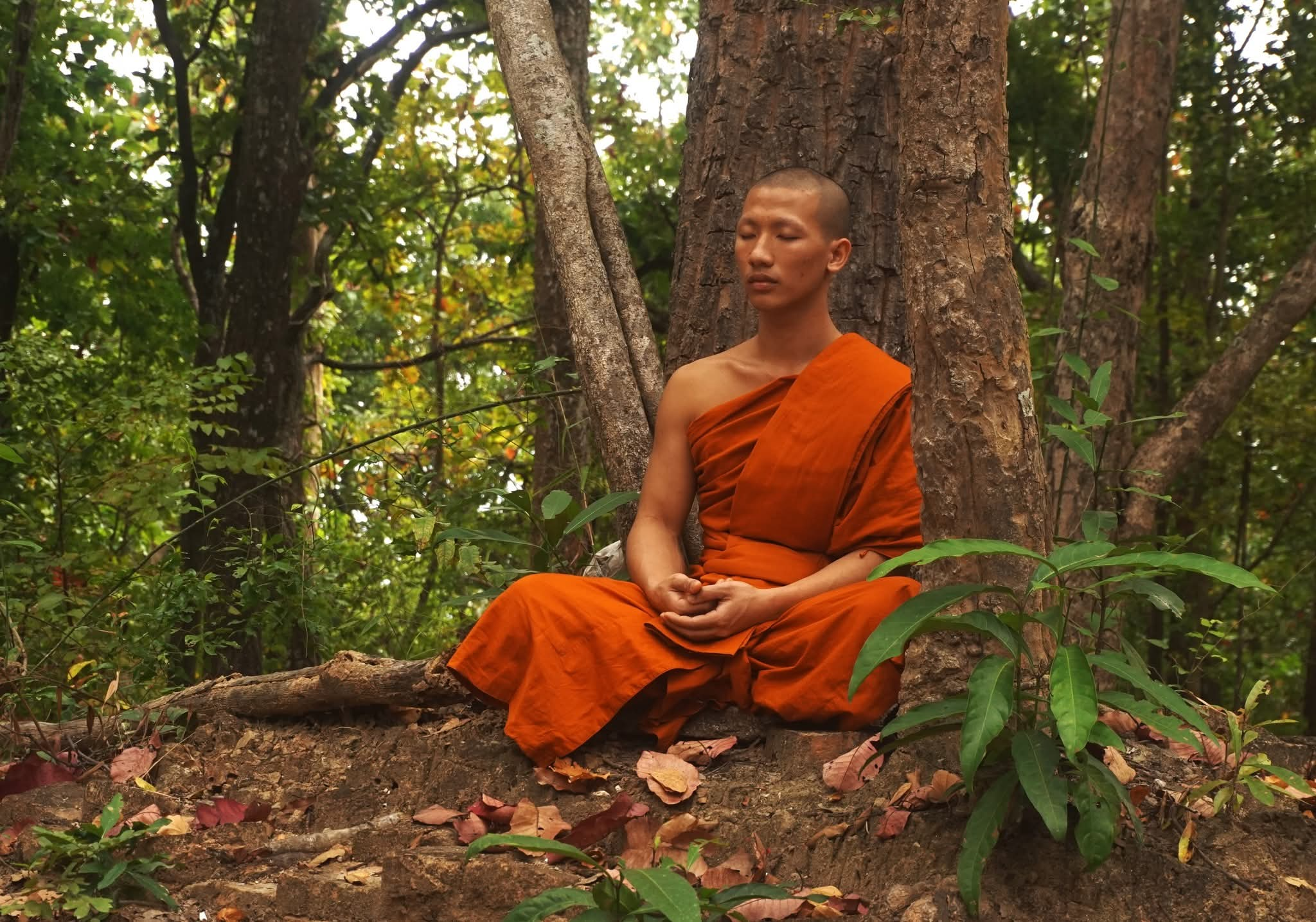
We met the nun C.M. nearly a decade ago at a monastery outside Burma's capital. She was one of a fairly sizeable group of monks and nuns from China, Vietnam and Taiwan — all, naturally, from the Mahayana stream that prevails across northeast Asia, and all of whom had come to Burma to train in the various vipassana techniques common in the Theravada countries. Sporadic contacts between the Buddhist regions have existed throughout the past thousand years, but it was only with the invention of "Buddh-ism" as a universal phenomenon in modern religious studies that these cross-regional ties grew more present — and that a rising interest, above all among the monasteries of China, Korea and Japan, in the Pali tradition of Southeast Asia gave rise to what can be seen as a lively movement of pilgrimage and study.
C.M. is not the only Chinese nun we have met in Southeast Asia. Last year, while staying at one of the "Forest Tradition" monasteries on the Thai–Lao border, we came to know a young Theravada nun of Chinese descent who served as a skilled interpreter for Chinese-speaking devotees. Like her, they had been drawn to what foreigners, Chinese and Westerners alike, perceive as a window onto an original, supposedly authentic Buddhism, as compared with the one practised in the Mahayana lands. One could argue that the Forest Tradition itself — indeed the entire vipassana movement in all its forms — is the product of a modern reaction, somewhat Protestant in spirit. Still, nothing seems more beautiful to me than that Buddhist "league of nations," gathering people of different peoples, traditions and tongues and allowing them all to sit in silence and breathe themselves into knowing, side by side, within a movement as fairly new as it is ancient to the very marrow of its bones.
So when our friend the nun came to visit this week, I assumed I would need to prepare a hearty quantity of broccoli, soft tofu and the other foods befitting Chinese monastics. My partner reminded me, however, that the nun is now somehow affiliated with the Burmese mother monastery while remaining a full-fledged Chinese Chan (Zen) nun — and therefore eats meat. Slightly anxious, I laid a table heavy with vegetarian dishes, plus two plates of meat dumplings and chicken curry, which I positioned strategically on the side farthest from our monastic guest. C.M., in her wisdom, picked up on my mild embarrassment and kept to the vegetables — apart from a single stray meat dumpling that my partner insisted on pushing onto her plate.
Over evening tea we talked a little about the disrupted ties with Burma's communities since the military coup; about our friend being the only Chan nun in a monastery affiliated — technically, at least — with the Pure Land tradition of practice; and about the challenges facing a younger generation of monastics who grew up under the one-child policy. We also came to a subject I find especially interesting: the particular esteem in which monks of modern China hold Theravada practice. Personally, I do not believe China lacks any resources for practice, many of which rest in one way or another on skilled versions of the layers of śamatha-vipaśyanā (Chinese: 止观) and other classical practices. But a temporary thinning in the ranks of teachers skilled in these methods, together with the widespread view that the southern vipassana methods are the more ancient, has understandably produced the present trend.
As another facet of that colourful commonwealth, last week we also met a local Tibetan lama, to whom we had been sent by Teacher S. — a talkative, opinionated physician who, beyond a brief flirtation with evangelical Christianity and an innate fondness for the Jewish people, is said to have served as a monk in the Chinese, Tibetan and Burmese traditions alike (though I tend to doubt some of these details a little). Despite the complicated relations between the Chinese state and the institutions of Tibetan Buddhism, the two share long and intricate historical ties, and even today Tibetan Buddhism enjoys no small measure of power — though at present this is largely confined to generous budgets from state institutions and great popularity among Han students, while any spiritual ties with the upper reaches of government remain, for now, hidden at most. Our first meeting with the lama was rather formal, but it is always amusing to notice the difference in mentality between Tibetan teachers and Han devotees: the differences in body language, in codes, and in the web of mutual expectations are a little reminiscent of Ashkenazi guests at a Mimouna.
The Sino-Tibetan fabric of the Dharma is itself a fascinating matter which, then as now, combines genuine qualities of practice with a winking promise of a special kind of power bound up with proximity to the charismatic figure of the Tantric teacher — all of it packaged in a kind of spiritual, social and economic mandala of a thousand hues.
Finally, I was sorry to hear that Master S.Z., abbot of our local home monastery, is under certain pressures to step down for rather worldly reasons. For to my eyes, at least, this bold-eyed teacher expresses more than anyone the complexity of historical Chinese Buddhism and the force of its vitality in the present. As such he combines, with virtuosity, the simplicity of a log, a gaze that pierces to the tissue in the manner of the old Zen tales, and an uncompromising faith in the power of a single mantra to breach the walls of ignorance that stand between heaven and earth.
It would, of course, be hard to sum up the thousand faces of Buddhism in contemporary China and where they are all heading. Yet it is clear there is no way to eulogize the future of the Dharma in an ancient land where it forms an irreplaceable spiritual and aesthetic marrow. Moreover, while many of Buddhism's classical institutions of learning are, no doubt, under tight official supervision as ever, the countless groups for meditation, tea ritual and the study of canonical texts, the lectures and the host of related activities taking place day after day across the Chinese internet are an example not only of the resilience of Buddhism's pull in a society saturated with passion and pain, but in large measure a resounding proof of the lasting answer it offers tens of millions of China's people — and of its enduring place as the soul of the land.
Continue the conversation
A question, a correction, a source I should know about? Write to me privately — I read every note.
Send a noteField dispatches
New essays and journey announcements, a few times a year.