Recently, a side discussion here raised the question of “Chineseness,” along with the claim that different Chinese states today—China and Taiwan, say—keep the same supposedly essential quality alive. We could turn our magnifying glass towards different periods, but they would offer radically different answers to the question of who is Chinese, how, and when. Clearly, then, the question is complex, and its answers more complex still.
Even so, one might argue that in the twenty-first century, after a hundred years of upheaval and internal digestion, that same “Chineseness” remains alive and kicking through flexible codes, even if its essence is still difficult to define, measure or privilege.
A disclosure is in order here: I have never visited Taiwan or Singapore. Anything I say on the subject will therefore remain somewhat sweeping, and confined to what I know of the People's Republic.
It is entirely clear, meanwhile, that Maoism and the Cultural Revolution did real damage through the destruction they inflicted on arts, beliefs and generations-old teaching lineages. It also seems that a significant portion of religious traditions—both popular religion and the lineages of religious Daoism and Chinese Mahayana Buddhism—found refuge across the strait during the stormy years of the Cultural Revolution and afterwards.
Still, I prefer to leave institutional matters aside, including the simple-but-complicated argument that the rulers of the People's Republic are first “Chinese” and only then anything else. I will also avoid attempting an in-depth comparison between China and Taiwan: as I have said, I lack the necessary knowledge of Taiwan, and such a comparison strikes me as a contest between two battered carts in which quite a lot has been replaced apart from the name.
So, if this discussion avoids institutional questions as well as a useless checklist of traits, what basis does it actually have left?
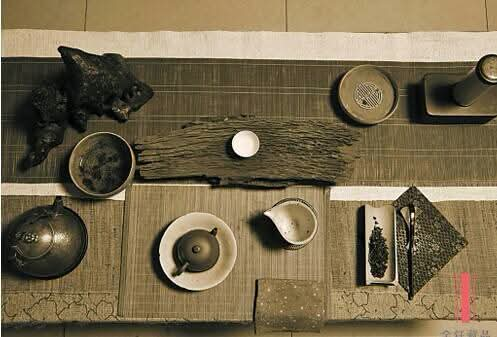
I therefore suggest taking the modern tea studio—even as a not particularly searching case study—as the embodiment of some Chinese core, as changeable as it is continuous. I believe such a case might not only clarify my sense—subjective, obviously—of that cultural vitality, but perhaps also bridge the two sides of the strait.
A recent visit to just such a studio gave me precisely that feeling, grounded in a code that is only partly verbal, and whose spirit reflects, to my eyes at least, everything that weaves the fabric of this country together.
The rural studio contained, as expected, everything one expects of a studio worthy of the name: furniture, books and assorted decorative objects. Although the purpose of gathering there—drinking tea—is enough to embody something of that distilled Chineseness, one could argue that the space itself preserves something of this spirit, even if its nuances are, predictably, quite modern.
Like similar spaces across contemporary China, the room's design at least aspires to aesthetic restraint. Its carefully balanced textures and shades are all intended to create a timeless atmosphere of familiar heritage. The ink scrolls, the vase, the porcelain and clay teaware, the raw wood and coarse linen mats all form a harmonious yet carefully coded setting—one certainly legible to anyone at home in this ethic of small details.
As for that ethic, the space is devoted entirely to self-cultivation and inward inquiry. Everyday activities such as practising calligraphy, painting or preparing tea become exercises in a self-aware art of living, in which the distinction between the sacred and the mundane is already crumbling.
In this sense, even when the studio is used today to cultivate connections or for personal branding—on Xiaohongshu or other online networks, for instance—one can still argue that it carries the literati ideal of moral withdrawal within the world. That ideal, as we may recall, allowed the Chinese scholar to adopt a reclusive way of life, if only an imagined one, even in the thick of political and social activity.
In this connection, I am not entirely convinced that the vanished world of old China's scholar-bureaucrats differed very greatly in its range from that of the white-collar workers who find themselves engaged in today's tea ritual. However differently expressed, their world was hardly detached from unmistakable threads of social mobility and economic prosperity either.
There is certainly room for qualifications here, incidentally. Taiwan, as well as government policy within China itself, played a significant part in bringing “traditional” tea culture back to the mainland after the Maoist years. Like any orthodoxy, this one is a product of selection—including a few decorative additions that look Japanese, of all things. Yet to my mind, the fairly harmonious fit between the “Taiwanese” scion and the “Chinese” rootstock speaks more to the argument's strength than its weakness. The wider range of mutual influences between the two Chinese entities supports this too.
And perhaps this is where I should stop going on and retreat to a corner. Beyond all the porcelain and straw, the raw wood and all that tea, what reflects this Chineseness that merits reaffirmation is actually the bookshelf in the corner of the room. There, jumbled together, are volumes of history and ancient poetry, Buddhist sutras, the Zhuangzi and the Huangdi Neijing.
Here lies the heart of the argument, which ultimately reaches beyond carefully designed rooms used by the country's elites—China, after all, includes a great deal more than that. China's soul lies in the written character, the stanza, and historical memory encoded through language. These constitute, as perhaps they always have, both the safety net and the operating manual for rebuilding the country after periods of destruction and decline.
Heaven forbid that the modern studio and tearoom should be replicas of the past. But they, and the intellectual foundations beneath them, demonstrate that this “Chineseness,” however abstract, can survive profound upheavals through flexible adaptation and the reaffirmation of aesthetic, ethical and literary codes that continue, in their own way, to nourish contemporary China.
Continue the conversation
A question, a correction, a source I should know about? Write to me privately — I read every note.
Send a noteField dispatches
New essays and journey announcements, a few times a year.