Essay
By Noam Backner
The Imagined Chinese Village: Craft and Nostalgia
Chinese craft videos offer a polished pastoral fantasy, but also a window onto rural memory, urban longing, and the revival of traditional skills.
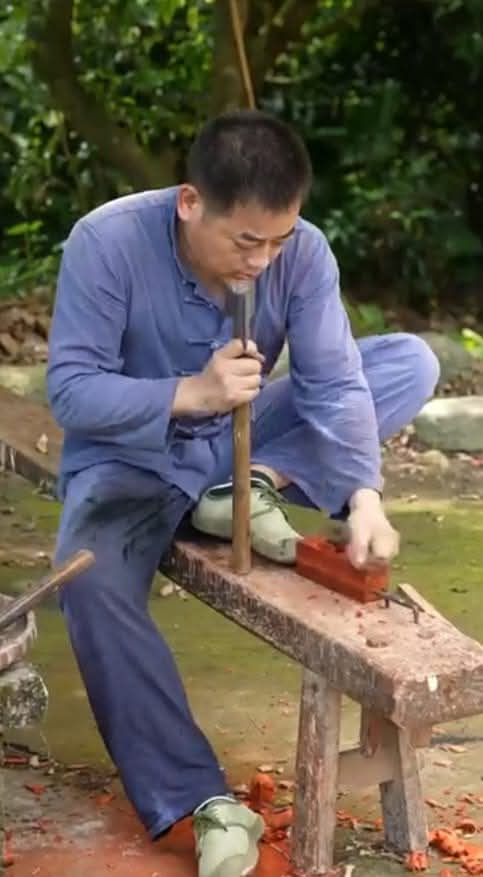
Admittedly, several years have passed since Li Ziqi’s craft videos set screens ablaze in China and beyond.
And admittedly, it was easy at the time, perhaps justifiably, to see them as a kind of “agro-kitsch,” peddling a contrived simplicity. Yet it is hard to deny Miss Li and her many counterparts due credit for the ingenuity, planning, skill, polish, and production that go into their videos—even when they all seem to follow the same recurring, sometimes hackneyed formula of mortar–kitten–rinsing–full moon–bamboo breeze–sanding, and so on.
Still, it may be worth briefly revisiting two angles that catch my eye, at least, whenever I find myself drawn into these videos of the Chinese countryside, whether more or less successful. Both revolve around historical continuity and memory, real or imagined.
We can say with some confidence that the Chinese village is the most significant phenomenon in the history of this immense civilization. And while, as readers, travelers, or momentary passersby, we naturally find it easy to focus on the wealth of palaces, temples, fortifications, and other products of Chinese imperial authority and its satellites, it is hard to ignore the simple fact that, throughout the overwhelming majority of Chinese history, most Chinese people were born, grew up, and passed away in rural surroundings.
The Chinese peasant always served as the subjugated foundation of the imperial system, and for the vast majority of its roughly 2,000-year history, the Chinese model of government rested on the peasant’s labor. Many thinkers, whether from the Daoist, Legalist, or Confucian quarters of the Chinese intellectual universe, broadly agreed that the peasantry should be kept free of predatory forces—apart from the machinery of empire itself, of course. Peasants were to remain free enough to earn their bread on the one hand, and on the other to provide the classes above them with the minimum necessary tax, in labor and especially grain, so that the Chinese world could continue in its proper order.
Given all this, it is hardly surprising that the twentieth century was the most dramatic century in the lives of the Chinese people and state: the walls of empire were shattered by forces greater than itself, and the entire country was tossed between ideas, systems of government, and some of the largest social experiments in history, with fateful consequences. In this astonishingly brief period, roughly half of China’s population—an enormous number in absolute terms—crossed the divide between village and city, most never to return.
The move to the city, dependent on and closely bound up with rapid economic and political processes, severed many Chinese people’s ties not only to working the land—which need not be regarded with excessive nostalgia—but also to the many social webs that bound families, households, and clans to their places through cords of blood, soil, and memory. This also means that the overwhelming majority of urban Chinese, regardless of class or education, are only a generation or perhaps two removed from a fading rural life, and many still have family, close or distant, living in the countryside.
For all its obvious advantages, rapid urbanization exacted a considerable social and psychological toll on many Chinese citizens. The urban rat race, its costs and challenges, and later the COVID lockdowns and the days of economic slowdown may all have contributed to a certain idealization of Chinese rural life—or at least of rural life as a city dweller can imagine it with a little self-persuasion.
Yet this is not a case of an ideal wholly detached from reality. A partial or full return to rural areas, certainly those close to tourist destinations in Yunnan, Fujian, Sichuan, and elsewhere, allows well-established urbanites—or at least their children who embrace “tang ping,” or “lying flat”—to return to an imagined agrarian and communal order, in a way not fundamentally different from their Western counterparts seeking a simpler life of reduced consumption. The videos of Li Ziqi and her peers perhaps reflect a complex, nostalgic, and substantially imagined—and decidedly sugar-coated—view of relations between city and countryside in modern China, at a time of economic maturation and even slowdown. Are they merely aesthetic creations aimed squarely at the heart of the social media industry? Quite possibly. Do they contain a genuine echo of what lies deep in the hearts of contemporary Chinese people? That is a matter of context, time, and place.
A second and final issue is the question of the traditional technology starring at the heart of these Chinese agro-social-media videos. Their more talented influencers display a dizzying range of “ancient” skills that were once largely the preserve of family or local specialists, and certainly required a lengthy process of acquiring those skills within such settings. These crafts range from metalworking and boneworking to the making of paper, traditional ink, and brushes, encompassing a rich array of techniques and complex, inventive production processes. Many involve the elegant use of hand tools—a technological creation that is itself gradually disappearing. All of this lends an aesthetic, and decidedly virtuosic, dimension to the supposedly traditional maker at their center: seemingly frozen in a timeless pastoral moment, yet in fact planted firmly at the heart of the global social media industry and its immediate demands.
To my mind, at least, the preservation, revival, and presentation of traditional Chinese crafts, even in their entertainment version, hold an interest beyond questions of museum nostalgia. They cast a certain light on the Chinese character and its capacity to bring together erudition, exceptional meticulousness, and attention to detail. Combined with imagination and a long historical memory connected to wellsprings of both folk and textual knowledge, these qualities allow social media artists to bridge social and technological ruptures—some of which occurred, or are still occurring, in the most recent generations—and even to reconstruct or renew ancient technologies that died out without leaving any living links in the chain of generations.
It should also be noted that these trends do not remain confined to screens or condemned to a moment’s scrolling. I have met quite a few artists, some of whom certainly belong, to one degree or another, to the quietly rebellious “tang ping” generation, who are finding their way as craftspeople, artists, and small-scale artisans. These fascinating individuals are firmly rooted in China’s technological and design heritage, within an unseen network of reconstruction, mutual learning, and trial and error. They produce objects of beauty poised between past and future, between the dimness of the workshop and the online marketplace.
What value is there in all this? Let each person judge for themselves. Perhaps what matters here is the spirit of the times, the elusive conflict it gives rise to, and the longing among many audiences, within China itself as well, for a romantic return to nature and an imagined simplicity firmly rooted in a warm human community and an ecologically sustainable environment. So despite the considerable distance between the utopian, sentimental, and finely groomed idyll offered by these polished films and the complex reality that accompanied life in the historical Chinese village, the result is undoubtedly quite revealing.
Continue the conversation
A question, a correction, a source I should know about? Write to me privately — I read every note.
Send a noteField dispatches
New essays and journey announcements, a few times a year.