Essay
By Noam Backner
Demons, Dervishes and Black Pens
The mysterious paintings attributed to Mehmed Siyah Qalam, "of the black pen": demons, nomads and wandering Sufis born of the Mongol encounter between East and West.
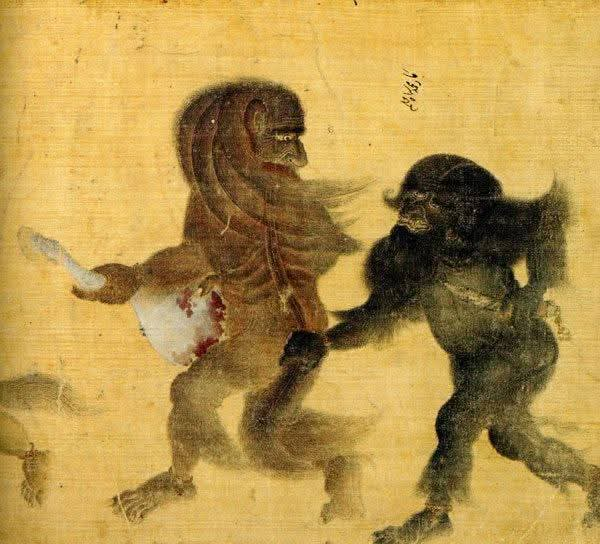
Mehmed Siyah Qalam (Persian: Mehmed "of the black pen") is the name given to a unique and wonderfully mysterious type of painting, known to us mainly from collections that found their way into the albums of the late Ottoman Empire.
Because the individual pieces in these albums came from diverse and curious sources across Asia, it is sometimes genuinely difficult to date some of the works and assign them to a precise place, and this is especially true of the paintings attributed to Siyah Qalam.
Scholars are divided on when and where Siyah Qalam was active, but tend to place him in fourteenth-century Khorasan, although some place the work in locations such as Tabriz and in a later period, as late as the sixteenth century.
Beyond the difficulties of dating, it is hard to determine clearly whether these are works from the black pen of a single painter or of several artists united by one illustrative style. Either way, these illustrations are, to my mind, nothing short of bewitching.
The world of Siyah Qalam is a strange and alien world of monsters and demons, drawn in stylised, sharply expressive lines. These creatures are depicted in the monochrome tones that gave the school its name, as they converse, quarrel over a horse's carcass or loot, are bound in chains or draw bows.
Siyah Qalam's paintings show stylistic influences and depictions of material culture of distinctly East Asian and Chinese origin, as well as motifs and themes drawn from the life of the Turkic nomads of Central Asia. This mixture of influences is a unique product of the unique cultural and historical window of opportunity created by the Mongol Empire. That vast empire, at its height in the thirteenth century, generated a tremendous momentum of cross-cultural exchange, which echoed for centuries after it dissolved into a jumble of successor states and kingdoms, and perhaps even down to our own day.
As an example of the transcontinental encounters this period produced, the demonic figures in Siyah Qalam's paintings bear a strong resemblance to depictions of the various wrathful Dharma protectors of Mahayana Buddhism, especially in its Tantric form. This renewed encounter between Buddhism and the world of Islam, some 500 years after Buddhism's decline in the Iranian world, would never have been possible had the Mongol cavalry not shattered the cultural barriers of their time, fusing East and West into each other once again.
As mentioned, many of the material objects depicted in the paintings are of distinctly East Asian origin, as seen in the style of dress and textiles, metal vessels and other objects. Even so, other influences, Middle Eastern and perhaps even Byzantine, are also evident.
In narrative terms, many of Siyah Qalam's illustrations depict a Central Asian world that is largely pre-Islamic: the world of wandering storytellers trudging under steel-grey skies among dusty encampments, telling tales that bind together history and imagination, demons and humans, reality and dream.
Despite the strong pre-Islamic influence, a considerable number of the paintings depict scenes from the lives of wandering Sufi ascetics who roamed the frontier lands between the eternal steppe and the settled civilisations to its south.
Siyah Qalam's paintings show wandering dervishes playing music, dancing, conversing and withdrawing into solitude, and it is clear that he knew their world well, and perhaps even lived among them as one of them.
Sadly, in the absence of any textual description, the paintings attributed to Siyah Qalam remain opaque to us, and we can only guess at the mythological and conceptual world they portray. A forgotten world of demons, shamans and wandering mystic seers, a world of forgotten Turkic epics and strings whose sound has faded, remains closed to our ears.
Whatever the origin of these paintings, they resemble nothing made in the Muslim world before or after, and their magic and dread have not faded, centuries after they were painted by the stained hand of the artist, Mehmed of the black pen.
Continue the conversation
A question, a correction, a source I should know about? Write to me privately — I read every note.
Send a noteField dispatches
New essays and journey announcements, a few times a year.