Essay
By Noam Backner
Dog dynasties of China
A small drawing from Mogao leads from supposed yaks to sleeve dogs—and into the long exchange between East and West.
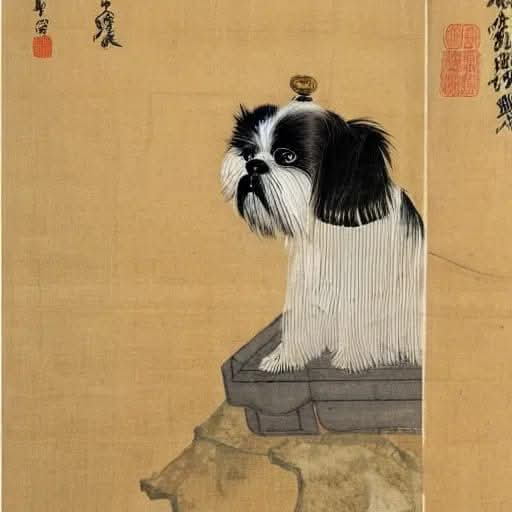
And as a light follow-up on courtyard animals—those with us and those no longer here—sometimes a small, seemingly marginal article cannot help but bring a smile.
In this case, it is an attempt to identify a charming doodle in the French collection of Mogao documents, that famous “geniza” on the great trading artery linking Central Asia to China.
Although the drawing was originally identified as showing several yaks, perhaps under the influence of the Tibetan Empire, of blessed and righteous memory, the article’s author argues that they are actually dogs.
If so, these dogs may be what the medieval Chinese called “sleeve dogs,” thanks to their ridiculously small size, with their genetic legacy eventually giving rise to Pekingese, Shih Tzus, pugs, and similar breeds.
As you will recall, dogs were domesticated in several parallel events in different regions and among different human societies, and were probably among the first creatures to share the human household. While East Asia experienced a domestication event of its own, most likely as part of an ancient web extending throughout central and eastern Eurasia, at some point East Asian dog breeds differentiated into herding, guarding, and hunting types, including spitzes, mastiffs, and the like.
Through successive waves of contact between East and West, the people who would eventually become the Chinese encountered additional types of dog. These, such as the Saluki and other sighthounds, probably represent a relatively early wave of migration into the Central Plains, though the origins of northern China’s local hunting breed, the xi gou, remain disputed.
Returning to the Mogao dog drawings, they may well depict early sleeve dogs, or “wu,” as they were sometimes called in Chinese. Descriptions of such dogs, imported from Samarkand or even distant “Fulin,” as Byzantium was called, became common chiefly during the Tang dynasty—one of the high points, as you will recall, of East–West relations in the Chinese context. The presumed Western origins of Chinese sleeve dogs, perhaps from a lineage related to that of the Mediterranean Maltese, also accord with their mixed genetic makeup, while the Tibetan lapdog, the Lhasa Apso, may, interestingly, represent an isolated lineage of its own.
The breeding of the Lhasa Apso to resemble that mythological snow lion, a legendary creature combining elements of the snow leopard, the Asiatic lion, and the mighty wild yak of the Tibetan Plateau’s expanses, brings us back to that pan-Asian game of paddleball, in which East and West, China and Tibet, yak and dog, echo one another, back and forth along the road, until the dynasty fades.
Continue the conversation
A question, a correction, a source I should know about? Write to me privately — I read every note.
Send a noteField dispatches
New essays and journey announcements, a few times a year.