Essay
By Noam Backner
Eternal China: Reading the Qingming Scroll
Does the celebrated Qingming scroll depict a spring festival in the Song capital, or an ideal, timeless China of bustling commerce and imperial order?
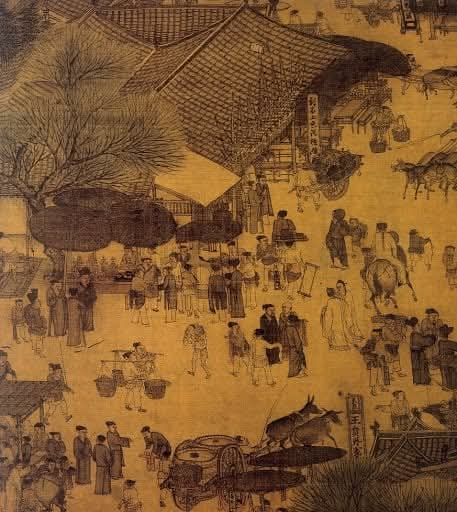
Although the original post was meant to use the revered scroll known as “Along the River During the Qingming Festival” as an excuse to contemplate its graceful camels, the approaching holiday is probably as good an excuse as any to discuss the painting itself. There is scarcely room here to enumerate its myriad virtues, its importance, and its ink-laden echoes, which punctuate the history of Chinese art.
As is typical—and fitting—with monumental works of this kind, we know little about Zhang Zeduan, the keen-eyed, steady-handed painter who created one of the most famous paintings in Chinese history. A native of Shandong, Zhang seems to have come to the Song dynasty capital of Bianjing (present-day Kaifeng) to further refine his art. He specialized in a technical style of painting derived, among other things, from professional and architectural drawings—a possibility beautifully reflected in the almost perfect renderings of buildings, bridges, and means of transport that appear in the scroll.
The painting itself is a long, narrow silk scroll ostensibly depicting events in one part of the imperial capital at Kaifeng on the day of Qingming, the Chinese “Tomb-Sweeping” Festival. This spring holiday, still celebrated throughout the Chinese cultural world roughly a hundred days after the winter equinox, includes an important element of ancestor-honoring rituals, the cleaning of family graves, and the burning of incense and paper offerings. It has been celebrated in more or less similar form since at least the Tang dynasty and the seventh century.
As a horizontal panorama, the painting allows the viewer to wander along the scroll, while the scene unfolding across it serves not merely as an exercise in the composition of people, nature, and landscape, but also as an actual timeline. Along it, the imperial capital—and the festival itself—unfolds, from the outskirts at dawn, through the bustling heart of the metropolis at the height of the festivities, to their ebbing away somewhere at the leftmost reaches of the silk scroll.
In terms of its content, and in keeping with half the work’s title, the scene unfurled within the painting depicts an indescribable profusion of scenes, figures, places, buildings, vehicles, stalls, shop assistants, peddlers, porters, donkeys, drunkards, and dignified officeholders, all going about their business along and upon a bustling Chinese river.
How Chinese is this bustling river? Well, as Chinese as it can be, since this painting represents, to a great extent, historical China itself—or, as we shall shortly see, at least its ideal—in a way no Chinese painting did before or has done since.
And here we come to the second half of the work’s title. Although, as noted, the scroll is commonly understood to depict China’s illustrious capital at the height of a bustling spring festival, with, as my holiday-minded aside would have it, a Passover Seder scheduled for that evening, there are several fundamental problems with this identification. First, despite its pleasing palette, tending toward spring green, the scroll makes very little reference to the festival customs known from the period. Perhaps the most conspicuous of these is the abundant ritual use of green willow branches as a symbol of the day’s purity and as a foremost means of sweeping away spirits, harmful demons, and other shadow-dwellers liable to trouble the inhabitants of this world and the next alike.
Carrying spring willow shoots or hanging them in cheerful bundles at the entrances to homes remains an established festival practice today, just as contemporary chroniclers described it. The almost complete absence of so central a feature (and perhaps also the somewhat autumnal appearance of the trees lining the avenues) in a painting supposedly representing the high point of so important a festival may suggest a misplaced identification. The almost complete absence of women—some 20 female figures out of more than 500 human figures in the entire painting—from its many scenes might be attributed to the strict Confucian values that guided many of the period’s educated men. Yet this, too, arouses suspicion, given contemporary accounts of women’s public and enthusiastic participation in the festivities, especially among the lower classes.
One possible explanation for the entrenchment of the painting’s title and its associated meaning may lie in the name it was given and the ambiguity it carries. Qingming (清明), the Chinese name of the Tomb-Sweeping Festival, meaning “pure clarity,” or perhaps also “the just and the wise,” refers not only to the festival but also to the governance of the Celestial Kingdom in its ideal form, and to the vital, prosperous peace that reigns over all under heaven.
The Song dynasty (960–1279), as modest militarily as it was productive in diplomacy and trade, may have been the dynasty that made China recognizably itself. A blazing crucible of commercial vitality, restless enterprise, and mobility between regions, it was, broadly speaking, the polity with the largest economy in the world at the time. More modest in its ambitions and its ties with the West than its legendary predecessor, the Tang dynasty, the Song saw so much of what is now considered Chinese become so in spirit and substance: from religion to agricultural technology, from porcelain to the canonization of the Chinese cult of tea, and from commercial transport to coal-fired kilns. All this took place amid the seething urban commotion of selling and buying, manufacturing and packing, negotiating and bargaining, followed by dispatch to destinations near and far, beyond the mountains or over the waves of the southern sea.
And this may be precisely what the scroll depicts. “Along the River During the Qingming Festival”—or perhaps, under another possible title, “Just Rule Prevails Along the River”—may represent not an earthly Kaifeng but an ideal Chinese city on high. Not during a spring festival at a particular moment, but at an ideal, timeless point: a clear and eternal China, commercial to the bone, threaded with networks like blood vessels, and wrapped in a covering, tight as skin, of bureaucratic organization and imagined imperial order.
Without any of Kaifeng’s famous landmarks (there are none in the painting, although Zhang Zeduan probably knew them well), or recognizable institutions (many bear generic names), the scroll represents the Chinese city as heaven itself intended it to exist. A place clean and peaceful, without blemish, yet commercially vital and restless. Full as a hive of industrious human beings, yet running in exemplary order—an order that makes room for every human activity, each person according to their standing, education, place in society, and occupation. They mingle with one another and find their proper places aboard a riverboat drifting with the current, in teahouses beneath a broad-canopied tree, or beside a street stall steaming with noodles.
And just to sum up this unproven thesis, still the subject of immense debate in the narrow side rooms of forgotten campuses: the possibility that the painting was commissioned by none other than Emperor Huizong, one of the finest calligraphers and painters ever to plant their backside on the Dragon Throne, and perhaps ceremonially presented in public by an educated, steady-handed official named Zhang Zeduan, seems to affirm the eternal symbiosis between ruler and servant, emperor and official. Upon the currents of this turbulent, complex relationship, with its many rapids, there are presented, in ink on silk, the stability of the Mandate of Heaven, just rule, eternal peace, and with it the historical prosperity of all China, from then until today.
Happy holiday.
Translator’s note: The Hebrew source says “winter equinox.” The intended astronomical event is the winter solstice; there is no winter equinox. The reference to a Passover Seder is the author’s humorous aside, not a Qingming custom.
Continue the conversation
A question, a correction, a source I should know about? Write to me privately — I read every note.
Send a noteField dispatches
New essays and journey announcements, a few times a year.