Essay
By Noam Backner
Horses for Tea
Some nations possess a culture so steeped in tea that it is nearly impossible to imagine them without it.
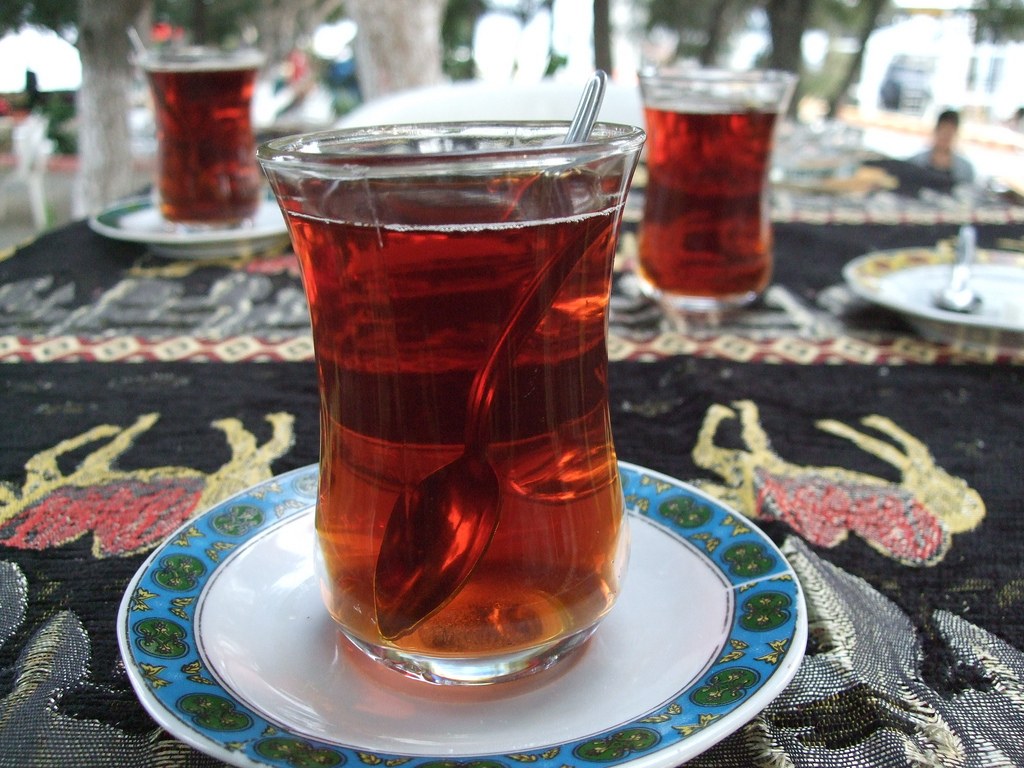
Some nations possess a culture so steeped in tea that it is nearly impossible to imagine them without it.
Take Turkey, for instance. Tea is so synonymous with Turkish life today—as anyone who has visited glorious Istanbul can attest—that it is hard to believe the Turks only joined the ranks of tea-drinking nations in the 20th century. The habit was actually a state project of the Atatürk regime, prompted by the skyrocketing price of coffee after the fall of the Ottoman Empire (may its memory be a blessing). Thus, Turkish Anatolia moved from ignorance to enlightenment.
As for the Tibetan Plateau, the arrival of tea likely signaled the end of the grim necessity of sipping yak butter melted in hot water, allowing instead for the sipping of tea flavored with melted yak butter. Tradition credits the introduction of the leaf to Princess Wencheng of the Tang Dynasty, who was sent to marry Emperor Songtsän Gampo, the founder of the Tibetan Empire. Yes, such a thing once existed.
Songtsän (605–649) began his reign by unifying the Tibetan Plateau, but eventually turned his sights on China itself, securing his status through military pressure. In a characteristically Chinese response, the Tang court sent him a mountain of gifts and, as mentioned, the Emperor's niece. Legend has it that the princess's dowry included several bundles of tea leaves, introducing the Tibetan elite to the heavenly brew.
Songtsän's successors pushed the empire’s borders deep into Central Asia; at one point, even Kabul fell under the rule of a Tibetan governor. For two centuries, the Tibetans were major players in the regional power struggle, contending with the Chinese Tang Empire and the Abbasid Caliphate until their power finally disintegrated in the ninth century.
Dalai who? A Tibetan rider.
But we are not here to discuss war and conquest, but culture—and as everyone knows, without tea, there is no culture.
The seventh century saw a surge in trade between China and Tibet. Following the usual pattern of Chinese foreign relations, luxury goods like silk and metal flowed into Tibet alongside increasing quantities of tea, which became a local obsession. In exchange, Tibet provided the one thing China could never quite master raising: horses.
Tibetan horses were nothing special in military terms—certainly no match for the legendary steeds of Fergana or Nisa, or even the hardy Mongolian pony. But in the seventh century, the Chinese bought horses wherever they could find them, and Tibetan exports grew steadily.
Tea is a delicate cargo. As organic matter, it is easily ruined by poor storage or extreme weather. The variety imported to Tibet was a strain of the Chinese Camellia known as "large-leaf tea" (Camellia sinensis assamica), which still grows wild in the forests of Yunnan and Northeast India.
Camellia sinensis assamica
The processing of this large-leaf tea was born of necessity: it had to survive being hauled in bulk across Himalayan passes five thousand meters high. The leaves were picked, fermented, dried, and compressed into molds—round, rectangular, or otherwise—then wrapped tightly for the climb.
Today, this compressed large-leaf tea is known generally as Pu-erh (Pǔěrchá). It falls into two categories: "Sheng" (Shēng Chá), meaning raw or green, and "Shou" (Shóu Chá), meaning cooked or ripe.
Pu-erh "cakes."
Originally, all compressed tea was "Sheng"—green or lightly oxidized leaves that would continue to oxidize very slowly over time. With age, the tea darkened, developing a heavy, complex, and slightly sweet aroma. While most teas—white, green, or Oolong—are best consumed within a few years, Sheng Pu-erh is the only tea that, by definition, improves with age, often peaking after a decade or more if stored correctly.
The soaring demand for Pu-erh and the desire to skip the wait led to a new invention in 1973: a microbial processing method designed to mimic the taste and color of aged tea. By subjecting the leaves to wet fermentation with specific yeasts and fungi (such as Penicillium and Aspergillus), producers created "Shou" Pu-erh, which tastes remarkably like the genuine aged article.
China even experienced a Pu-erh "bubble" a few years ago. Forecasts of skyrocketing prices for aged Sheng cakes sparked a buying frenzy among investors looking for a liquid goldmine. The speculation proved wildly exaggerated, and the market has since cooled.
This trade in tea and horses eventually carved a route that endured for over a millennium, surviving until the advent of modern roads and engines. Winding two thousand kilometers through Sichuan, Yunnan, and the Himalayas to the capital of Lhasa, it earned a fitting name: The Tea Horse Road (Chámǎdào).
Porters carrying compressed tea.
The road was essentially a southern branch of the Silk Road. While the main Silk Road linked Northern China to the Middle East and Europe, these mountain paths allowed for the exchange of more than just goods. They were conduits for ideology, technology, and people. The Tea Horse Road connected China’s urban centers to the Tibetan Plateau, which in turn linked to India and the Islamic world, fostering a Tibetan culture of unique spiritual and intellectual depth.


Related writing
Field Note
The Ginger Garden
On gardening, rhizomes, and a small botanical obsession in a Dali courtyard.
Essay
Rivers and Lakes
“When the springs dry up, the fish huddle together, gasping to keep one another moist; it would be better if they could forget each other in the rivers and lakes.” (Zhuangzi)
Essay
The Humid South: Miasma, Body, and Space in Southern China
On the perception of the Chinese South as an ecological and metaphysical frontier—and how a landscape of danger became the empire’s economic and intellectual engine.