Essay
By Noam Backner
Seeking Figs, Even in China
The stall owner noticed me eyeing the bamboo basket beside her stand and urged me to buy.
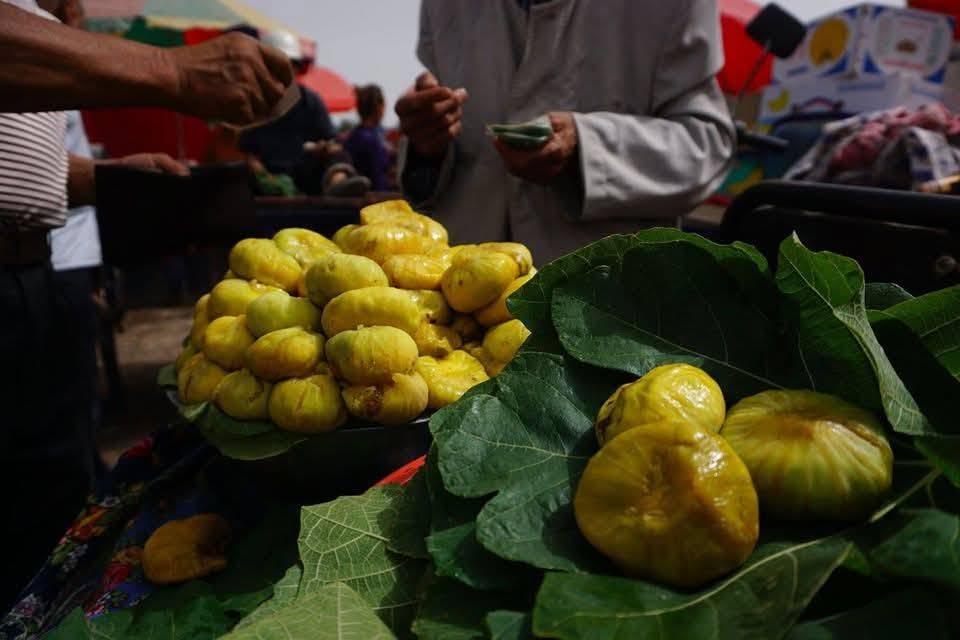
The stall owner noticed me eyeing the bamboo basket beside her stand and urged me to buy.
"Delicious, delicious! Local wu hua guo (无花果—the 'flowerless' fruit)!"
With typical Levantine condescension, I thought to myself that the last thing one could call the figs in this Yunnanese basket was "local"—or "flowerless," for that matter.
So what exactly were these figs doing here in far-flung Yunnan, swelling in the summer rains between the hills of Myanmar and the mountains of Tibet?
The common fig (Ficus carica) is a small to medium-sized tree native to Western Asia. Its place in human culture and cuisine is anchored in the tens of thousands of years since its domestication began. Archaeological evidence from the Jordan Valley suggests that fig cultivation may have started as early as the Neolithic period, making it one of the first domesticated species—predating even wheat.
The intense sweetness of figs, their high nutritional value, and their long shelf life when dried made them a vital food source in ancient Middle Eastern cultures and a key commodity on the early trade routes of the Fertile Crescent.
The economic importance of the tree is reflected in its status across world cultures, appearing in the hymns and texts of Sumer, Assyria, and Babylon.
The fig tree is also the first to be mentioned by name in the Hebrew Bible. Adam and Eve fashioned rough loincloths from its leaves to cover their nakedness, as if to express an inherent doubt in the utility—or perhaps the knowledge—granted to humanity by eating the forbidden fruit.
"And they knew that they were naked; and they sewed fig leaves together, and made themselves aprons..." (Genesis 3:7).
The fig’s place is no less prominent in the Islamic world. It appears in the Hadith as a fruit beloved by the Prophet Muhammad and a remedy he recommended for gout. The fig's status and exquisite taste even turned it into a symbol of celestial delicacy, leading Jalal ad-Din Rumi to observe:
"Not every man attends the Sama* equally; not every bird is privileged to feast on figs."
Like many foreign crops, the fig arrived in China via the trade routes. Along with walnuts, pomegranates, carrots, and sesame, it took root in the soil of the Middle Kingdom alongside foreign technologies, beliefs, and peoples. As a reminder of their origins, their names were often adorned with the character 胡 (hu), meaning foreign or barbarian, referring specifically to those from the northwestern regions or Central Asia.
Certain accounts—for which I have yet to find sufficient corroboration—claim that the first Chinese name for figs was pronounced "ti-er," echoing the Arabic "tin," consistent with the origins of the early Muslim merchants who frequented the cities of the Tang Dynasty in the seventh century.
In Yunnan, however, it is said that figs first arrived when they were planted in the palace garden of Sayyid Ajjal Shams al-Din Omar al-Bukhari, the first governor of the province appointed by Kublai Khan, Emperor of the Mongols and the Yuan Dynasty.
The tender fig saplings were carried alongside camel humps all the way from Central Asia, al-Bukhari’s homeland, and planted with due honor in Yunnan’s fertile soil. Another sapling was planted in the courtyard of the province's first mosque. It is possible that the figs still growing in mosque courtyards today—planted in cloud-decorated clay pots and shaped in classical Chinese style—are their descendants.
Whatever the origin of the Yunnanese fig, its presence here at the crossroads of Asia’s trade routes is another wonderful example of the constant movement of objects, people, plants, and stories from one end of the continent to the other. It is a testament to the ability of a small, succulent fruit to gladden the heart of a foreign barbarian—scruffy, bearded, and weary at the end of a long journey.
And to remind him of forgotten summers in the Middle East.
That is enough.
In the photos:
A fig merchant in the Kashgar market, Xinjiang, July 2018; Ficus carica: a botanical illustration; Figs in the Dali market, August 2018; Fig harvesting: a manuscript from a remote region of Western Eurasia; A fig tree styled as penzai (bonsai).


Related writing
Field Note
The Ginger Garden
On gardening, rhizomes, and a small botanical obsession in a Dali courtyard.
Essay
Rivers and Lakes
“When the springs dry up, the fish huddle together, gasping to keep one another moist; it would be better if they could forget each other in the rivers and lakes.” (Zhuangzi)
Essay
The Humid South: Miasma, Body, and Space in Southern China
On the perception of the Chinese South as an ecological and metaphysical frontier—and how a landscape of danger became the empire’s economic and intellectual engine.