Essay
By Noam Backner
Monks, Meat and Religion
A teacher says I "smell of beef": Shaolin's legendary licence to eat meat, Buddhist vegetarianism in China, and the line between spiritual charisma and worldly power.
One of my teachers claimed that I "smell of beef". The remark mostly amused me, certainly given my lack of any well-developed sense of the famous Chinese reverence, but I didn't want to correct him either: I don't eat much beef, and the smell probably came from another kind of meat.
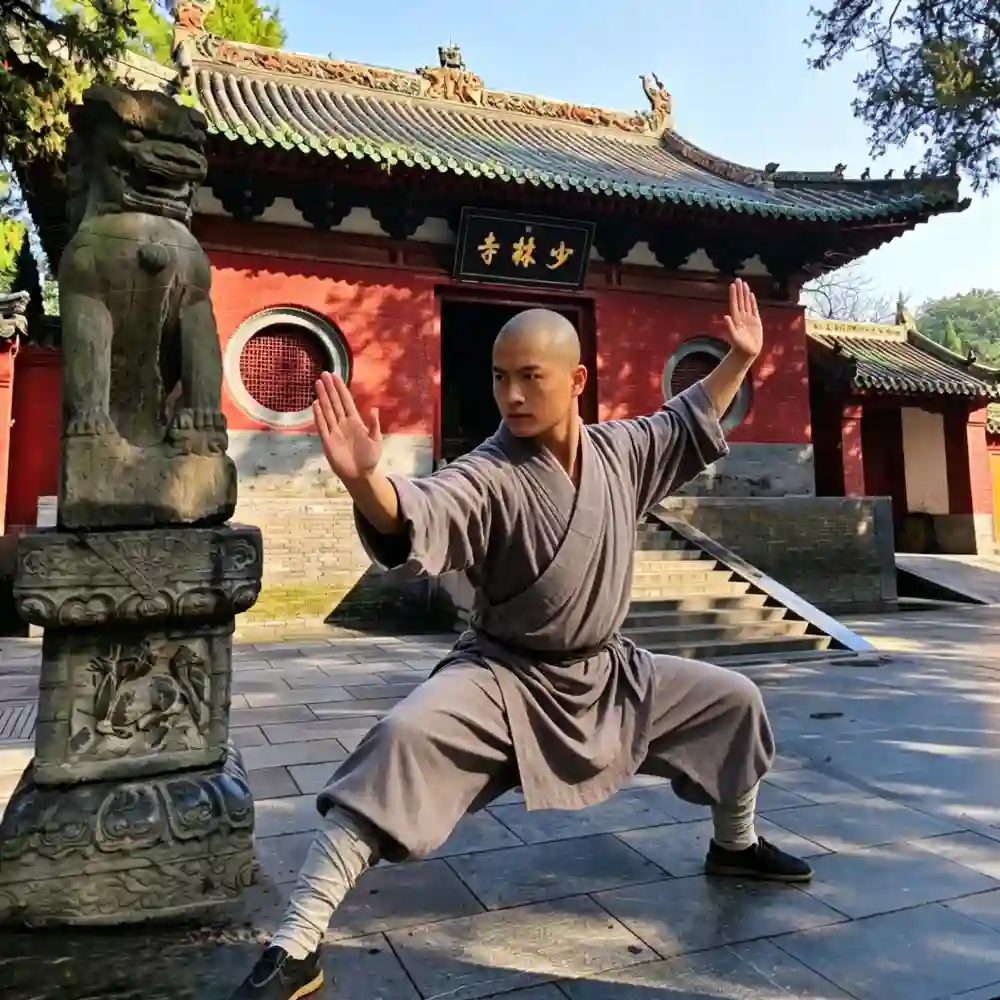
Even so, it was hard in that moment not to think of the tendency, in literature at least, of wayward monks to consume meat and other impure substances, and certainly of the licence to eat meat that the Shaolin monks supposedly received from the heir to the house of Tang, Li Shimin. The historical evidence linking the Tang royal house to the legendary monastery naturally makes no mention of any such licence, and the later mythology was perhaps meant to reconcile the rules of Buddhist renunciation with the paradoxical figure of the warrior monk.
The ox and the ploughing buffalo were, as we know, vital to work in the fields, and so in historical China, at least in certain periods, restrictions were placed on their slaughter. Early Buddhism also forbade eating meat under certain conditions, but this tendency grew much stronger once Buddhism took root in China, which entrenched the ideal of vegetarianism as an expression of absolute compassion towards all sentient beings.
The historical taboo, even when it was not absolute, developed out of that complex encounter, and at times a genuine overlap, between agricultural needs, local traditions and foreign Indian influences. Abstaining from meat, and usually from every animal product, thus became a central marker of Chinese Buddhism, anchored on the one hand in the Mahayana scriptures and on the other in the ethos of the monasteries' self-sufficient economy.
The military myth of Shaolin, and the licence to eat meat within it, whether as the outcome of an imperial decree or, in another version, as heavenly permission from the wrathful deity Vajrapani to eat "flesh and sinew", converges in any case on that same bleeding and always problematic middle line between spiritual charisma and earthly power.
The military activity of monks associated with Shaolin (as well as monks from other institutions in Henan, Sichuan and perhaps even Dunhuang) is fairly certain, even if this proves neither that they ate meat nor that the historical monastery itself enjoyed an imperial, or heavenly, exemption from the monastic code. The familiar figure of the archetypal kung fu monk is therefore, to a large extent, the product of a rather late encounter between history and folklore, certainly popular literature, and later cinematic mythology.
The tendency of certain groups of monks, and at times of entire monasteries, to pursue military ends can therefore be attributed to the way Buddhist institutions were woven into the fabric of the land, with all the economic, political and social constraints this entailed. In that sense, those bound up with the needs of the flesh end up, in the end, dwelling within it, like any other human being.
Continue the conversation
A question, a correction, a source I should know about? Write to me privately — I read every note.
Send a noteField dispatches
New essays and journey announcements, a few times a year.