Essay
By Noam Backner
Pashtuns and Jews: The Roots of a Myth
Tribal names, inherited customs and genetic evidence behind the enduring story of Afghanistan’s lost tribes of Israel.
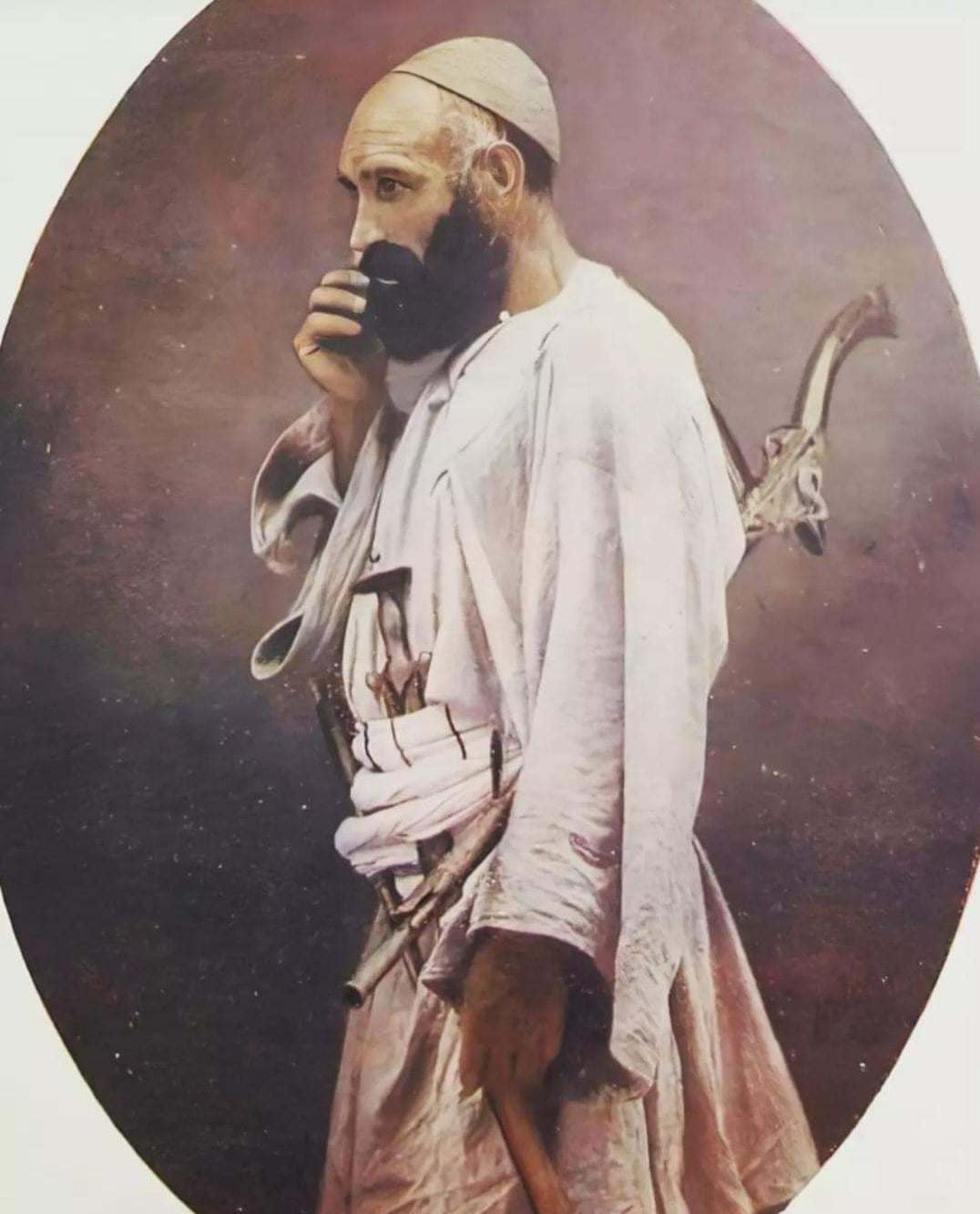
‘The Afghans call themselves the Children of Israel… and look like Jews.’
Alexander Burnes, 1835.
Well, briefly—and as has come up here more than once in passing—everyone knows, from the elders of Herat to American intelligence officers, that the Pathans, or Pashtuns as they call themselves, preserve a memory of descent from Israel and its Ten Lost Tribes. We might even indulge the fantasy that beneath the dusty woolen cloak and faded shalwar kameez, just a little to the right of the worn Kalashnikov stock, a warm Jewish heart beats quietly in hiding, yearning for its brothers in Zion.
We are also told that many Pashtuns know perfectly well of their sacred ancestry, but guard its memory with a deep suspicion befitting a proud people well acquainted with the sword, and beneath the weight of the Islamic tradition that rests so heavily on the distant mountains of Afghanistan. Those in the know whisper that some of these Pashtuns carry, or at least once carried, sealed amulets containing mysterious parchment inscribed with a strange, square-shaped script. Beyond these, only tribal names, an ancient code and curious customs remain to reveal the ancient Semitic origins of these tough mountain men. The God of exile alone has the answers.
Shall we begin?
The Pathans—henceforth, ‘Pashtuns’—are a large, dispersed people, numbering around 65 million, chiefly in Pakistan, Afghanistan and India, with diaspora communities in Western countries and several Muslim countries. They speak a southeastern Iranian language, the most widely spoken of its ancient sister languages, most of which are endangered or at least confined to very limited areas.
Born of a harsh, rugged land at the world’s crossroads, the Pashtuns and their ancestors have seen their homeland trampled by, or at least witness to, the passage of countless foreign armies. Greeks and Arabs, Turks and Mongols, Britons and Persians all left their mark in blood, religion and law, turning it into the restless historical concoction we now know by the fairly modern name ‘Afghanistan’.
Equal and worthy participants in the general commotion, the Pashtuns produced their own succession of military leaders who played substantial roles both within the local ‘Afghan’ setting and on the wider Inner Asian stage. From the poetry-loving Ahmad Durrani to Muhammad Omar, the Taliban leader who loved no one, each enjoyed his duly allotted days of chaos.
The Jews, by contrast, played a much more modest role in Afghan history. Yet they were present relatively early in the Hindu Kush, leaving traces in stone and place names from at least the eighth century and establishing prosperous trading communities in Balkh, Bamiyan and Ghor. These important communities were apparently largely wiped out during the Mongol invasion, alongside their fellow believers in one God.
We cannot be certain when Jews and Pashtuns were first joined in a story of shared ancestry. Sources from the Mughal period, foremost among them the chronicle of the vizier Ni‘matullah al-Harawi, first record in writing the supposedly Jewish* origins of the Pashtun tribes, ostensibly on the basis of their own testimony. Earlier works dealing with the Pashtun borderlands and their inhabitants say nothing about so sensational a detail. Some scholars, however, suggest that oral traditions of ‘Jewish’ descent may have circulated earlier, as far back as the fifteenth century.
From the heyday of the Mughal sultanate, the question of Pashtun Jewishness resurfaced repeatedly, alongside the rise of the British Empire in the Indian subcontinent and its growing engagement with the frontier beyond the Indus, with all the intellectual and strategic baggage that entailed. The story of the Pashtuns as descendants of the Assyrian and Babylonian exiles recurs in the writings of linguists and bureaucrats, missionaries and frontier scouts. Their varied arguments tend to come down to two familiar claims:
- The Pashtuns descend from the exiles of Israel, as shown by their names, customs and their own testimony.
- The Pashtuns look like Jews.
There is little reason to doubt that these repeated claims of supposedly Jewish ancestry have some basis in the traditions of different Pashtun groups. Outside research, however, is inadequate in scope or quality, while research from within is, for understandable reasons, severely lacking or fundamentally biased. On the evidence currently available, we can nevertheless propose a conclusion:
There is no connection between the Pashtuns and the Jews, and the traditions linking them date, at the earliest, to more than fifteen hundred years after the Assyrian and Babylonian exiles.
The convenient derivations offered for the names of various Pashtun ‘tribal’ groups—most famously the Afridis (‘sons of Ephraim’), the Yusufzai (‘sons of Joseph’) and others—tempt us to conclude that these groups preserved the names of the Levantine nation’s forefathers. Yet these names appear to be later additions to the repertoire of Pashtun identities. Older names such as Ghurghusht, Karlan and Sarban eventually gave way to a collection with a Middle Eastern ring: Yusufzai, Mahmudzai and Sulaiman Khel, probably during the premodern period. Meanwhile, Hellenistic, Islamic and other sources make no reference to Middle Eastern or supposedly Jewish populations in the Afghan context until the threshold of the modern era, when the Pashtuns supposedly draw back the curtain and emerge from history’s synagogue ark.
Another thread seized upon by the identity miners digging through Afghanistan’s mountains is the alleged equivalence between Jewish customs and Pashtunwali: the traditional code governing individual and communal Pashtun life, with its strong emphasis on honor, public obligation, hospitality, separation of the sexes, the use of violence and related matters. This piece is too short to examine individual provisions, which would in any case be difficult to establish as identical where there is merely a resemblance. Suffice it to say that claims circulating on various ‘Return to Zion’ websites—covering a slaughtered animal’s blood with earth, lighting a ritual fire, wearing four-cornered garments with fringes, practicing kabbalistic customs (!), prohibiting the consumption of marine creatures (!!), and all the rest—very probably concern customs with only coincidental similarities to biblical or later Jewish practices. They belong within the much broader context of Pashtunwali, fundamentally a social and economic system regulating individual and collective life in a decentralized, challenging and unstable environment, rather than primarily a body of religious or ritual observances.
If that is not enough, we can dig quite literally into the substance of the matter and turn to the dry evidence of genetics. This places the Pashtuns where we would expect them: a population rooted in the transition between South and Central Asia. They show relatively close affinities with Central Asian ‘Tajik’ populations, with regional departures toward ‘Indian’ groups, including Dravidian populations, on one side, and West Asian, chiefly Iranian, populations on the other. This fits modern Afghanistan’s role as an exceptionally diverse funnel for the movement of peoples.
If we must clutch at some scrap of a chromosome, we might seize with trembling hands upon G-M377, a cluster of genetic markers associated with Y-chromosome inheritance that is, intriguingly, particularly common among Jews and Pashtuns. A closer look at this supposedly sacred genetic code, however, reveals that the Afghan and Jewish populations carry somewhat different versions of the cluster. The version common among Jews is less similar to the Afghan one than to related versions from other parts of the Middle East, including Lebanon and Anatolia. Its distribution may point to some mixing of populations between six and eight thousand years ago—not exactly convenient timing for the narrative we are seeking.
Moreover, the famous physical resemblance between Pashtuns and Jews depends, well, rather heavily on the observer’s starting point and aesthetic expectations. Just as some Jews fit the expected Semitic archetype, many do not. The same is true of the many and varied people across the vast expanse between Jerusalem and Kandahar, and between the Caucasus mountains and the shores of Yemen.
So what might we actually have here?
It is hard to pinpoint the origins of the myth of the Pashtuns as ‘Children of Israel’, whether as a belief within the community or a story told about it. If we must put this hot potato down somewhere, we might use the entirely invented but serviceable term ‘ancestral mutation’. We could then suggest that the cosmic collision between the religion of Muhammad, with its weighty monotheistic inheritance, and the tribal frontier society of the Hindu Kush brought about some change in Pashtun self-perception. Along the way, the Pashtuns may have adopted, even within a limited context, a suitably monotheistic family tree. Perhaps—and this requires due caution—it offered a fitting alternative to the prestige of orthodox Islamic descent from the Prophet Muhammad’s family or his companions in the Hejaz.
From the fourteenth century, genealogical works linking a group’s ancestors to important figures in Islamic and wider monotheistic history became widespread across the Muslim world as a means of establishing political, religious and spiritual legitimacy. This literary practice was particularly common among Sufi communities, tribal groups and minorities. Despite their mountainous homeland, the Pashtuns were thoroughly engaged in the politics and culture of their region. Even if they often played the underdog, they both shaped and absorbed its dominant cultural trends, including genealogical writing as a source of authority.
The desire for proximity to the wellsprings of ancient Israelite prophecy is also familiar from other parts of western Asia and beyond. Place names, mountains and holy sites acquire a biblical coloring that brings the distant and unattainable closer, even at the price of an ambivalent association with the actual Jewish people, with all the familiar dangers that entails.
It may also be worth emphasizing the peculiar enchantment of Jewish identity, even when wholly invented: its power to mark almost any modern society it touches with the radiance of divinity or the stain of the devil. Especially today, this cannot be disentangled from the deep currents associated with the establishment of the State of Israel, or from the internet’s contribution to the circulation of knowledge, misinformation and a considerable quantity of baseless mental sewage.
A glance at websites engaged in contemporary Afghan discourse is enough to see how the question of the Pashtuns’ hidden ‘Jewishness’ supplies another chapter in that haunted, densely layered catalogue of images of the eternal Jew, concealed in every hidden corner—even on the arid slopes of Central Asia’s mountains. Woven into that question are the bloody associations of Afghanistan’s grim history over the past forty years: the Mujahideen, the Taliban, and killing across national, ethnic and religious lines.
If, in closing, we must draw some insight from this ethno-historical muddle, perhaps it is that the utterly natural human craving for ancestry, belonging and a connection to the past can lead us to very strange places, for all the comfort and reassurance it provides. Perhaps increasingly sophisticated genetic studies, becoming more efficient and affordable, will give us all access to our actual shared past and to the rather uniform genetic milkshake we call the human species. I believe such tests can not only ease the feelings of superiority and hostility that so readily accompany this hunger for origins and belonging, but also lead us somewhere remarkable: if not to the mountains of Afghanistan, then at least to our neighbor’s door.
Shabbat shalom.
*I deliberately use ‘Jewish’ rather than ‘Israelite’, despite the claimed descent from the Ten Tribes of Israel, for ease of reading and in view of the contemporary Israeli context.
Continue the conversation
A question, a correction, a source I should know about? Write to me privately — I read every note.
Send a noteField dispatches
New essays and journey announcements, a few times a year.