Essay
By Noam Backner
Persian Tiles, a Chinese Roof
Could a familiar ornament on Chinese roof tiles be Iranian? A village collection opens a window onto pearl roundels, Sogdian migrants and the long history of cultural exchange.
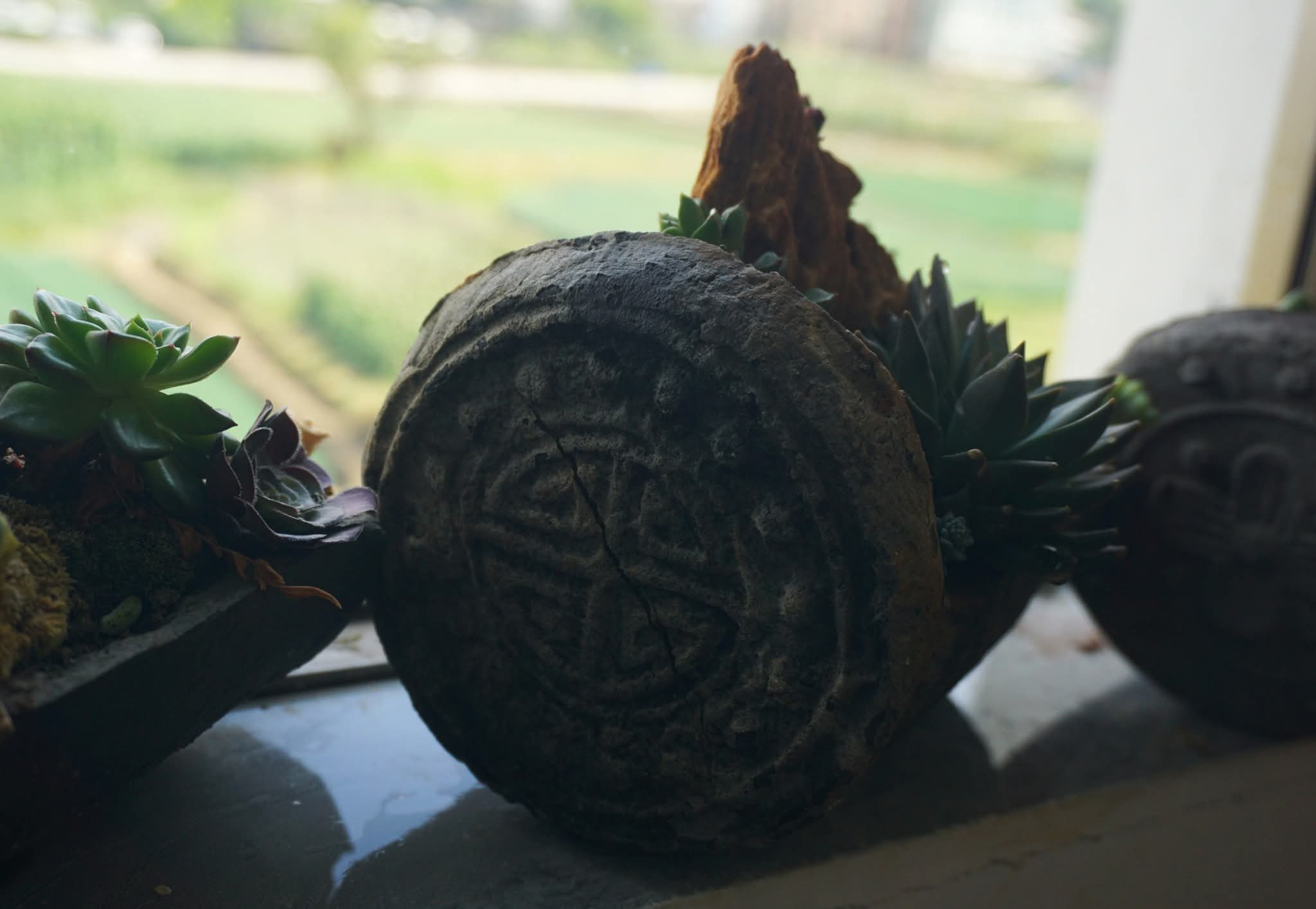
And while we’re on the subject of ties between China and Iran, then and now: could a decorative detail so common in modern China actually be entirely Iranian?
One spring day, as I sat gazing at the cabbage fields, as one does, I experienced a minor revelation. I have a sideline hobby here in the village: collecting old roof tiles. These sometimes bear all manner of curious ornaments, most commonly reliefs of flowers and birds, but also a few rarer designs, such as the longevity symbol (shou) and that most elusive find—the taiji symbol, better known as yin and yang.
So far, so familiar, and Chinese through and through. But the “Persian” slap in the face came when I noticed something that had been there all along, in a rather marginal ornament—or, in fact, an entirely marginal one: around the edge of the faces of Chinese roof tiles, the vast majority of them today, runs an orderly ring of small circles.
While a circular sequence of dots sounds like the most nondescript ornament in the book, even a design default wherever you need to squeeze in another element without making an effort, anyone with some familiarity with the visual traditions of Inner Asia and their recurring manifestations in China may see what is probably obvious.
The “pearl roundel” is one of the most prominent expressions of the design vocabulary of pre-Islamic Central Asia. Although its origins are quite early, and may even point to an ancient Hellenic source, the pearl motif recurs throughout Central Asian ceramics, textiles and metalwork. Its wide range of use encompasses the Parthians, the Kushans, Buddhist Gandhara and the oases of Transoxiana, while its subsequent adoption by the Sasanians of western Iran gave the ornament its best-known attribution.
Despite its common name, this ornament is generally thought to represent not pearls but rather divine emanation, in the form of rays radiating from the blazing sun. In its own way, and in its various regional contexts, the motif is associated with nobility, glory and cosmic authority, as well as the rule of justice, goodness and illumination—all those expressions so characteristic of notions of earthly and heavenly charisma in the Iranian world.
So what is a divine, thoroughly Iranian sun doing on the roof tiles of our Chinese village?
The answer lies, once again, in the fact that China served as a home, temporary or permanent, to diverse Iranian communities over prolonged historical periods. Merchants and missionaries, soldiers and political exiles all found themselves swept eastward by the gravitational pull of the Central Plains. These Iranians—Parthians, Khotanese, Kushans and Sogdians—contributed greatly to Chinese culture and enriched it. The last of these played an especially important role in establishing extensive trading colonies throughout northern China and beyond, eventually forging a distinctive synergy of Chinese, Buddhist and Central Asian elements.
It was perhaps the Sogdians who did the most to embed Central Asian culture among Chinese elites wherever they were found. Musical instruments and grape wine, exuberant dances and items of clothing all became common sights at the courts of early imperial China. And while there is a strong possibility that the pearl roundel in question migrated to China on the surfaces of imported ceramic jugs, it may well have spread on textiles and the decorated garments so characteristic of Central Asian immigrants in China.
Whether through ceramics or textiles, it seems that it was precisely this colourful period that impressed Iranian sunrays onto Chinese clay roof tiles. These appear from a relatively early stage, around the Northern Dynasties period, along the edges of tiles attributed to public buildings, temples, palaces and other structures. They are often accompanied by lotus flowers, another foreign symbol and a reminder of the special relationship between Iranian immigrants, the Buddhist religion and the broader Chinese context.
It should be noted that dotted ornaments can be found on Chinese roof tiles predating this period, and before the presumed arrival of the first Iranians within China’s borders. These, however, are generally quite minor in both their distribution and their extent. Given the enormous popularity of the motif during that peak period of foreign immigration, there is also no reason to rule out the possibility that the earlier ornament of the Qin–Han periods merged with a growing fondness for the foreign motif, much as the Indian lotus came to feel at home in Chinese culture at large.
As beautiful and prestigious things tend to do, these motifs gradually filtered into vernacular building. And although I admit I have not delved deeply into the process, today tiles adorned with sun pearls embellish almost every roof built in a traditional style. These tiles are, naturally, produced in their thousands and more, year after year. Multiply that by the number of tiled roofs in modern China, and you get millions upon many millions of Iranian suns blazing from the top of every building in the People’s Republic. Isn’t that eternal glory in all its radiance?
Continue the conversation
A question, a correction, a source I should know about? Write to me privately — I read every note.
Send a noteField dispatches
New essays and journey announcements, a few times a year.