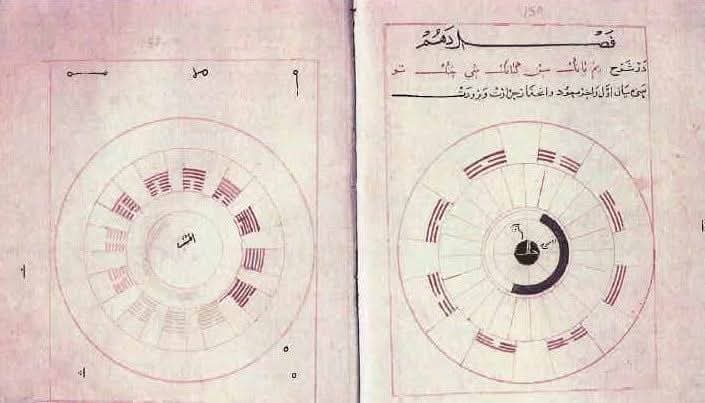
Bagua and taiji.
Illustrations from adapted translations of Chinese medical knowledge into the Persian scientific tradition. Ilkhanid Iran, fourteenth century. Hagia Sophia Library, Istanbul.
The Mongols' shattering of traditional cultural boundaries between East and West created a singular opportunity for the region's scholars. A period of relative peace, the House of Chinggis's support for trade and the arts, and the extensive network of exchange it established brought different—and sometimes conflicting—systems of knowledge into unprecedented contact.
Rashid al-Din al-Hamadani (1247–1318), a physician and courtier of Jewish origin, and unquestionably one of the most important intellectual figures in Iranian history, offers an illuminating example of a Persian scholar under the Mongol Empire. Trained in medicine, he also served, as was customary in such circles, as vizier and adviser to two of the most important Mongol Ilkhans, Ghazan and Öljaitü. In keeping with the scholarly tradition of his time, Rashid al-Din pursued many fields of knowledge. Besides sponsoring an encyclopedic historical work without precedent in its day, he wrote extensively on medicine, science, religion, and agriculture. His many sources included colleagues from the far reaches of the Mongol world, whose expertise he drew upon for his projects, as well as Chinese texts that the Mongol imperial framework had made available to Iranian scholars for the first time.
Their origins on the margins of the Chinese world had given the Mongols a considerable familiarity with, and appreciation of, Chinese medicine. During the conquest of Iran and Baghdad, Chinese physicians served Hülegü, the commander of the invading army. After the establishment of the Mongol state in Iran, they continued to serve his successors. The medical knowledge they brought from their homeland must have attracted the attention of local physicians, including Rashid al-Din.
The Ilkhan's Treasure Book on Chinese Science and Techniques (Tansuq-nama-yi Ilkhan dar funun-i ulum-i Khitai; hereafter, the Treasure Book) is, as far as we know, the first Western monograph devoted to the Chinese medical tradition. In his introduction, Rashid al-Din explicitly identifies the Arabic translations of Greek medicine as the model for his translation from Chinese. Just as the Abbasid translations had opened the treasury of Greek knowledge to the Islamic world, he declared, he intended to make Chinese knowledge accessible to Muslim scholars by translating it into Persian.
Alongside detailed anatomical illustrations of the internal organs—a subject that raised difficulties under Islamic law but had been developed in China through the dissection of executed prisoners—the Treasure Book offers a detailed account of Chinese pulse theory. Diagnosis by the pulse, although not unique to Chinese medicine, was highly regarded not only by the Mongol aristocracy but also by visitors from the West, including the Islamic world and even Christian Europe.
As noted, the use of the pulse as a principal diagnostic tool was not foreign to Iranian physicians: Ibn Sina and his contemporaries had discussed it at length. Yet the sophistication of Chinese practice and its celebrated reputation seem to have encouraged the borrowing of Chinese medical knowledge. Accordingly, one of the principal sources Rashid al-Din and his collaborators appear to have used for the Treasure Book was a work called Secrets of the Pulse (Miao jue), by the twelfth-century Chinese scholar Cui Jiayan. It was highly regarded under the Yuan dynasty, from which the Ilkhanate drew many of its Eastern sources of knowledge.
If we must draw a boundary around this exchange and summarize, in broad strokes, the mutual enrichment of Chinese medicine and the Persian tradition, the following picture emerges. Despite possible intercultural contacts extending over centuries, both in the trading cities of the Tang and Song dynasties and under Mongol rule, these fascinating encounters seem to have remained largely confined to the exchange of medicinal substances and prescriptions between the two traditions. Ideological differences—the Chinese difficulty in accepting certain aspects of Galenic humoral theory, and the corresponding Islamic difficulty in accommodating Chinese medical ideas with their cosmological and religious associations—apparently created substantial cultural barriers to an open, receptive examination of medical theory on either side of the divide.
Continue the conversation
A question, a correction, a source I should know about? Write to me privately — I read every note.
Send a noteField dispatches
New essays and journey announcements, a few times a year.