Essay
By Noam Backner
Tea Roads #1863: Tea and Treasures
Eight Treasures Tea, the Muslim merchants of western China, and how history, medicine and commerce blend in a single gaiwan.
I'm not a great fan of tea with additions, and prefer to give pride of place to the leaves themselves.
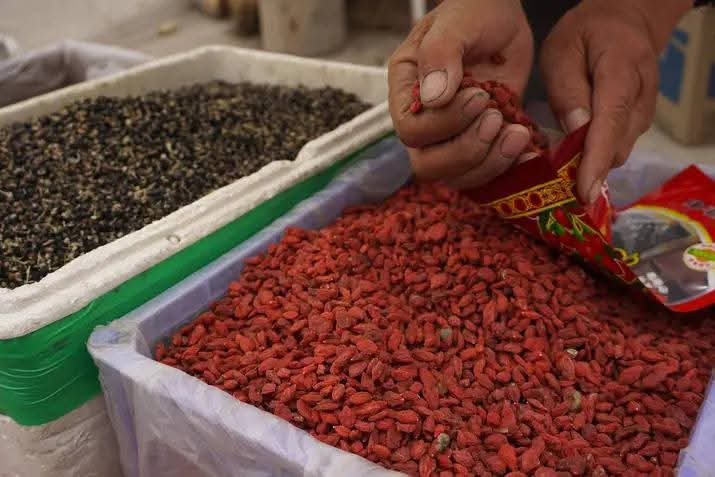
But "Eight Treasures Tea" (八宝茶) is another of those exotic items engraved in my memory from a young age, when my dear brother brought back a few mysterious tea bags from a long trip to the East. It is quite possible that these unfamiliar treasures — a bundle of leaves, dried longan, nabat rock-sugar crystals, chrysanthemum flowers, jujubes and wolfberries — were some half-conscious milestone that showed me the way to the place where I am rooted today.
Recipes are hard to trace, even in a culture as fond of documentation as the Chinese. And even if it is clear that a tea like Eight Treasures Tea belongs to a long line of ancient brews based on camellia, fruits, seeds, blossoms and the like, I could not verify the beginning of its association with the western regions and their Muslim populations — and here too the community elders I questioned repeat the overly sweet narrative of "very ancient" and "from the Silk Road".
Either way, it seems that the custom of drinking a compound of tea with sweet and/or medicinal additions, even in its north-western version and its link to the Muslim merchant communities of western China, does not depart substantially from that long tradition of complex tea drinks — even if at least some of the ingredients, such as the jujubes and the wolfberries (goji berry, gouqi, Lycium barbarum), are certainly rooted deep in the arid soil of the north.
Another angle on the matter is the additional layer of commercialisation that the digital age makes possible for the powerful commercial drives that already reign in China. Within this, one can see continued development and branding of Eight Treasures Tea, partly within what might perhaps be called "uniqueness under heaven", as different ethnic groups are encouraged to emphasise their cultural and "ethnographic" (as opposed to historical) distinctiveness, with the economic dividend that comes with it.
Accordingly, it seems that the "original" recipe I knew has gained a wealth of further ingredients, most of them from the Chinese herbal and culinary canon, and these vary from recipe to recipe.
To these is matched the gaiwan (a lidded tea bowl), sold here in a larger than usual version, so as to hold the bursting abundance of treasures and capture their reviving fragrance. Both are then marketed on mobile screens, sometimes in enthusiastic live broadcasts, stressing the medicinal and spiritual virtues of each specific treasure formula, or demonstrating the proper way to steep it in the oversized gaiwan.
So it is that in western China tea and ritual, medicine and commerce, history and the story told about it are blended together — as is customary in our day, and as it always has been.
Continue the conversation
A question, a correction, a source I should know about? Write to me privately — I read every note.
Send a noteField dispatches
New essays and journey announcements, a few times a year.