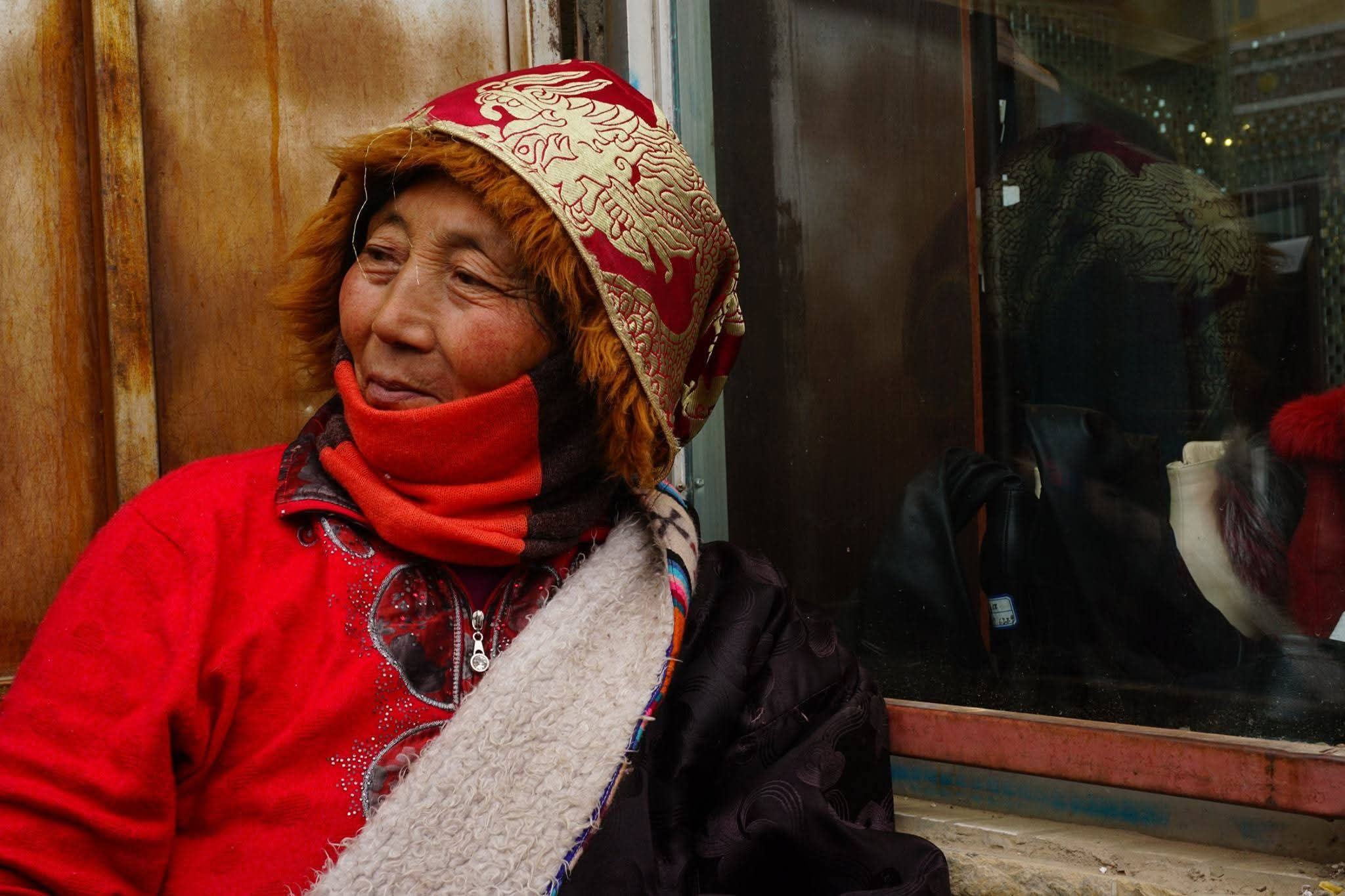
We need borders. So often, borders define us and hold our familiar selves in place, lest we scatter in every direction. They draw the familiar close and push the foreign away, anchor families, settlements, and peoples around a centre, and guard against a dangerous breaking of fences that might lead into an impoverished present and a future lost in fog.
The cultures of China and Tibet, so closely interwoven today within the rigid, stone-like borders of the People's Republic of China, are as distant from each other as the Himalayan peaks are from the Yellow Sea. Despite a thousand years of religious and commercial ties, the assumptions underlying these two ancient cultures—their values, economies, and metaphysics—still stand, to a considerable extent, on opposite edges of a deep and bitter gulf.
Since the days of the vigorous Tibetan Empire of the Yarlung dynasty, which reached its height in the eighth century and inspired awe from China's plains to the depths of Central Asia, the Tibetan world maintained a splendid isolation. It nevertheless remained well connected to regional centres of power in every direction, while the plateau's steep passes and bitter winters formed a fortified wall against direct foreign rule.
In the plateau's east, however, Tibet's harsh geography softens and yields. Just as it generously feeds the great rivers of East Asia, the foothills of eastern Tibet offer a welcoming home to complex encounters between ethnic groups. The seam of the Tibetan-Chinese frontier became a fascinating, intricate arena of commercial, religious, and cultural contact, whose echoes still reverberate today.
The Sino-Tibetan tea trade—perhaps the single most defining element of the pre-modern relationship between China and Tibet—did more than supply Tibetans with their essential, virtue-laden drink and the Chinese with a steady stream of horses for transport, communications, and warfare. It allowed both sides to sustain a close relationship that, in turn, cast a vibrant restlessness over western China's frontier regions.
Those regions became woven into elaborate networks of officials and nomads, clerics and exiled criminals, Han border guards and lamas bundled in robes, Muslim wool merchants and black-clad Lolo mercenaries. They rubbed robe against shoulder and saddle against saddle in a place as distant from the Western Paradise as from the seats of power in Beijing and Lhasa.
But if any place offered comfort and rest, a well-fed belly and a little human warmth amid the winding expanses of the Tibetan-Chinese frontier, it was the iron hearth of the kortso.
Broadly comparable to the khans of Western Asia and similar institutions in eastern China, the kortso—literally, "circle"—developed from the meeting and administrative houses of the local Tibetan elite. Over time it became a wayside inn where weary travellers could shelter from the freezing night, dig into a steaming bowl of stew, and, should the gods of the many worlds permit, find a buyer for goods brought from here or there. Its combination of lodging, food, medicine, and trade resembled that of related institutions elsewhere. In one essential respect, however, the Tibetan kortso differed from its sisters to east and west: women.
Whether because of the plateau's frontier economy, the structure of the traditional Tibetan family, or the demands of life in one of the earth's harshest environments, Tibetan women enjoyed relative freedom to participate in public life. In China and the lands of Islam, women were rarely permitted to take an open part in economic activity; when they did, it was generally from behind a curtain and a bolted door. Tibetan women, by contrast, could attend to the needs of this world alongside their obligations to parallel worlds. They actively sustained households and agricultural work, managed the rituals needed for family prosperity, took up the political reins when opportunities arose, and, as we shall see, secured a firm place in vast trading networks stretching from sunrise to the sun's resting place in the west.
Dartsedo—modern Kangding in western Sichuan—is regarded as one of the Tibetan frontier's most important trading towns. At a comfortable altitude below 3,000 metres, astride routes from Yunnan, Lhasa, and Sichuan, it was an important centre for interregional trade in tea, musk, medicinal herbs, and furs. Under the Qing dynasty, a state tea-trade customs office, the chaguan, was established there. By the early seventeenth century, some eighty thousand tonnes of tea reportedly passed through the town each year before being distributed among Lhasa's noble households, the great monasteries of Ü-Tsang and Amdo, and the remote nomad tents of the northwest. Toward the end of the nineteenth century, Dartsedo became truly cosmopolitan. It hosted Muslim merchants, Sichuanese porters afflicted by tuberculosis and drug addiction, Western missionaries, Manchu customs officials, and proud-faced Khampa nomads. Contemporary chronicles describe brisk trade not only in musk and silk, tea, and gold and silver dust, but also in tobacco, smuggled rifles, and Japanese matches—and, during the Chinese Republic, ever-increasing quantities of opium and syphilis as well.
With commerce so lively, it is hardly surprising that Dartsedo witnessed the kortso inns' greatest flowering. Whereas comparable establishments in the West were sometimes considered disreputable places run by dubious characters or worse, Tibetan hostelries seem to have held an honoured place among local and foreign communities alike. They were trusted to store goods, broker deals, exchange money, extend loans, and provide the other services merchants required.
Closely bound to the Tibetan elite and its economic prosperity, the kortso formed a kind of extension of the frontier's great households. These maintained political ties not only with major regional monasteries, but also with the Dalai Lama's establishment in Lhasa, important trading houses in China proper, and Muslim trading networks in the Hui regions reaching as far as the Yellow River. Unlike Confucian Chinese society, where "the man holds the plough, the woman the spindle," Tibetan society afforded women relatively broad freedom and discretion in their own lives. Qualifications are necessary, of course, according to time and place. Nevertheless, the strategic Kham region of eastern Tibet and its important hostelries appear to have been a principal setting for vigorous female activity.
Young women, some only fifteen, worked actively and energetically as skilled intermediaries in barter involving tea, silk, musk, and other goods. They dealt shoulder to shoulder with foreign and local merchants, on terms that can only be described as equal. Such encounters sometimes led to marriages between Tibetan women and Han men, who then entered the women's families as dependants—a complete reversal of the Confucian tradition, which prescribed male supremacy and the husband's household's authority over the married woman. The connection between women managers and the kortso became so pronounced that, at its historical height around the turn of the nineteenth century, the institution was also known as achak khapa: "one of eloquent speech," or alternatively "the honoured host." In popular usage, the name often referred directly to the woman who firmly managed the inn and its many needs.
The need to perform a wide range of tasks—from maintaining the household to provisioning trading caravans, feeding pack animals, mediating between merchants from different regions, allocating suitable space for tea storage, and receiving high-ranking guests—defined and shaped our eloquent hostess's considerable standing in her community. While many men aspired to study and monastic seclusion, or at most undertook long-distance trading journeys, the women who remained were often entrusted with the journeys' intricate logistics. They also managed the tangled social and commercial web connecting the far ends of the land with its heart.
Like Dartsedo's commercial importance, the kortso reached its height between the seventeenth and early twentieth centuries. A slow but persistent decline followed, as the Chinese Civil War, changes in international markets, and finally the establishment of the People's Republic of China consigned the ancient institution to oblivion. Women's position in Tibetan society should not be idealized: they, too, were sometimes relegated to a subordinate role under their fathers, husbands, or multiple husbands. Still, their relative freedom compared with women in other traditional societies gave them opportunities to accumulate social and economic capital and run thriving businesses connected to far-reaching trading networks.
Within this dynamic, enabling setting, the women of the kortso were more than skilled, eloquent commercial intermediaries. They were agents of genuine cultural exchange, translators between the Tibetan Buddhist world and China's Confucian order. Receiving strangers and sending the beloved and familiar out toward distant places, moving steadily and persistently around ever more distant, ever more expansive axes, they worked day after day to break, build, and redefine the cultural borders of their time. Borders as elusive as a river and as weighty as mountains: between guest and host, monk and merchant, the Yellow Sea and the Himalayan peaks, China and Tibet.
Continue the conversation
A question, a correction, a source I should know about? Write to me privately — I read every note.
Send a noteField dispatches
New essays and journey announcements, a few times a year.