Essay
By Noam Backner
Tea Routes #1868: The Teahouse at the Threshold of Modernity
Behind West Asia’s seemingly timeless teahouses lies a modern history of empires, trade, technology, and changing tastes.
Tea, as we have seen, is an elusive commodity in this respect: even as a handful of dried plant matter, it contains fathomless ethical, social, and sometimes religious meanings, folding the foundations of culture itself between its leaves.
Tea has become so commonplace among most of the world’s populations that it is easy to forget how recent, in historical terms, its consumption outside East Asia really is. As for the institutions bearing its name across West Asia—those traditional “teahouses,” from the chai khana (Persian) to the chai evi (modern Turkish), which seem to have belonged there forever—it is hard to imagine that all are products of the modern period, the outcome of gradual, layered processes of adoption, themselves bound up with early commercial globalization.
Tea was not, admittedly, a stranger to the neighborhood. Muslim trade in tea was known almost from the earliest days of Islamic Central Asia, including among the Qarakhanids in the ninth and tenth centuries, who inherited stretches of the Sogdian trade routes to China and profited from the lucrative tea-and-horse trade between the Qinghai Plateau and the fringes of the Gobi. Fairly accurate descriptions of the drink’s production, trade, and consumption appear in the writings of al-Biruni, including distinctions between different kinds of tea—all, of course, derived from the Chinese camellia—as well as information about the Song dynasty’s tea monopoly and the extensive trade in tea among China, Mongolia, Tibet, and Nepal.
Yet despite documented access to bricks of compressed tea, a common trading commodity in High Asia and, at times, a currency in their own right, the material culture of West Asia seems to have remained indifferent to the noble leaf. Chinese tea stayed frozen in the compartments of medicine and diplomatic exchange until quite late in the region’s history, and even then emerged in response to a pincer movement largely originating outside the Islamic world.
The foundations for the development of the teahouse in its West Asian sense must be sought in underlying social, political, and economic factors: the development of local consumption, supply networks reaching tea-growing regions, and enabling technological and social conditions. As we shall see, the overwhelming majority of these factors could not have existed before the threshold of the modern era.
Socially and institutionally, the teahouse drew on its older cousin, the coffeehouse. Although this dubious institution originated around the sixteenth century, and in any case only after the founding of the Ottoman Empire with its commercial ties to southern Arabia, the coffeehouse itself seems to have expressed the natural desire to gather among urban populations in Islamic lands. Such inclinations had traditionally met with suspicion from the authorities, a suspicion previously directed at even older gathering places: the hammam, the tavern (mey-khana), the Sufi khanqah, and the boza and sherbet stalls.
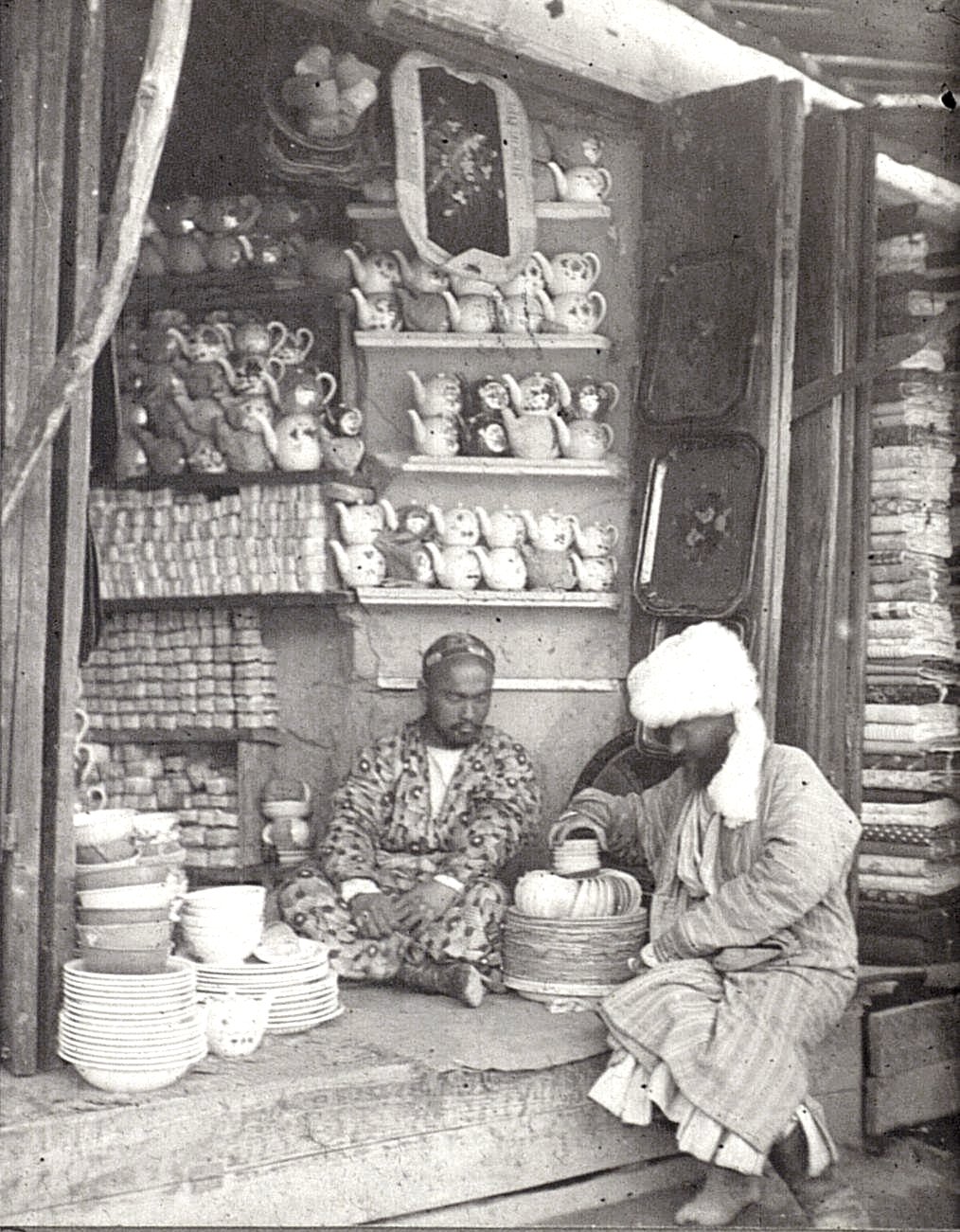
Tea’s arrival in Islamic lands and its establishment as a common, affordable commodity probably did not occur before the late eighteenth century; the process was not complete until some hundred years later. Although Central Asia certainly seems to have been tea’s initial point of entry into West Asia, partly as a result of the Manchu conquest of Kashgaria and the extensive trade links forged between Xinjiang province, Kokand, Bukhara, and Samarkand, it appears that local tea culture and the emergence of the Central Asian chai-khana as we know it today were not possible until after the Russian conquest of the mid-nineteenth century. This was also when the social and technological conditions matured, including the adoption of the tea utensils now familiar across the region: the chainik, the piala, and the samovar. All today proudly bear Russian names, and are Russian adaptations of Sino-Western, German, Dutch, and English implements. It seems, however, that for a relatively brief period these were used alongside copper vessels characteristic of the region, such as the ibrik, and sini cups, the latter drawing their classical name from the homeland of porcelain.
A similar process unfolded in the Iranian sphere, where the samovar and the glass teacup, the estekan, were first received as diplomatic gifts from tsarist Russia—perhaps in exchange for the hefty bite taken out of the shah’s Caucasian lands. Meanwhile, tea in Iran went from being a predominantly northern import, arriving by the Bukhara route, to an affordable drink of the people, especially after the establishment of the British tea industry in India and Sri Lanka. This enabled a short trade route carrying plentiful supplies from Indian ports to southern Iran, a stubborn coffee stronghold until the mid-nineteenth century or a little later.
It is interesting to note that the rise of Iranian tea culture went hand in hand with complementary narcotic substances, chiefly opium and tobacco. The former had long been present among Iran’s civilian and military elite, but spread substantially down through the ranks of Iranian society alongside the British opium trade, with tea serving as a balancing agent according to Greek-Islamic humoral theory. The latter was an import from the New World, enthusiastically embraced across the Middle East. Both, incidentally, sometimes met with opposition from religious and legal authorities. Shah Abbas’s mistreatment of his ministers is still remembered: he handed them dried horse dung disguised as “special tobacco from Hamadan”—without so much as a cup of tea to wash down the offering.
From its beginnings, Iranian tea culture was also associated with another global commodity: sugar. The familiar Persian habit of drinking scalding tea through a lump of sugar took root at precisely the same time as Iranian tea culture itself, in turn binding the shah’s lands to the great sugar markets of the British Raj and tsarist Russia.
The last stronghold to fall to tea was, unsurprisingly, the ruins of the Ottoman Empire. The young Turkish Republic undertook the painful process of a forced severance from the coffee lands of southern Arabia, while the establishment of its Black Sea tea industry, drawing on Iranian precedents on the southern Caspian and Russian ones in the Caucasus, ultimately allowed it to become one of the world’s largest per-capita consumers of tea.
The teahouse culture of Islamic lands, from the chai khanas of the markets of Bukhara and Khujand to the chai evis on the shores of the Bosporus, is thus a heartwarming symbol of deeply rooted hospitality and binding social ritual, but also a fairly recent product of commercial, technological, and political processes originating in Western countries. Asia’s rewiring through predominantly maritime transport routes largely severed the southern arteries of the coffee trade, replacing them with immense horizons connecting the markets of West Asia not only to those of Bengal, Sri Lanka, and Canton, but also to the ports of the New World. This laid the economic foundations on which the entire modern world rests. .
In the images:
The beginnings of the tea institutions of Central and West Asia A teahouse in Central Asia, after the mid-nineteenth century: Russian and traditional tea utensils used side by side. Tea and opium consumption according to the principles of Islamic-Galenic medicine. Qajar Iran.
Continue the conversation
A question, a correction, a source I should know about? Write to me privately — I read every note.
Send a noteField dispatches
New essays and journey announcements, a few times a year.