Essay
By Noam Backner
The Empty Bowl: Myth and Practice on the Himalayan Margins
Tibetan singing bowls, the mythology of ancient wisdom, and the intricate meeting of spiritual longing and global commerce.
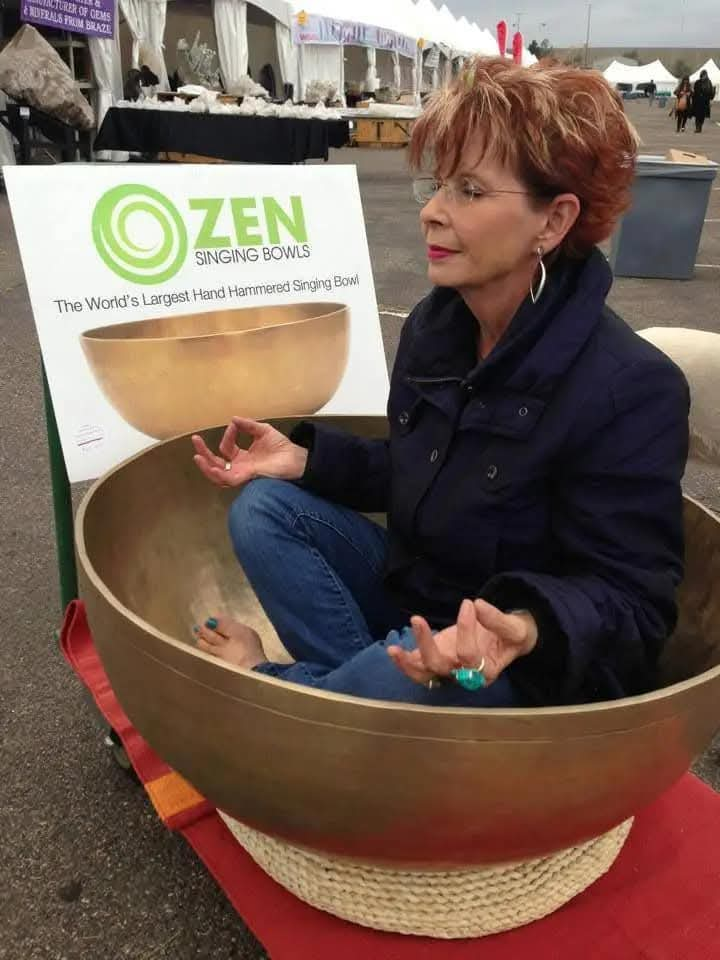
Within their golden interiors, they hold the secrets of spiritual awakening. Bearing the delicate marks of a hammer or lovingly engraved dedications, they brim with elusive vibrations, revealed little by little only to those whose ears are attentive and whose hearts are open. The finest are made from a special alloy of seven metals, an earthly echo of the seven planets. In substance and sound, they are among the most tangible expressions of ancient, esoteric rites originating in the dark monastic cells of the Himalayan slopes and the Tibetan plateau.
Tibetan bowls are powerful musical and visual instruments, said to originate in unorthodox rituals—perhaps among the yogis of northern Kham, or in the secretive Bön monasteries of the Himalayan borderlands. The penetrating resonance they produce is said to reach deep into bodily tissue, transform a weary consciousness, and even cleanse entire rooms and spaces of unwanted energy.
These bowls also vividly express the way cultural mythologies, at once new and old, resonate through complex layers of culture, intertwining images and purchasing power, the allure of a foreign civilization and the networks of global trade.
Tibet—that rugged mass of the earth's crust thrust skyward to an average elevation of four kilometers—is a sacred object of longing for pilgrims, backpacking seekers, researchers clothed in gratitude, and Western philanthropists clothed in linen and silk. As a real, mythological, and mystical place, Tibet has fed the Western imagination at least since the bayonets of the British Empire brushed the Himalayan slopes. Yet the way Tibet, its culture, and its material representations have been woven into modern life is perhaps embodied most fully in the polished metal curves of that supposedly ancient and mystical instrument: the Tibetan bowl.
The spoken word, sound, and echo have probably been inseparable from the Buddhist dharma ever since the teaching broke through the confines of Vedic culture and set out on its own journey to the four corners of the earth. Instruments whose sound seems to penetrate everything are certainly integral to Buddhist ritual in its many forms, with gongs, bells, and other resonant percussion instruments widely used. Accordingly, if you enter the treasure-filled markets of Kathmandu or Dharamsala, Darjeeling or Rishikesh, you will scarcely escape the heavy shelves and dusty corners laden with mysterious bowls. The first of these, so the story goes, reached the refugee settlements along Himalayan paths, carried all the way from the ravaged homeland beyond the mountains and its awe-inspiring monasteries.
Supposedly.
The birth of the Tibetan bowl as a vessel for mythologies and spiritual aspirations, as an industry, and as a tangible expression of worlds merging within the mature global system of the late twentieth century can be viewed through any number of lenses. Each may offer some truth. Still, it may be useful—merely as a convenient point of reference—to choose a symbolic starting point: Japan's defeat in the Second World War and the emergence of a world bipolar in its outward structure, yet mosaic-like in its underlying complexity.
The collapse of Asia's colonial order, alongside the emergence of a complex system of states and spheres of influence from India to Korea, opened the way for new perceptions and sensibilities among new Western audiences. At the same time, material drawn from the cultures of East and South Asia became increasingly available.
The cultural work of the Beat Generation's leading figures, among them Kerouac, Ginsberg, and Gary Snyder, coincided with growing interest in Buddhist teachings. These were often mediated by Japanese Zen teachers who came, or returned, to live in the United States in the years immediately following the end of the American occupation of Japan, establishing the continent's first Zen centers.
The American eagle's fateful hovering over East Asian nations, the rise of the civil rights movement, and Western counterculture all helped generate a shift in consciousness. It sent so many Westerners on pilgrimages to the spiritual powerhouses of the “dharmic belt”: India, Southeast Asia, and Japan.
The famous hippie trail, winding from southern Europe through the Shah's Iran and prewar Afghanistan, gave rise not only to Mother India's familiar German bakeries, but also to early encounters between Western spiritual seekers and Tibetan refugee settlements—another, more sorrowful legacy of postwar Asia.
Since matter and spirit are never truly separate, the Western search for gifts of the soul went hand in hand with an expanding consumer market for dharma-related goods that pleased the body and the eye. Jewelry and prayer wheels, tantric statues and textiles satisfied the Western appetite for comforting religious objects and ritual accessories that improved the home. They also supported the refugee communities themselves, helping them survive in the challenging country that had taken them in.
We do not know for certain when the first Tibetan bowls appeared in the markets of the southern Himalayas. Their emergence as both a product and a mythology may have begun with the sale of actual utensils: brass and bronze storage vessels, perhaps even offering bowls used to hold ritual gifts in Tibetan tantric worship. Some may indeed have come from the other side of the Himalayan passes. We cannot establish where the first bowls were sold, or which merchant in India or Nepal first discovered the trick of rubbing the outside of a bronze vessel to draw a resonant, undeniably pleasant sound from its vibrating walls. Tibetan bowls nevertheless seem to have become common consumer goods around the 1970s. The rise of alternative music, alongside the growth of New Age culture, encouraged experiments with new sounds and forms of musical expression. These responded not only to a developing market but also to a desire to anchor such expressions in historical and theological legitimacy, drawn from the reigning mother of late-twentieth-century Western spirituality: Tibet.
The recurring, now amplified image of Tibet as a mystical kingdom—almost the opposite of the decadent West and its ailments of body and soul—took shape at the intersection of two forces: a sincere yet feverish search for answers in a terrifyingly interconnected world, and the immense consumer power embodied in that very world.
A brief consultation with the oracle of Google now yields millions of references to Tibet's mystical bowls. The accompanying material offers solemn explanations of their status as ancient, important aids to meditation originating in Tibetan monasteries; claims that their healing sounds promote health, happiness, and general purification; the familiar legend of the seven metals; and assorted other exotic wonders. If reading tires your eyes, specialist YouTube videos will gladly teach you to distinguish “fake” bowls from rare examples whose characteristics supposedly reveal an origin in the eighteenth or nineteenth century, or in one part of the Tibetan world or another. Their price tags will generally run to thousands of dollars apiece.
In a world caught between the poles of spirit and matter, it may be uncomfortable to discover that Tibetan bowls are a “new” product devised under distinctly economic conditions on the slopes of the Indian Himalayas. Here is an object brimming with symbolic meanings and practices, an almost indispensable talisman in many of the yoga studios, retreats, and workshops at the heart of globally circulating modern spirituality. Some audiences may find the discovery unsettling; others, skeptics in their own estimation, may take a certain pleasure in it.
Yet the short, resonant history of Tibet's mystical bowls reveals no proven connection to the ritual or meditative practices of Tibetan tantra. Their emergence as symbolic, therapeutic, and meditative instruments may instead lie in the tangled encounters between East and West: the possible adoption, through American intermediaries, of a “standing bell” from the Mahayana tradition; its incorporation into the experimental music of Westerners who had spent time in India; and the development of a mythology linking it to Tibetan esoteric practices. Ultimately, an unfamiliar object repackaged and woven into older traditions is not necessarily meaningless—or, for that matter, useless—even in a world where failing an imagined test of authenticity counts among the greatest sins.
The human world of symbols is complex, richly varied, and almost infinite in its concrete associations. The great bazaar of global spirituality has always contained sham teachers and hidden saints, transformative practices and sordid forms of exploitation, fanciful talismans and layers of knowledge laid like roof tiles: ignorance over wisdom, wisdom over ignorance.
If a single copper bowl, through its very existence and elusive history, resonates with the fine line between falsehood and truth, the relative and the absolute, attachment and release, judge for yourselves. And if it does, is this not a skillful means without equal?
May it resonate well.
Continue the conversation
A question, a correction, a source I should know about? Write to me privately — I read every note.
Send a noteField dispatches
New essays and journey announcements, a few times a year.