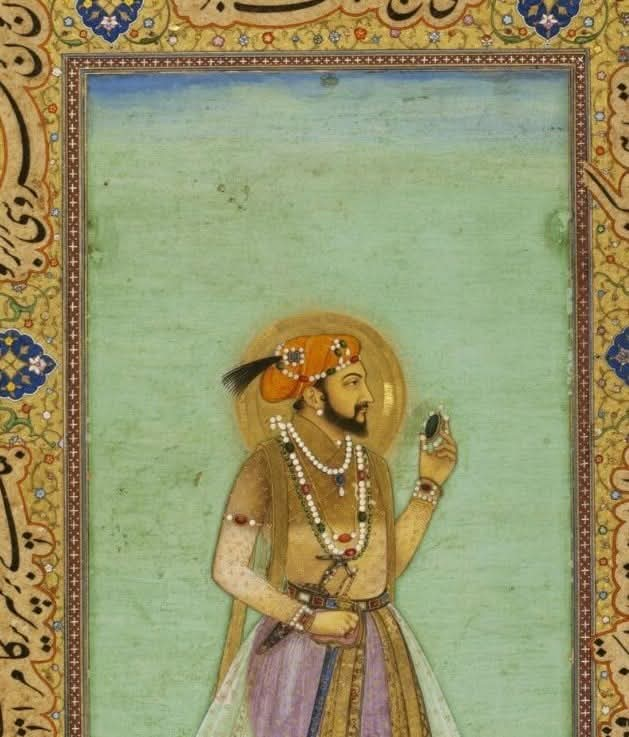
As we have seen, transparent stones in arresting colours exert a considerable influence on the human soul—and on the sums of money attached to them. We have already noted the ability of the Mughal Empire's extravagantly bejewelled rulers to cover themselves in almost ridiculous quantities of pearls, diamonds, sapphires, and rubies. Yet another stone could not only rival them all, but sometimes outshine them entirely.
Like its relatives at either end of the colour spectrum, sapphire and ruby, emerald is a crystalline form of aluminium oxide and ranks among the hardest minerals in nature.* Its seductive green made it coveted for generations, but the few places where it was mined, such as Afghanistan's Panjshir Valley and Wadi Sikait in eastern Egypt, supplied relatively small quantities of modest-quality stones. These circulated among the early elites of the Nile Valley, the Mediterranean basin, and Central Asia.
Fortunately for those royal appetites, the dramatic discovery of the American continent supplied the courts of the Old World, for the first time, with a steady flow of green stones from the mines of New Granada—present-day Colombia. American emeralds surpassed their Old World counterparts in quantity, size, and clarity alike.
Gemstones of every kind had always appealed to the world's aristocracies, but emeralds acquired a particularly deep place in the world of Muslim elites. Their vivid hue connected them to the established significance of green in Islam, evoking paradise, religious salvation, and the worlds beyond. Among other things, the expanding transatlantic trade gave Ottoman, Safavid, and Mughal sovereigns unprecedented access to virtually inexhaustible quantities of first-rate emeralds. This distinctive material allowed Islamic gem-cutters, particularly the Mughals, to cut tablets suitable for carving and decoration, including inscriptions and emblems of religious and political significance—a tradition inherited from their Timurid forebears in Central Asia.
Beyond their use as amulets or material for jewellery, these stones—rubies, sapphires, diamonds, and especially emeralds—played a central role in Hindustan's internal gift economy and, more broadly, in Eurasia's diplomatic system. High-quality stones held such importance for the Ottoman, Safavid, and Mughal courts that few seem to have remained in Europe after arriving from the New World. Instead, merchants from the Low Countries, Iberia, and Italy sent them onward to the courts of Islam, where they were swiftly drawn into royal polishing workshops.
In keeping with the Mughals' sincere devotion to the green stone, Jahangir is said to have kept thousands of loose emeralds in his palace. Shah Jahan himself reportedly owned spectacles with emerald lenses to soothe eyes sore from weeping over his beloved wife Mumtaz Mahal's death. The Mughal court's location in one of Asia's most important economic regions, together with the relative cultural openness of India's Muslim monarchs, meant that Surat's port and the roads leading from it thronged with merchants of every faith. Some had made direct trade with the Peacock Throne their particular speciality, including the trade in precious stones.
Turning back to the far west: in the decades after the expulsion from Spain, Jewish and Iberian converso communities scattered to the ends of the earth—to the New World, northwestern and southern Europe, and the Middle East. Their dispersal enabled the creation of extensive trading networks rooted in those communities. Highly profitable maritime commerce both made possible and, in some cases, encouraged the migration of converso families, among them the renowned Mendes and Pinto families, from Iberia to the port cities of the Low Countries and the Ottoman Empire. It also facilitated the gradual return of conversos to Judaism.
The intricate interplay of religion, commerce, and government that so characterized the Iberian maritime world of the sixteenth and seventeenth centuries left many converso families in their former social positions. Yet it also subjected them to persistent suspicion. They were forced to negotiate continually between preserving their economic power and global trading connections and facing pressure at home from religious authorities and rival factions within the Iberian elites.
Portuguese trade, for its part, relied to a significant extent—at least from the early sixteenth century—on private financiers and operators, many connected to converso families. They wove an unprecedented, worldwide commercial web, stretching from Iberian possessions in the New World through West Africa, Lisbon, Antwerp, and London to Istanbul, Goa, Manila, and Macau.
With their exceptionally high value relative to their volume, emeralds from New Granada were a sought-after commodity in transatlantic trade. A substantial proportion appear to have been shipped to Europe by Jewish or converso merchants, sometimes mixed into bulkier cargoes of tobacco and textiles. From southern European ports, the stones continued directly into Ottoman territory, Safavid Iran, and especially Mughal Hindustan. Gemstones accounted for a respectable share—roughly 14 percent—of the total value of Portuguese trade with India in this period. This also included Indian diamonds shipped back west, through, among other channels, Jewish trading networks in Italy and later London and the Low Countries.
The presence of Iberian conversos in Portugal's Indian colonies allowed them to continue participating in the subcontinent's profitable trade while offering some respite from persecution by the Catholic Inquisition. When the Inquisition reached Goa after the middle of the sixteenth century, one of its purposes was to keep those conversos under close scrutiny and prevent their association with India's ancient Jewish communities, a common practice at the time.
The trading networks of the sixteenth century created, for the first time, a world that was global in the fullest sense. Indian textiles and spices, in turn, drove the transatlantic slave trade and, within it, the emerald-mining industry: round and round the circuit went. Like a butterfly beating its wings over Manila and sending commercial shockwaves across the Caribbean, the bustling maritime age of the early modern period connected China's economy with the New World, Goa's shores with West Africa's markets, and Muslim monarchs' heavy purses with the trading networks of people of Spanish and Portuguese origin uprooted from their faith.
Gleaming, finely worked, and impressive though Mughal emeralds may be, they are only a glittering, arresting sign of that explosive, impassioned phenomenon: early modern maritime trade. Hindustan's ages of greatest splendour were borne largely on the very shockwaves that would, within so few years, bring the Old World to an end amid cannon fire and the quiet rustle of commercial contracts. As their Western-connected involvement in the Mughal emerald trade illustrates, Jews—openly practising and concealed alike—were deeply woven into the new global age. Their communities' linguistic, occupational, and geographical flexibility suited the demands of the time and place, and their vitality contributed to modernity's accelerating advance.
The emerging global order did indeed rest heavily on the weight of ancient royal courts and the attraction of precious metals and gleaming stones. Yet it was propelled forward and upward by sails, damp ropes, and new, dynamic civic elites. The emeralds of Jahangir and his peers are therefore more than ornaments to luxuriate in. They are a crystallized expression of a singular period in human history, when distinctive forces converged with an unusually favourable mixture of historical circumstances and coalesced, to a great extent, into the world we know today—a world that, in much the same way, is still being woven beneath our feet.
Translator's note
*The mineralogical statement above is preserved from the Hebrew original. Emerald is actually a variety of beryl (beryllium aluminium silicate), not aluminium oxide. Ruby and sapphire are varieties of corundum, which is aluminium oxide. This factual error has not been silently corrected in the translation.
Continue the conversation
A question, a correction, a source I should know about? Write to me privately — I read every note.
Send a noteField dispatches
New essays and journey announcements, a few times a year.