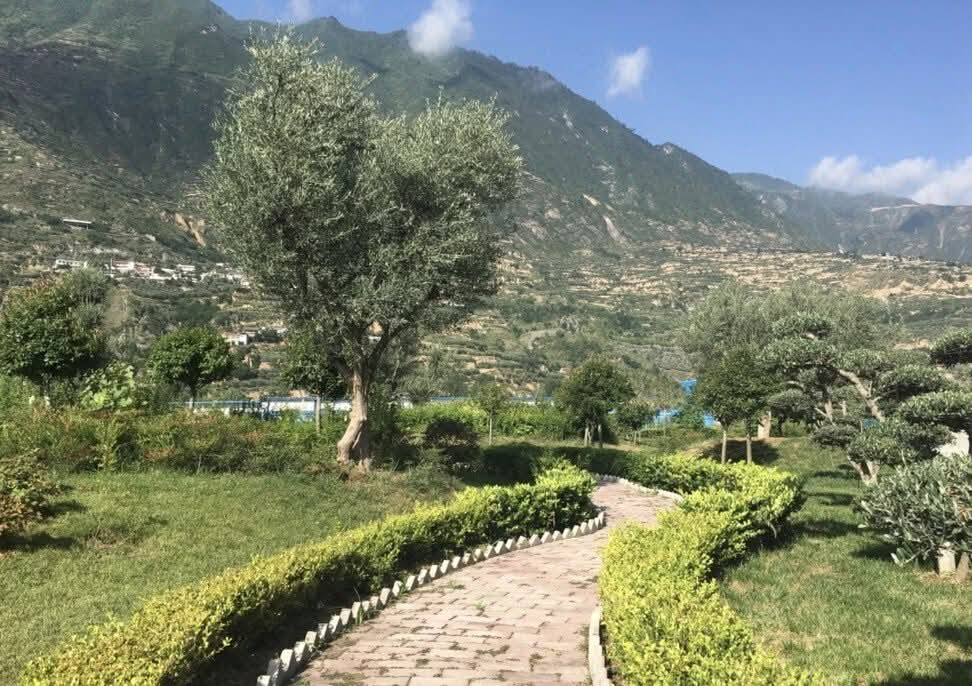
Olives are not a traditional Chinese crop.
The Chinese olive, or ganlan, is something quite different, native to the south. Like the cultivated olive, however, it is generally fit to eat only after soaking, salting, and fermentation—or, alternatively, after a thorough simmer in a brightly coloured, spiced sugar syrup, followed by proper drying.
Arab merchants did call the Fujianese city of Quanzhou (泉州) "Zaytun," the Arabic word for olives. The name's etymology remains uncertain, but a common theory links it to the similar-sounding Chinese citong, one of the names of a subtropical tree associated with the production of tung oil, a familiar sealant widely used in Quanzhou's shipyards during the late imperial period.
So when we decided to take a chance on Chinese olive oil rather than the Greek oil (decent enough) or Spanish oil (usually inferior) commonly found in the realms of Taobao, I recoiled not only at a price substantially higher than that of the imports, but also out of a deeply rooted contempt for olive products that had never known a scorching Mediterranean sun. Eventually, when I discovered that the oil came from the distinguished province of Gansu, I approved the transaction with a nod of feigned Levantine expertise.
China's cultivated olive has a fairly recent history. Surprisingly, it owes its beginnings to the Albanian "Empire" under Enver Hoxha and a gift of ten thousand Balkan olive trees donated to Maoist China during the golden age of Sino-Albanian relations. Chinese and Albanian agronomists oversaw their planting in several provinces, seeking the terroir that best matched the trees' rocky homeland far to the west. The most illustrious of these trees was planted here in Yunnan by none other than China's legendary premier, Zhou Enlai. It seems to be thriving in its new homeland, on the approaches to Tibet and in the face of the summer monsoon rains.
Despite those proletarian origins, modern Chinese olive oil is, above all, a product of China's latter-day capitalism: its ability to harness vigorous market forces and various systems of state support, and the increasing integration of the Chinese consumer market into the global networks that made this industry possible in the first place. It would be hard to claim that olive oil—imported oil, and still more so the local product—has become a staple of every Chinese kitchen. Nevertheless, Chinese consumers' growing familiarity with its qualities, prestige, and flavour has brought a substantial rise in consumption and recognition of the olive industry's economic potential in China.
Funding and the planting of olive groves have increased accordingly. Many are in the western borderlands, in Yunnan, Sichuan, and especially Gansu: regions that have traditionally lagged considerably behind the industrialized east. Significant investment in professional expertise—some of it Israeli, incidentally—the development of local varieties resistant to altitude and cold, beyond the original Balkan, Spanish, and Italian varieties, and heavy investment in marketing, including to Japan, have raised local production by more than 200 percent: from 2,500 tonnes to some 8,000 tonnes last year. These figures represent a tiny share of the market beside the Mediterranean olive-oil giants. Still, they certainly suggest the industry's ambition to establish itself as a recognized agricultural sector with a thoroughly global outlook.
Back in the kitchen, brimming with Mediterranean arrogance, I gave the Chinese oil tin a semi-ceremonial opening. The oil emerged in a gleaming but slow, rather congealed stream. Given the kitchen's low temperature, that might have been a positive sign, although even to my modest understanding such behaviour depends more on the particular composition of the oil's fats than on any intrinsic seal of quality. After a short rest on the windowsill in the fierce Yunnan sun, the now-liquid oil passed my smell and colour tests. Both were exactly what I expected of good olive oil's first encounter with those two senses: a beautiful, fresh greenish-yellow hue and a deep, pungent olive aroma. More a dim oil press in the Beit Netofa Valley than the anaemic imported pressings unfortunately available here most of the time. A little ashamed of my earlier disdain for the splendours of Chinese agriculture, I respectfully paired the oil with sourdough bread and homemade ayran. The next day, with a hint of compulsion, I put it to work with hummus, fresh pitas, and a spicy tomato salad. It met the demands of place and occasion in full.
Beyond cheering a Middle Eastern stomach on a Friday afternoon, Chinese olive oil is perhaps, above all, another sign of modern China's commercial restlessness: its ability to adopt, adapt, and sometimes even improve products and ingredients borrowed from elsewhere, and to do so exceptionally well. Whether Chinese olive oil, like coffee and technological products, becomes a familiar product with a respected mark of quality, or limps along as a relatively marginal sector like the Chinese wine industry, we shall leave, as always, to time and the forces of the global market.
加油!—Keep going!
Continue the conversation
A question, a correction, a source I should know about? Write to me privately — I read every note.
Send a noteField dispatches
New essays and journey announcements, a few times a year.