Essay
By Noam Backner
The Silk Road—or the Paper Road?
From everyday invention to waxed sheets flecked with gold, Chinese paper carried knowledge, authority and beauty far beyond the Silk Road.
Most of you are still too young to remember the ancient writing materials of the Fertile Crescent. Suffice it to say, though, that all that clay, papyrus and animal hide left something to be desired in terms of user experience, retail price and supply-chain management.
Nor do we always give the paper revolution, and its contribution to recording human knowledge, the place of honor it deserves. That is especially true now that, barely a moment ago in historical terms, we exchanged vigorous page-turning for feverish scrolling in search of shorter text better suited to our present cognitive capacities.
There is not enough space here to discuss paper’s importance to world history. Let us simply recall the familiar fact that paper originated in China. The industry developed regional specializations fairly early. Together with intense competition, these produced distinct recipes for paper suited to different uses, some extending well beyond its obvious role as a surface for painting and writing. Paper was, in many respects, a remarkably sophisticated technological product, bringing together knowledge, experimentation and practical experience. In China it served as an early material for covering windows; as a durable yet lightweight skin for packaging, kites, parasols and umbrellas; and even for military purposes, including lacquer-reinforced paper armor and coverings for bows. There were also early uses in personal hygiene and, of course, ritual.
China was also the first to use paper as a means of payment: initially in forms resembling travelers’ checks and bonds, and eventually as a way to address imperial China’s acute shortage of monetary metals. This solution was tried and failed several times, owing in part to inflation and the state’s chronic inability to back its paper obligations.
Paper’s special standing in China—as both a physical medium and a less tangible vehicle of ethical and spiritual cultivation, as well as an expression of the emperor’s absolute authority—encouraged the growth of extensive papermaking industries. These made sophisticated use of different plant materials and chemicals according to the requirements of the moment. At least where calligraphy was concerned, the ideal was a light, flexible sheet that would absorb the skilled writer’s or painter’s strokes of ink with precision. Historically, those two skills were inseparable. Paper also had to withstand time, damp and insects. Such qualities came from the skillful use of plants, including the bark of paper mulberry (Broussonetia papyrifera), sometimes combined with white mulberry, hemp, rice straw, bamboo or wheat, and with various adhesives, resins and minerals such as alum, calcium and lead. These could be incorporated during manufacture or applied afterward as a protective finish.
One of late imperial China’s luxury papers, lajian, or ‘waxed paper’, was celebrated less for any waxy appearance than for its dazzling range of rainbow colors and the flashes of silver and gold scattered across its surface.
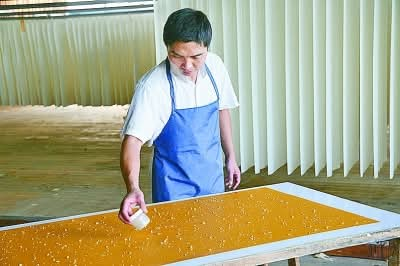
Making lajian was, naturally, a fairly elaborate process. It sometimes involved producing separate sheets, each treated differently. Pulp made from bamboo shavings and bast fibers was colored with natural pigments such as turmeric extract, cochineal and other dyes. Layers of differently colored paper were joined with animal-hide glue, then treated with kaolinite and insect wax—the finest came from Sichuan—to give them a sheen and greater resistance to mold and other climatic damage.
An intricate luxury product made from costly materials, lajian was plainly intended for those who could afford it. It was sheets of this paper, you may recall, that the Timurid embassy of 1419 bought or received as diplomatic gifts, probably during its stay at the ‘Black Barbarians’ Station’ or one of the other sumptuous guesthouses in which the Ming Empire accommodated tributary missions from near and far. Those sheets were later used to make the Timurid Quran: one of the most expensive Quran manuscripts sold in modern times, purchased by an anonymous buyer.
Technological and economic changes eventually brought the Chinese lajian technique to an end. It shared the fate of countless demanding handicrafts tied, in one way or another, to the whims and deep pockets of the Chinese elite. The technique appears to have faded around the middle of the nineteenth century, or somewhat later.
Today, intriguingly, a man named Liu Jing, from an Anhui papermaking family, is working to revive recipes for lajian and other traditional papers, although his process may be simpler than those of the past.
Shabbat shalom.
Continue the conversation
A question, a correction, a source I should know about? Write to me privately — I read every note.
Send a noteField dispatches
New essays and journey announcements, a few times a year.