Travel Journal
By Noam Backner
The Afghan Walk
On walking, breathing, and the distance between presumed tradition and practical exercise.
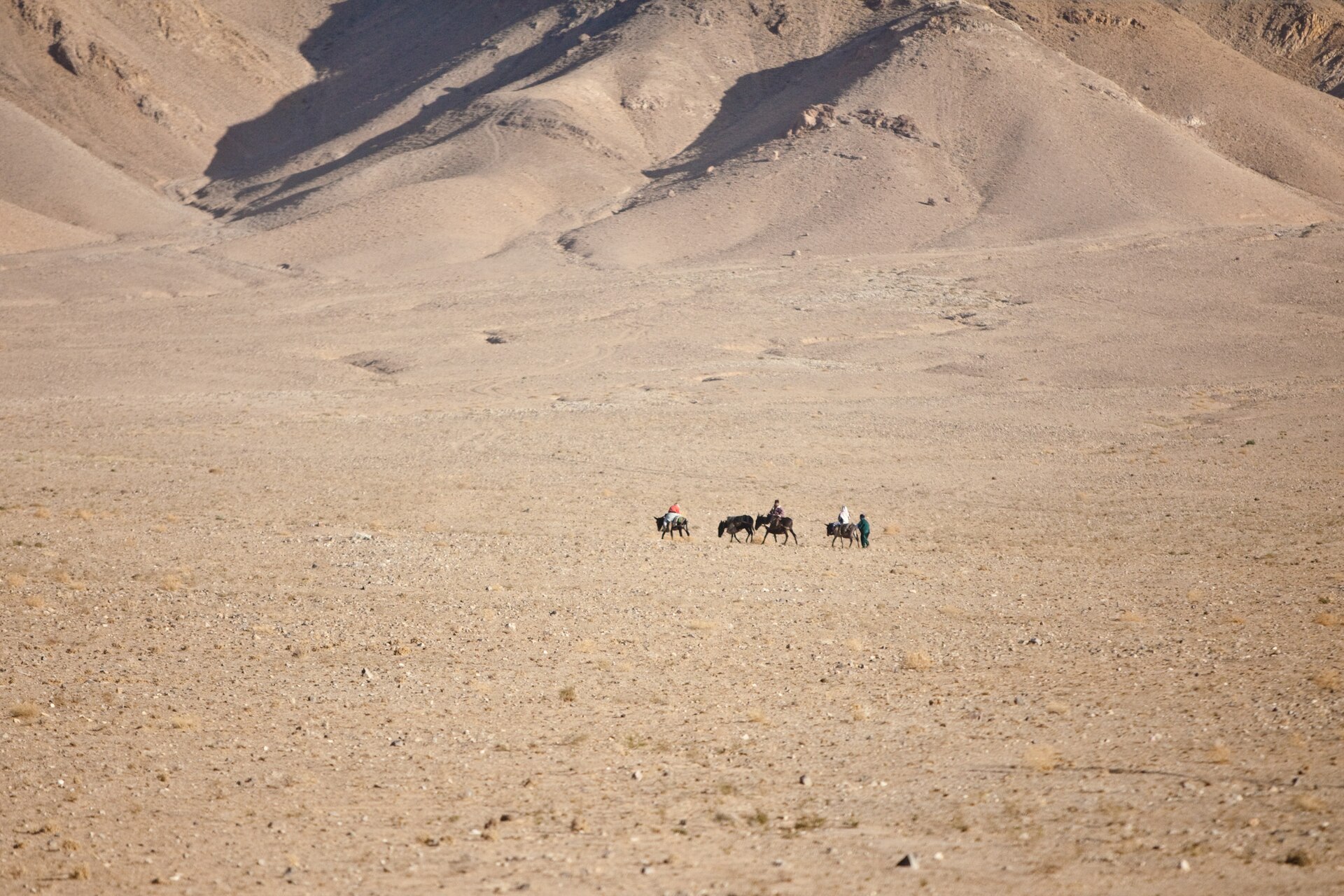
Since we are all currently required to find the stamina for the long haul—given the vastness of space and time demanded of an eternal people who do not fear a long road—I found myself thinking about the "Afghan Walk." This is a technique that at least one Frenchman claimed was based on the traditional gait of Kuchi caravan leaders in the mountains of Pashtunistan.
The Afghan Walk, as you may recall, is a method of meditative walking and breathing that gained fame in the cheerful 1980s thanks to the French traveler Édouard Stiegler. He claimed to have mastered the technique by observing the people of the Afghan highlands as they covered immense distances across harsh terrain, showing almost no signs of exhaustion.
In keeping with its exotic origins, the method is often presented as an ancient technique based on the rhythmic coordination of steps and breath, using a fixed cadence and specific periods of breath-holding. It aims to improve physical endurance and is sometimes linked to meditative habits resembling Sufi dhikr.
The relative popularity of the method—which I only encountered because it appeared in some modern travel chronicle whose name I have forgotten—fits into the broader modern attraction to Asian traditions of physical and mental discipline. The goals for adopting such practices range from raw physical utility to various epistemological achievements and material well-being.
Looking at the reality on the ground, the picture is likely more complex, especially regarding the technique's codified origins. While Afghan highlanders, and mountain people in general, are known for their ability to maintain a steady pace during essential journeys, there is—to my knowledge, at least—no evidence of a structured breathing system identical to what is now called "Afghan Walking."
Nevertheless, certain parallels exist across Asia. Himalayan porters have developed economical, measured movement patterns often accompanied by chants; similarly, manual laborers in Japan, boatmen on the Yangtze, and soldiers have all utilized the universal principle of work songs and rhythmic calls to coordinate breath with physical exertion. This suggests that the coordination of breath and movement is a common human adaptation rather than a uniquely Afghan tradition. The tendency arises quite intuitively; I still remember trying to hum the entirety of *Ziggy Stardust* on climbs in India, or calibrating rhythmic breaths here on the tedious ascent to the only grocery store that sells milk for 9.90 shekels.
Perhaps the closest thing to a combination of rhythmic walking and meditation in a traditional context can be found in East Asia, particularly in the austerities of Japanese Shugendo, where rhythmic vows to the Amitabha Buddha are integrated into ritual walking through the mountains. Other lineages may be related to the "nurturing life" (*yangsheng*) and qi-preservation techniques of Daoist circles. Many of these practices continue to be reinvented today in a wonderful blend of old and new, ancient texts and modern TikTok trends.
Physiologically speaking, these intuitive claims may actually have some basis. Locomotor-Respiratory Coupling (LRC) can help maintain a steady pace, improve breathing efficiency, reduce the perception of effort, and support a more regular oxygen supply to the muscles during prolonged activity.
Ultimately, even if evidence for extraordinary powers—similar to Alexandra David-Néel's reports of "lung-gom-pa" monks in Tibet—is largely lacking, it is worth acknowledging that certain meditative techniques do allow us to reshape the relationship between human physiology, with its clear limitations, and the way a developable cognition responds to them.
In conclusion, it is perhaps best to view Afghan Walking not as a relic of ancient knowledge preserved in its entirety, but as a catchy adaptation of a basic principle: humans move across greater distances with greater comfort when attention and movement settle into a shared rhythm mediated by structured breathing. And if this invites a sense of the unity of all phenomena, then why not, really?
Related writing
Essay
Between Mysticism and Revolution: The Poetry of Khomeini
On Persian verse, mystical insight, and the fine line between spiritual transcendence and political authority.
Field Note
The Ginger Garden
On gardening, rhizomes, and a small botanical obsession in a Dali courtyard.
Essay
Rivers and Lakes
“When the springs dry up, the fish huddle together, gasping to keep one another moist; it would be better if they could forget each other in the rivers and lakes.” (Zhuangzi)