Essay
By Noam Backner
Beyond the Five Pungent Roots
A vegetarian kitchen on practice days: navigating Buddhist tradition through the raw abundance of the market.
"Therefore, creating an obstacle to all forms of practice, it is not proper for a Bodhisattva who seeks to benefit others to eat any meat."
— The Lankavatara Sutra
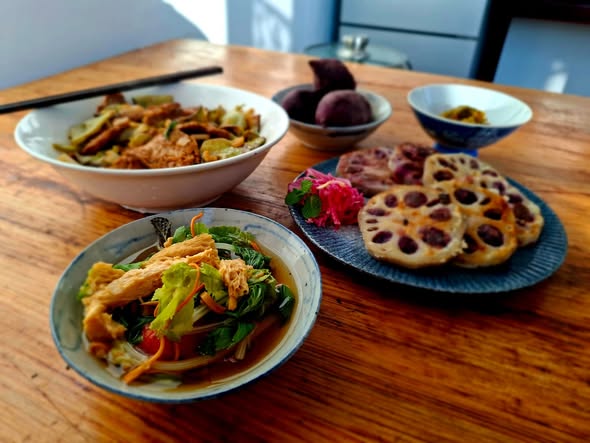
In recent years, we haven't strictly avoided meat, each for our own reasons. Yet on occasional practice days, in keeping with our teachers' tradition, the kitchen is dedicated to a higher purpose, turning out a selection of simple, strictly vegetarian dishes.
As someone with the palate and hands of a peasant, I thoroughly enjoy the challenge. The religious mandate on one hand, and the inexhaustible abundance of greens, legumes, and mushrooms in the Dali markets on the other, allow for a delightful play of color, shape, and texture. The work of the kitchen becomes an extension of practice through 'skillful means,' as well as a golden opportunity to experiment with new techniques and ingredients.
Buddhism maintains a complex relationship with meat-eating. East Asian traditions take the firmest stance against animal products, regardless of their source. This approach stems from a continuous interpretation of early Buddhist logic—a trend that peaked within the Mahayana, following the ripening of the Bodhisattva ideal and the concept of universal interconnectedness that underlies reality.
While the commitment to a vegetarian diet relies on foundational texts like the Lankavatara, Shurangama, and Brahmajala Sutras, it is also shaped by the unique history of Chinese monasteries. It draws from ancient Chinese dietary traditions, including the habits of fasting, simplicity, and meat-avoidance rooted in Taoist and Confucian thought.
Over time, Chinese Buddhist cuisine evolved from a modest response to the nutritional needs of an ascetic community into a sophisticated system that nourishes both body and soul. Today, it offers a dizzying array of dishes based on seasonal and fermented vegetables, alongside tofu and seitan-based foods that satisfy the body’s craving for protein without crossing ethical boundaries. It is said that sixth-century monks could transform a single winter melon (Dong Gua) into a variety of aromatic dishes, while those of the Qing Dynasty created meals that, in the eyes of the Qianlong Emperor, surpassed even the bear paw and dried venison favored by the Manchu royalty.
Despite the upheavals of the 20th century, modern Chinese culture never lost touch with its vegetarian roots, which have flourished again since the 1980s alongside globalization. While economic status, education, and social circles—including the vast network of Buddhist practice groups—drive the popularity of modern vegetarianism, the level of personal commitment to religious law remains a matter of individual timing and devotion.
Back in the kitchen, the cook’s hands are somewhat bound. We must avoid not only the primary flavor-maker of Chinese cooking—meat—but also the 'Five Pungent Roots' (wǔ hūn): onions, garlic, and leeks, as well as cilantro and five-spice powder. Yet these restrictions force one to lean into what is natural and inherent in every ingredient. To prepare a meal worthy of the Buddhas and those who walk their path, procuring the freshest possible produce becomes a matter of paramount importance.
Since the market is already overflowing with roots, aromatic leaves, bamboo shoots, dried seaweed, various tofus, and at least seven types of mushrooms, all that remains is to extract the most from them as time, skill, and imagination allow.
I am by no means a master or a particularly pedantic cook. However, the need to elevate plant-based ingredients in taste and texture demands a certain degree of research and experimentation. Even if the result doesn't always match my hopes, the effort serves the needs of the hour—and, at the very least, it is always done with full intention.
Related writing
Essay
Between Mysticism and Revolution: The Poetry of Khomeini
On Persian verse, mystical insight, and the fine line between spiritual transcendence and political authority.
Field Note
The Ginger Garden
On gardening, rhizomes, and a small botanical obsession in a Dali courtyard.
Essay
Rivers and Lakes
“When the springs dry up, the fish huddle together, gasping to keep one another moist; it would be better if they could forget each other in the rivers and lakes.” (Zhuangzi)