Essay
By Noam Backner
The Eight White Yurts
The mobile tent-shrines of Genghis Khan, their hereditary guardians, and the modern struggle to anchor Mongolian memory.
In these days, when many of us mark the destruction of the Temple and the exile of a people into a life of wandering, it is worth recalling those rare instances where the opposite occurs—the result of reversals of fate and frontier, of tide and sword.
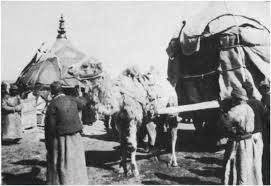
The "Eight White Yurts" is the collective name for a complex of shrines dedicated to the beloved son of the Eternal Blue Sky, the iron-born world-conqueror, Genghis Khan. While the temples of heavenly and earthly ancestors across the world were typically built of wood and marble, fired brick and stone, these modest sanctuaries were made of wooden lattice and felt, in keeping with the tradition of the House of Temujin. Their custody was entrusted to the Darkhad, hereditary holy servants responsible for their safety and ritual function.
The cult of Genghis Khan is ancient, its origins nearly as old as the vast empire he and his descendants forged in the spirited 13th century. We know that mobile tent-shrines dedicated to the radiant forefather of the dynasty once stood on the banks of the Volga, and likely at other administrative centers across the Mongol domains.
The collapse of Mongol rule in China and the retreat of his descendants to their ancestral homeland signaled a century of silence regarding the Genghis cult—though there is no reason to assume it was abandoned—before it reappeared in the historical record in the 16th century. At that time, the sacred Genghisid tents served as the coronation site for the Tümed Khans and occasionally accompanied them on military campaigns.
True to the nature of their worshippers, the Mongolian holy tents were scattered and nomadic, moving across the Mongolian Plateau. However, a special status was accorded to the "Eight White Yurts," centered mostly in the Ordos region and the Loop of the Yellow River in modern northern China. These would gather four times a year for ceremonies of honor and remembrance, featuring offerings of milk and meat and the veneration of holy relics attributed to the father of the Mongol nation—including his arrows and quiver, Siberian sable furs, sacred scriptures, a saddle, and stirrups.
While Mongolian tradition itself places the Great Khan's burial site with certainty in the Khentii Mountains of the northeast, several cult centers associated with the Eight White Yurts eventually became sanctified as his final resting place, absorbing the immense political and ritual potential inherent in such a presence.
This explosive potential did not escape the notice of modern China’s leaders in their various incarnations. Although a substantial portion of original Mongol territory was swallowed by the new Chinese nation, the ability to control, contain, and channel this Genghisid legacy was a clear ambition for every party struggling for control over the northern frontier. Mongol nationalists, Japanese intelligence officers, and Chinese Kuomintang members all sought to drain and direct the energy stored in the shrines for their own ends.
A central part of this attempt to control the memory of Genghis Khan involved driving a permanent wedge between the cult and the nomadic communities entrusted with it. The first permanent shrine, made of plastered earth, was built by the Republic of China in 1916, provoking horror and contempt from the Darkhad, who went so far as to raze it to the ground a decade later. The Chinese Republican Party’s fear that the Japanese might seize the tent-shrines led to their forced migration to western Gansu, and later, as the Civil War intensified, to Qinghai on the heights of the Tibetan Plateau.
The victory of the Chinese Communists led not only to the final hardening of the northern border but also to repeated attempts to domesticate the Mongol spirit, transforming seasonal gatherings from religious events into displays of sport and folklore. In the early days of Communist rule, Beijing would have been happy to see the sacred objects and their felt dwellings destroyed along with the "Old World" they represented. However, local cadres in the Ordos region argued that a shrewd use of the shrines would actually help recruit the people of the steppe to the Party’s banner and the immediate needs of the People’s Republic.
The issue of the wild, wandering shrines was finally resolved during the madness of the Cultural Revolution, when the last of them went up in the torches of the Red Guards. This ended a mobile ritual tradition of some seven hundred years. A properly managed permanent mausoleum, built in the early days of the People’s Republic, became the concentrated expression—and effectively the only permitted material manifestation—of the memory of Genghis Khan, his household, and the fierce Mongolian spirit of the 13th century.
Thus, in a kind of inverted process, the driving of a permanent stake into the ground and the building of thick walls to imprison the Genghisid spirit—which once hovered over steppe, city, and the abyss between them—became a triumphant symbol of the decline of a way of life. It serves as a reminder that, occasionally, the destruction of a home is achieved precisely by its construction.
Related writing
Essay
Between Mysticism and Revolution: The Poetry of Khomeini
On Persian verse, mystical insight, and the fine line between spiritual transcendence and political authority.
Field Note
The Ginger Garden
On gardening, rhizomes, and a small botanical obsession in a Dali courtyard.
Essay
Rivers and Lakes
“When the springs dry up, the fish huddle together, gasping to keep one another moist; it would be better if they could forget each other in the rivers and lakes.” (Zhuangzi)