Essay
By Noam Backner
From a Bowl of Porridge to a Plate of Spaghetti
Roads, bridges, and the financing of infrastructure in Imperial China and contemporary Yunnan.
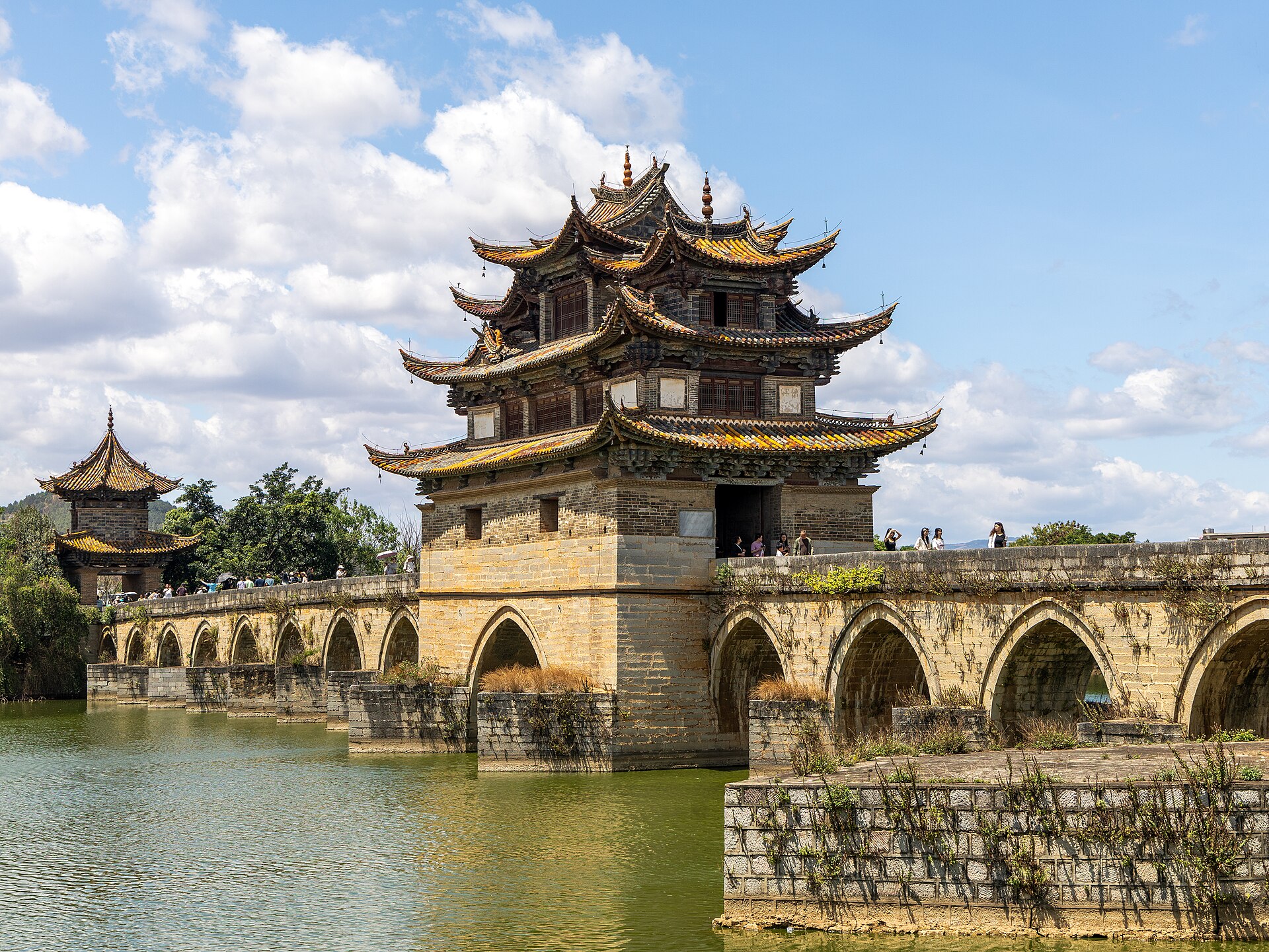
On the way to the mountain, it is hard not to be impressed by the ever-improving road network. We live in fortunate times, no doubt, when benevolent asphalt neither flinches under the scorching sun nor yields when the long-awaited rains finally arrive.
The roads of Yunnan—choking with dust in the sun and drowning during the monsoon—were once notorious to every merchant, pilgrim, and bureaucrat. They serve as a reminder that the pre-modern state resembled a plate of spaghetti far more than a bowl of porridge.
Across the land, roads, bridges, mountain passes, and caravan routes functioned as the arteries of an amorphous entity, one held together by a delicate balance of power between distant centers. Centralized authority reached only as far as these dusty paths and the administrative junctions that connected them.
In practical terms, across the breadth of a continent, roads and bridges were vital for moving armies, collecting taxes, transmitting intelligence, and consolidating rule. Yet the dynasties themselves often lacked the resources to build and maintain this infrastructure alone, especially during periods of political decline or overextended territorial reach.
In late Imperial China, despite the popular image of an all-powerful centralized state, a vast network of roads and bridges was actually constructed and maintained by local communities, merchants, wealthy families, monasteries, and private donors.
The state apparatus, in the modern sense, was remarkably thin, particularly in the remote borderlands. While the dynastic center provided a veneer of legitimacy at the provincial level—along with oversight and the occasional injection of funds—the bulk of the labor and financing rested on civil society. Infrastructure was, in effect, a joint venture between the state and the local community.
These patterns were not unique to the Chinese world. In Islamic lands, bridges, roads, khans, and fountains were often funded through waqf endowments or the initiative of local governors using regional taxes, rather than the ruler’s treasury in a distant capital. In Safavid Iran, for example, stretches of desert and mountain were linked by complex networks that relied on cooperation between the government, merchants, tribes, and local towns.
In Inner Asia, many frontier roads were controlled by local tribes—Pashtuns, Turkmens, and others. While the state might demand a tax on trade, the right to use the road depended on a web of local agreements, armed escorts that were effectively protection rackets, and relationships spanning generations. In practice, sovereignty was a multi-layered affair, far more complex than any map suggests.
As vital lifelines, these infrastructures also possessed a moral and religious dimension. In China, Tibet, and the Himalayan fringes, mountain passes and river canyons were perceived as sites of intense spiritual potential. Traversing them required rituals of appeasement and an internalization of the landscape as a reflection of the Absolute.
The famous bridge-builder Thangtong Gyalpo was renowned for the iron-chain suspension bridges he erected, transforming remote spaces fraught with physical and metaphysical danger into paths for human welfare. Following this tradition, Buddhist monasteries and Taoist temples across East Asia played a central role in maintaining roads and rest houses, viewing the work as an act of charity and a way to accumulate spiritual merit.
The biography of the great patriarch Xu Yun recounts that during his wanderings in Yunnan, he encountered a hermit monk who had spent years repairing a section of road in Baoshan, almost entirely alone. Xu Yun joined him for several days of grueling labor, met only by the hermit’s total silence. After a brief, curt rest, Xu Yun continued on his way, leaving the "saint of the roads" to finish repairing the infrastructure of his own life.
Today’s state, perhaps under the auspices of 5G, looks more like a bowl of porridge, where the ability to transcend the dusty path depends entirely on the hand of the sovereign. The heavens remain high, but the Emperor is now very near. Perhaps, from this mountaintop, one can see the entire fabric and feel a certain longing for those forgotten dusty roads—even while finding no reason not to praise the smooth power of the black asphalt.
Related writing
Field Note
The Ginger Garden
On gardening, rhizomes, and a small botanical obsession in a Dali courtyard.
Essay
Rivers and Lakes
“When the springs dry up, the fish huddle together, gasping to keep one another moist; it would be better if they could forget each other in the rivers and lakes.” (Zhuangzi)
Essay
The Humid South: Miasma, Body, and Space in Southern China
On the perception of the Chinese South as an ecological and metaphysical frontier—and how a landscape of danger became the empire’s economic and intellectual engine.