Essay
By Noam Backner
How Food Crosses Borders
From the imagined Burma of Mandalay Sauce to the absorption of foreign crops into the grammar of Chinese cuisine.
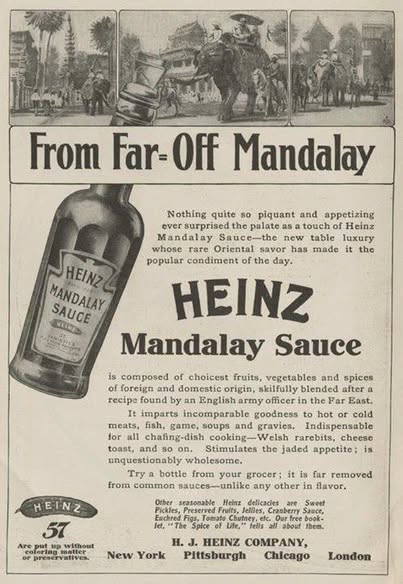
Foodstuffs rarely cross borders exactly as they are. Instead, they travel as narratives, images, or the promise of something internal.
In the early 20th century, for example, Heinz marketed “Mandalay Sauce”—named for the ancient Burmese capital—using exoticized imagery of a distant land. This occurred even as colonial writers were dismissing fermented Burmese fish pastes like ngapi as a “stench” or mere “filth.” The consumers of that era weren't looking for an authentic Burmese palate; they wanted something familiar—specifically, the taste of Empire.
The foreign is only accepted once it has been translated into existing cultural expectations. We don't adopt foods because they are foreign, but because they have been made intelligible and acceptable within a local system of taste.
Chinese history offers clear evidence of this process. During the Han Dynasty, grapes, walnuts, sesame, and cumin migrated to China. While they retained a sensory memory of the “foreign,” they were absorbed into Chinese traditions—often starting as medicines (rare or even dangerous substances to be used sparingly) before eventually becoming food.
During the Tang Dynasty, the capital of Chang'an was one of the most connected cities on earth. Central Asian grape wines, foreign breads, dairy products, and dishes brought by merchants from Iran, the steppe, and India were all sold there. The foods that survived the whims of fate and dynastic shifts were those that could be integrated into Chinese concepts of balance, texture, and refinement—a gradual culinary digestion that incorporated the strange into the local ecology.
The Manchu period provides an even more striking example: chili peppers, corn, potatoes, and sweet potatoes all arrived from the New World, yet today it is difficult to imagine Chinese cuisine without them. Most diners now don't experience Sichuanese heat as a foreign flavor, even though it stems from a crop that only arrived in the early modern period and took firm root as recently as the 20th century.
Successful culinary migrations do not—and cannot—simply replace one culture with another. Instead, they are assimilated into the “grammar” of the local kitchen until their origins are almost entirely forgotten, lingering only in the abstract layers of historical memory.
Modernity has, of course, changed the game. Tourism, globalization, and social networks have created a market where “authenticity” itself is the product—a path to social prestige and monetization. Diners now seek out “authentic” Burmese cuisine, rustic Ethiopian coffee, or obscure Mexican pastes precisely because they promise an encounter with another place, in a world that is slowly being ground down into a pale, uniform sauce.
In this sense, the modern consumer is quite different from the British enthusiast of Mandalay Sauce in 1907. And yet, the same ancient mechanism remains at work: foreign dishes that successfully migrate usually strike a balance between innovation and the familiar.
Whether it is sushi outside Japan, the journey of curry from Anglo-Indian kitchens to the high streets of modern Britain, or American-Cantonese cuisine, all have undergone local adaptations. Modernity has expanded our curiosity about the Other, but it hasn't abolished the basic human need for the familiar. Migrating foods succeed when they allow us to taste the world without losing our sense of home—especially at the sensitive hour of breakfast.
The Briton of 1907 sampled an imagined Burma and went no further, while the sophisticated cosmopolitan of the 21st century seeks the “real” thing. In both cases, food serves less as an open window into another culture and more as a mirror reflecting the imagination, aspirations, and identity of the society consuming it, even when the glass is tinted in entirely different hues.
Related writing
Essay
Between Mysticism and Revolution: The Poetry of Khomeini
On Persian verse, mystical insight, and the fine line between spiritual transcendence and political authority.
Field Note
The Ginger Garden
On gardening, rhizomes, and a small botanical obsession in a Dali courtyard.
Essay
Rivers and Lakes
“When the springs dry up, the fish huddle together, gasping to keep one another moist; it would be better if they could forget each other in the rivers and lakes.” (Zhuangzi)