Essay
By Noam Backner
A Tangut Blessing for the Road
The Cloud Platform, a vanished script, and the Dharma that echoed long after the fall of the Western Xia.
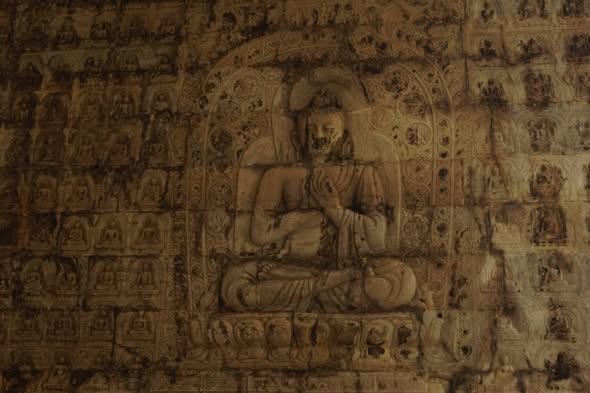
Before setting out once more for the Far West, it is only fitting to receive a blessing for the road.
Among the few surviving monuments of the Mongol era, the Cloud Platform embodies the essence of a world empire—a canopy of karmic protection stretched over the Great Khan’s skies and all who dwell beneath them.
For seven hundred years, this structure has stood at the heart of the mountain pass between Dadu and Shangdu. It served as a primary Rosetta Stone for a vanished civilization and one of the most mysterious, complex writing systems ever devised in the region.
It is perhaps no surprise that few today know the Tanguts—a martial mountain people who carved out a place for themselves in the narrow corridor between peak and desert. They maintained a delicate military and commercial balance against both the Song Dynasty and the tribes of the eastern steppe, until their state was utterly annihilated by the Mongols. The destruction was likely fueled by the fact that Genghis Khan died during the siege of their capital.
Regardless of their end, the Tanguts built a fascinating state where military might was matched by bureaucratic sophistication. While their economy relied on trade, agriculture, and pastoralism, the kingdom’s backbone was the great monasteries that flourished within its borders.
The Western Xia, as the Tangut kingdom was known, was the era’s preeminent model for a state governed by the power of Dharma. Their scholars plunged into the translation and composition of Buddhist texts using that same intricate—and now extinct—script, designed specifically to rival the prestige of the Chinese writing system.
Though the Mongol conquest in the early 13th century uprooted the Tanguts' political and cultural heart, the people themselves endured, serving in the Mongol military and administration. The final flickers of their distinct existence only faded some two hundred years later, during the Ming Dynasty.
The Tangut state may have turned to dust—the province named after them still bears characters meaning "pacification through warfare"—but their legacy proved resilient.
Despite the Mongols' initial scorched-earth resentment, Tangut Buddhist prestige was harder to erase. The refuge they offered to Tibetan religious exiles and their mastery of political Tantra provided the mold for the relationship between teacher and student, priest and Khan, Lama and Emperor, from that time almost until the present day.
It is no wonder, then, that the most vital passage between the two Mongol capitals was adorned with this arch of esoteric purification. It bears six languages, and one silent one. Fixed at the center, even a century after their fall, is the Tangut language in its labyrinthine script, eternally echoing the hidden Dharma that stands above the heads of Khan and Emperor, merchant and peasant. In all worlds, from then until now.
"Praise to the Blessed One, to all the Buddhas in all worlds.
Om! Purify, purify, always purify!
O, you who are pure as empty space, conqueror of all obstacles.
May the waters of Nirvana be victorious.
May the suffering of all sentient beings—in all the lower realms—be wiped away.
Grant us long life, wisdom, and peace.
Svaha!"
Related writing
Field Note
The Ginger Garden
On gardening, rhizomes, and a small botanical obsession in a Dali courtyard.
Essay
Rivers and Lakes
“When the springs dry up, the fish huddle together, gasping to keep one another moist; it would be better if they could forget each other in the rivers and lakes.” (Zhuangzi)
Essay
The Humid South: Miasma, Body, and Space in Southern China
On the perception of the Chinese South as an ecological and metaphysical frontier—and how a landscape of danger became the empire’s economic and intellectual engine.