Essay
By Noam Backner
The Bone Shaker
The mule carts that connected Beijing, North China, and the trade networks of the late Empire.
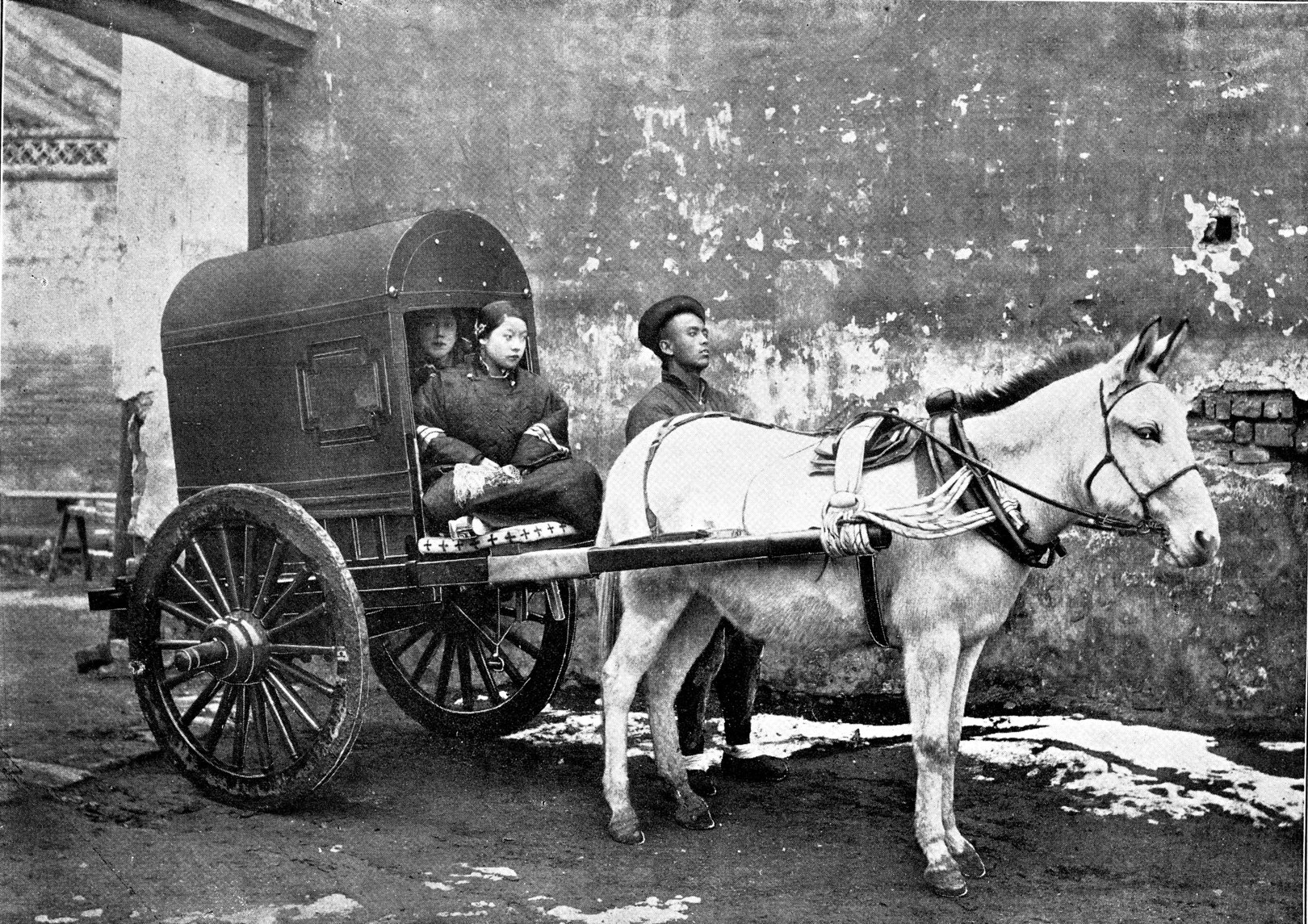
Foreign travelers in turn-of-the-century Beijing described the northern mule cart as one of the world's most grueling modes of transport. Missionaries, diplomats, and assorted adventurers were tossed about on the rutted, dusty roads of North China, immortalizing the local carriage as the "bone shaker" and the "Chinese torture cart."
"Inside you find only a mattress... and so, like a tailor or a turbaned Turk, you kneel cross-legged. But the torture continues until you grow accustomed to it and harden into indifference. The roads are wretched, nothing but a sequence of ruts and deep puddles, while the cart has no springs at all (which would, in any case, break within ten minutes)."
(Charles W. Wason)
Built as a sturdy box almost entirely devoid of shock absorption, the Chinese carriage was the product of an ancient, rather conservative technological evolution. It reached the peak of its ubiquity during the Qing dynasty, serving a wide range of social classes.
Despite its reputation, the North Chinese mule cart was perfectly suited to its environment. With massive axles and giant wooden wheels reinforced with iron, pulled by a pair of mules or fewer, this workhorse of the late imperial era was built for durability in an arid region where waterways were rare, roads were broken, and distances were vast. Under these harsh conditions, the cart became the vital link between villages, remote market towns, provincial cities, and the northern capital itself.
The engine of this system was the mule, among the most important work animals in China. A cross between a male donkey and a mare, the mule combined the endurance and hardiness of the donkey with the size and strength of the horse. Although mules were known as far back as the Chinese Bronze Age, they remained somewhat prestigious until the Song period, with their prevalence increasing steadily throughout the late imperial era.
By the 19th century, Western Shanxi was renowned for its fine mules. Experts judged these noble beasts by the length of their necks, the width of their chests, their height, coat color, and temperament. A superior mule did more than just pull the yoke; it walked with a steady, smooth gait—a trait that required rigorous training in the best local tradition.
The carriage itself, clumsy as it appeared, was a fairly complex piece of engineering, certainly relative to its drab reputation. Its production relied on a broad network of carpenters, wheelwrights, saddlers, blacksmiths, and rope makers.
The variety of models dotting the dusty roads of the North China Plain included official government carriages, commercial wagons, passenger carts, and even the more splendid versions used by nobles and Manchu elite women. Equipment changed with the seasons: nets and awnings for the scorching summer were replaced by thick sheets and wool covers for the bitter winter.
Furthermore, the craftsmen of Beijing knew how to assemble the carts so they produced a clean, rhythmic sound while in motion. Residents of the northern capital could identify a well-made cart by its unique acoustic signature, which was said to resemble the loud, resonant drums of the Beijing Opera.
As the most common vehicle in the region, an entire social and economic world developed around these carts. Drivers were professionals of significant prestige; navigating crowded thoroughfares like Dashilan and Qianmen required exceptional steering skills, tactical evasion of pedestrians, and the ability to maneuver through rival carts and other spatial disruptions.
In a secondary circle around the carters' community, a network of inns, mule markets, craft workshops, fodder suppliers, and transport brokers operated across the north. This created a dense commercial web throughout North China, with the mule cart filling a role largely parallel to that of the canal boats in the Yangtze Valley.
Despite Western contempt, the strength of the mule cart lay in its ability to move essential loads through mud and dust, over frozen ground and generally abysmal terrain. It offered low maintenance costs and an extraordinary durability that sometimes—reportedly—lasted a lifetime.
Behind the image of the bone shaker lay an entire, now-extinct world of mule breeders, expert craftsmen, bold drivers, regional trade networks, and the unique soundscape of old Beijing's streets. All of these are now but a faded memory in the dust.
Related writing
Essay
Between Mysticism and Revolution: The Poetry of Khomeini
On Persian verse, mystical insight, and the fine line between spiritual transcendence and political authority.
Field Note
The Ginger Garden
On gardening, rhizomes, and a small botanical obsession in a Dali courtyard.
Essay
Rivers and Lakes
“When the springs dry up, the fish huddle together, gasping to keep one another moist; it would be better if they could forget each other in the rivers and lakes.” (Zhuangzi)