Essay
By Noam Backner
Ti-Yong and the Iranian Crisis
Viewing the structural collapse of the Islamic Republic through the lens of Chinese political philosophy.
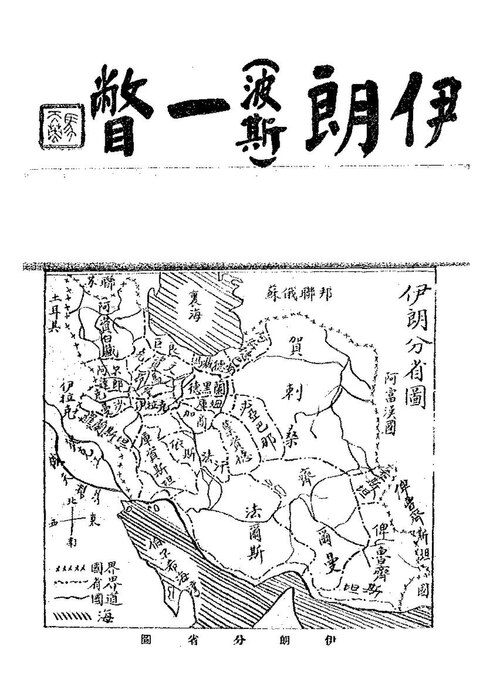
"Dressed in white they gather by night to listen to an abominable doctrine... [they abstain from wine and meat...]. At dawn they flee in all directions. If you take part in such activity, your end is imprisonment, and your children will be left in want."
— Chronicle from the Southern Song Dynasty
How might the current situation in Iran look when viewed through a Chinese lens?
Setting aside the risk of constructing essentialist strawmen of these two cultures, the failure of the Shiite state serves as a compelling test case for political superstructures, their cosmological foundations, and, by extension, the stability of governance.
Compared to China, Iran is an entity defined by even more punishing geography and sociology, with a far more limited capacity for agricultural and industrial production. Its vast oil reserves function largely as a modern cash crop of dubious blessing.
Yet, if we indulge these cultural archetypes for a moment, we might describe a Chinese view—at least a theoretical one—of the drama unfolding in Iran.
Ti-Yong (体用) is a cornerstone of Chinese thought. Though ancient in origin, it was refined within Chinese Buddhism to represent the relationship between "substance" and "application." This seemingly dualistic pair describes the ideal or underlying principle of any system (Ti) alongside the practical means available for its existence (Yong).
In China, for instance, rapid technological development or the concept of progress might be viewed as "Yong"—an application aimed at achieving the ideal goals inherent to the Chinese worldview, the "Ti." In the modern West, by contrast, progress often appears as the "Ti" itself. This stems from an essentialization of the process of progress, which is treated—perhaps as a religious impulse in secular clothing—as the natural, inevitable course of history.
This template also helps explain the current crisis of governance in the West, where liberal culture has become enslaved to an imagined progress as its "Ti" rather than its "Yong." Stripped of its ability to preserve its foundational qualities, the system tends to buckle under the weight of an ideological overreach that no human organization can likely sustain.
As for Iran, the actual China will surely keep a wary eye on its civilizational "sister." Meanwhile, Iran’s status as a secondary energy supplier, a second- or third-tier player in the Eurasian spatial conception, and a strategic partner of necessity may rapidly erode as circumstances shift.
The "Celestial China," however, might wag a cautionary finger, suggesting that the Islamic Republic has exhausted its limited resources building a mosque of dreams. The export of revolutionary values to a string of proxies across the Middle East was a "Yong" that devoured the state's ability to maintain its "Ti"—rendering it incapable of providing just rule, a functioning economy, basic services, or even stable water management. The latter is a classic sign that the Mandate of Heaven is departing, giving way to "Luan," or public chaos.
Here, as is our habit, we attempt to step back from the concrete toward more ideal realms. Yet the failure of the Shiite state—and, by comparison, that of the Russian Khanate—when weighed against the considerable success of the Middle Kingdom, for all its structural flaws, raises questions that narrow the gap between metaphysics and public policy.
The potential Iranian collapse of 2026 is evidence of a deep structural failure where ruling ideology became the essence and the art of statecraft was abandoned. While the leadership may remain captive to a narrative of divine justice, in reality, revolutionary zeal has become an empty recruitment tool, no longer capable of maintaining the classical Persian "Circle of Justice" or the legitimacy of the modern state.
From an ideal Chinese perspective, the Iranian state sacrificed the essence of governance for a destructive ideological "Yong" of distant proxy battalions and hollow militarism, thereby losing its measure of grace and its mandate to rule. The result is a transition from an aspiration for proper administration—always the Achilles' heel of the Persian state—to total chaos. It is a situation where the regime's unrealistic meta-history leads, inevitably, to the disintegration of the state's physical infrastructure.
If the next Iranian state to emerge puts everything in its proper place—institutionalizing even a modicum of wisdom, balance, and "Derech Eretz" as a prerequisite for doctrine—many blessings will surely return to the land, and a rule of justice shall govern the earth. Surely.
Related writing
Essay
Between Mysticism and Revolution: The Poetry of Khomeini
On Persian verse, mystical insight, and the fine line between spiritual transcendence and political authority.
Field Note
The Ginger Garden
On gardening, rhizomes, and a small botanical obsession in a Dali courtyard.
Essay
Rivers and Lakes
“When the springs dry up, the fish huddle together, gasping to keep one another moist; it would be better if they could forget each other in the rivers and lakes.” (Zhuangzi)