Essay
By Noam Backner
Matsutake: From the Forest Floor to the Global Market
The wild mushrooms of Yunnan sit at the center of a vast network connecting foragers, traders, and high-end restaurants across East Asia.
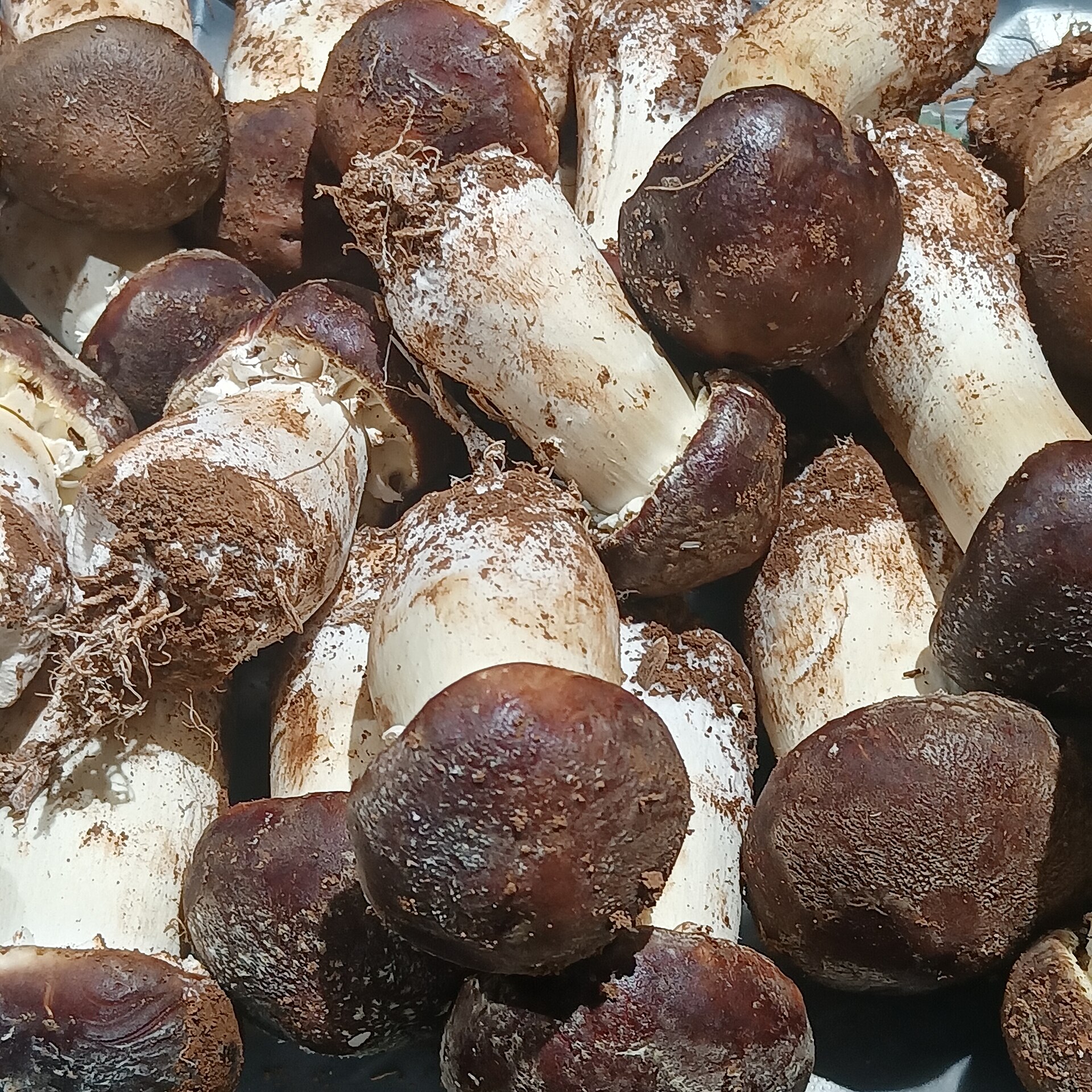
Yunnan’s mushroom harvest appears bountiful this year. Local markets are practically bursting with the diverse species yielded by the forest’s whims, yet few products better illustrate the collision of ecology and global commerce than the Matsutake (known in China as Song Rong).
Even in our era of advanced fungiculture, every Matsutake sold worldwide is still gathered in the wild. Because the fungus relies on a symbiotic relationship with living tree roots—primarily conifers—it cannot be grown on the dead organic substrates used for button mushrooms, shiitake, or the other varieties that dominate Yunnan’s modern industry.
For decades, researchers in Japan, China, and beyond have tried to domesticate the mycelium for commercial use. Even when inoculation techniques showed promise—including experiments that saturated the growth medium with olive oil to encourage mycorrhizal bonds—the actual yield of mushrooms remained unpredictable and economically unviable. As a result, the global supply remains tethered to the forest floor.
The Matsutake has held a place of prestige in Japanese records since the eighth century. In China, however, the mushroom is curiously absent from classical sources; clear descriptions of foraging in Yunnan, Sichuan, and the southwest only began to emerge in more recent centuries.
For a long time, the Song Rong was merely a local delicacy. But the late 20th century brought a dramatic shift: a decline in Japanese yields, surging global demand, and the opening of the Chinese economy transformed Northwest Yunnan into a primary global trade hub. Today, China is both the leading exporter and one of the largest consumer markets for fresh Matsutake.
The mushroom’s journey illustrates how a wild product becomes woven into the modern economy. The process integrates local foragers, regional middlemen, and sorting stations owned by national corporations into a capital-intensive supply chain. Through a series of coordinated cargo flights, a mushroom harvested in the Yunnanese highlands can be served in a prestigious restaurant in Shanghai, Beijing, or Tokyo in under 24 hours.
This meteoric expansion, fueled by national supply chains and a booming domestic tourism industry, has placed immense pressure on Yunnan’s ecological infrastructure. Economic competition over natural resources and the encroachment into wild areas have forced the government to intervene, placing new restrictions on foraging in sensitive zones.
There is a certain irony in the fact that the Matsutake’s underground networks actually seem to thrive in disturbed habitats, showing a stubborn disregard for human regulation. This hidden world continues to be the first to respond to changing conditions, finding its own sense of order within the chaos.
Related writing
Essay
Between Mysticism and Revolution: The Poetry of Khomeini
On Persian verse, mystical insight, and the fine line between spiritual transcendence and political authority.
Field Note
The Ginger Garden
On gardening, rhizomes, and a small botanical obsession in a Dali courtyard.
Essay
Rivers and Lakes
“When the springs dry up, the fish huddle together, gasping to keep one another moist; it would be better if they could forget each other in the rivers and lakes.” (Zhuangzi)