Essay
By Noam Backner
Between Mysticism and Revolution: The Poetry of Khomeini
On Persian verse, mystical insight, and the fine line between spiritual transcendence and political authority.
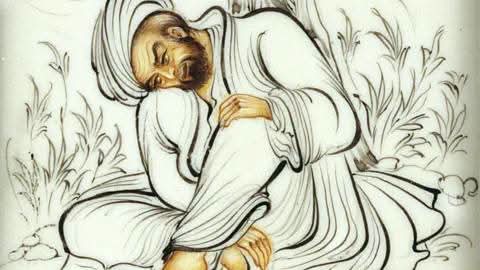
It is well known that the loftiest threshold to the Iranian soul is poetry. It is equally understood that this poetry, if only by historical circumstance, is saturated with recurring, coded imagery—as self-evident to its readers as it is cryptic to the outsider.
These motifs—the garden and the rose, the nightingale’s longing, the moth and the flame, the wine cup and the tavern—have become a kind of cultural mezuzah. What saves them from the wear of cliché is the poet's ability to recharge them at the living seam between emotion and mysticism, aesthetics and philosophy, the hidden and the manifest.
A few lines are often enough to stir anyone dwelling in these margins to dive into the sea of meaning stretching between the familiar and the occult.
By the breath of your lips, O beloved, I was caught; into your drunken eyes I gazed, and became drunk myself.
I left myself behind, beating the drum of "I am the Truth"; I became like Mansur al-Hallaj, attaining the station of the gallows.
And also:
Open the doors of the tavern, and there I shall enter day and night; for I have grown weary of the mosque and the madrasa.
While these generic lines hardly mark a new peak in the magnificent chain of Persian poetry, some may be surprised to learn they were written by none other than Ayatollah Khomeini.
The publication of these verses, particularly after the death of the Islamic Republic’s founder, startled supporters and detractors alike. Yet it is precisely the fluid nature of Persian lyricism that allowed the senior mujtahid to stain his nib with the ink of boundaries—even if only within a private framework.
Despite the inherent tension between Shiite Iran and Sufi institutions—an opposition rooted in both politics and ideology—Persian poetry remained deeply saturated with themes of intimacy with the Absolute, the limits of intellect, and the experience of union.
These layers were shaped by sources like Ibn Arabi, Suhrawardi, and Avicenna, which largely predated the Iranian-Shiite synthesis. They were further refined by Mulla Sadra, the preeminent architect of Shiite cosmology, whose influence still colors the Twelver religious landscape.
Mulla Sadra’s ability to integrate earlier mystical expressions, charging them with vivid images of continuous revelation and the dynamic uncovering of Absolute reality, fit the needs of a Shiite leadership claiming a direct connection to the innermost layers of meaning—and the political legitimacy that follows.
Khomeini’s mystical poetry thus raises several questions about the man. One could view it as the hobby of an intellectual, an expression of inner turmoil, or a purely aesthetic inclination; nonetheless, the potential contradiction between these verses and the violent revolutionism of his Islamic Republic remains palpable.
I do not pretend to offer an exhaustive analysis of Khomeini’s poetry or his political thought. But it is possible that these poems represent more than a consoling hobby: perhaps they sit at the heart of a process leading from mystical knowledge to a political order perceived as necessary, however bloody it may be.
In this sense, Khomeini’s intimate poetry may be an inner core, formulated in the imagery of Persian sages and embedded within concentric circles: from the metaphysics of Mulla Sadra, through the intricacies of Shiite jurisprudence, to the anti-imperialist demands of the twentieth century.
Thus, the recurring motifs of dissolution, intoxication, and renunciation are not merely personal expressions, but descriptions of a necessary shift in spiritual status—a prerequisite for participating in reality itself, in all its layers, including the political.
Whether these dimensions complement each other or exist in unresolved tension is a complex question. Neither Ibn Arabi nor Mulla Sadra developed a theory of the revolutionary state or tools for justifying political violence by theological technocrats; those are products of political modernity. However, they can be refashioned within a modern ideology using classical Islamic concepts—in Khomeini’s case, through a direct link to the laws of internal alchemy, or "Irfan."
Ultimately, Khomeini’s poetry asks whether there is a continuum between mysticism and revolution—a theme dating back to the 16th-century origins of the Shiite state. Is there ideological continuity between the hidden dimension of the Path and the external dimension of law and society? And if so, what tension exists between inner revelation and the bloody fist of the state?
The importance of Khomeini’s poetry lies not in its literary value, which is marginal, but in how it opens a window into an attempt to unite Persian poetics, metaphysics, jurisprudence, and revolutionary politics. It offers a glimpse at the perilous relationship between spirituality and authority, and that thin red line between transcendence and violence.
Related writing
Field Note
The Ginger Garden
On gardening, rhizomes, and a small botanical obsession in a Dali courtyard.
Essay
Rivers and Lakes
“When the springs dry up, the fish huddle together, gasping to keep one another moist; it would be better if they could forget each other in the rivers and lakes.” (Zhuangzi)
Essay
The Humid South: Miasma, Body, and Space in Southern China
On the perception of the Chinese South as an ecological and metaphysical frontier—and how a landscape of danger became the empire’s economic and intellectual engine.