Essay
By Noam Backner
Iranian Jews and the Baha'i Option
On the historical encounter between Iranian Jews and the Baha'i movement, and the possibilities for identity, equality, and modernity in the late Qajar period.
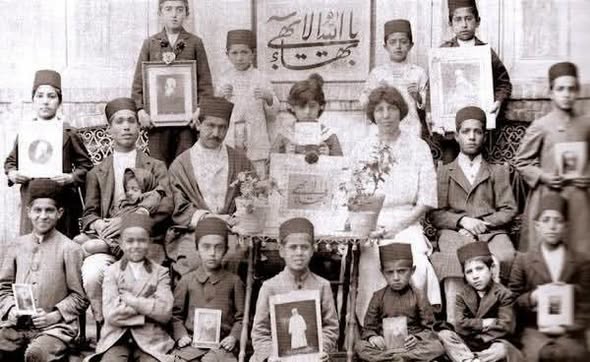
A brief note regarding the Baha'is: In light of the recurring accusation that the followers of Baha'u'llah converted many of Iran's Jews, one might offer a slight refinement, flipping the delicate equation on its head—and argue instead that many of Iran's Jews converted themselves to the Baha'i faith.
The subject of conversion is a charged one, certainly for an ethno-religious community that has built much of its ethos upon dichotomous narratives of persecution and the fortifying of walls, and surely from within the high fortress of the Zionist project and its dim view of the Jewish Diaspora throughout the ages.
While I will leave the matter of this modern dichotomy to experts greater than myself, it is worth returning to the Baha'i story itself and the secret behind the phenomenal success of that graceful hybrid—born of Shi'ite ferment and the transformative powers of modernity—and the endless opportunities the early Baha'i movement provided to the Jews of Iran.
There is no doubt that Jewish existence in Iran was one of difficult compromises, similar to other ethnic minorities who were required to negotiate with the Muslim establishment—the Sunnis prior to the 16th century, and the Shi'ites thereafter. The Jewish presence in Iran constitutes a highly complex mosaic of local and religious identity, institutional and popular pressures, but also a story of cultural autonomy that is entirely Jewish in its flavors just as it is saturated with Persian colors in its background. Furthermore, it is a story that leaves room for identities more complex than the supposedly eternal contrast between the Jew and the outside world.
Thus, even before the emergence of the "Baha'i option," Jews found ways to integrate their way of life with the possibilities presented by the general society. Common translations and interpretations of classical Persian literature were sometimes combined with joining the broad circles of various Sufi orders; even the occasional sacrifice of a sheep in honor of the eighth Shi'ite Imam allowed Jews to navigate their path within general Iranian society. They often bypassed the hostile religious establishment of the Qajar period without needing to succumb to the temptations of Islam and the potential prosperity that accompanied it.
Existing pressures, including the deep-seated institutional hostility toward community members who did choose to convert to Islam but remained under a cloud of suspicion as "crypto-Jews," made the Jewish condition particularly difficult in certain times and places. Perhaps there is no surprise in the relative chronological proximity between the forced conversion of a significant portion of the Mashhad Jewish community and the revelation of the Bab as the herald of a new monotheistic message just a few years later.
The Babi-Baha'i movement, a fascinating product of the 19th-century fusion of worlds, allowed many residents of the Persian sphere for the first time to gain a bridgehead into the heart of the modern machine. This was achieved not through a total, self-effacing abandonment to the West and its spiritual heritage, but as equal partners in the creation of a new world carried heavenward on the twin wings of technological and political progress on one hand, and monotheistic religious conservatism on the other. In the process, they were given the opportunity to rethink the question of eternal Iran, producing from their ranks artists, musicians, scientists, and other figures of stature.
For the Jews themselves, this Baha'i option offered the possibility of reclaiming their place in the domestic space where they had lived for generations, while finding a path around the oppressive Shi'ite orthodoxy and gaining increased access to the institutions of modernity—education, commerce, and social and political ties. While it is difficult to gauge the exact number of Jewish converts to the Baha'i faith during the turn of the 19th century and after, external observers, including European Jews and British intelligence officers, estimated that they numbered in the hundreds of families in the period preceding the Constitutional Revolution of the late Qajar era—equivalent to thousands of Jews scattered across many communities, including Hamadan, Yazd, Tehran, and other important centers.
While it is difficult for us, dwelling as we do atop the dichotomous tower and its shadows, to perceive Jewish-Baha'i conversion through tools clean of the "apostate" ethos, it is important to emphasize that the Baha'i movement—certainly in its early, formative years—allowed broad segments of the Qajar Empire to redefine their place in a rapidly changing world without the absolute necessity of abandoning their familiar social standing. We know, for instance, that in the early years of the crystallizing Baha'i religion, Jewish-Baha'i institutions still existed; these operated kosher Jewish-Baha'i butcher shops, held proper Yom Kippur prayers, and even sent letters of solidarity to the "Christian-Baha'is" of the United States from the "Jewish-Baha'is" of Tehran. This was before Abdu'l-Baha and the monotheistic fondness for fortified walls closed the shop and minted a clearer definition of who was a Jew, who was a Christian, and who was a strictly kosher Baha'i.
In summary, and contrary to the claim that the Baha'is converted the Jews of Persia, we can conclude that the Jews of Persia converted to the Baha'i faith willingly because it offered them, in that wondrous window of time at the end of the 19th century and shortly thereafter, a window into a new and more enabling world. It offered a chance for social equality, access to technology, and modern education at a singular point where a foreign light pierced the veil of pre-modern Shi'ite orthodoxy—just a moment before nationalism, Marxism, and finally Zionism offered the Jews of the Iranian sphere a new channel for ancient impulses, and a moment before Shi'ite orthodoxy performed its own flanking maneuver and sent everyone to write poetry in Evin Prison.
And while for the miners of identity, this is enough to tear a rent and mourn the loss of so many members of the Mosaic faith to the depths of a world of marble, peacocks, and inter-cultural congresses, perhaps one can take comfort in the fact that the religion of modernity itself, with its infinite galaxy of possibilities, currents, and shades, is the great equalizer permeating every corner, every place, and every human society.
And while human beings scurry hither and thither in a desperate attempt to rake and sort and understand what is theirs and what belongs to the neighbor, the great conversion of eternity is still underway. In the end, may we all sit as one among the ruins of known civilization, watching an endless loop of TikTok videos and eating sushi with mayonnaise.
Good luck to us all, and a happy Tuesday.
Related writing
Essay
Between Mysticism and Revolution: The Poetry of Khomeini
On Persian verse, mystical insight, and the fine line between spiritual transcendence and political authority.
Field Note
The Ginger Garden
On gardening, rhizomes, and a small botanical obsession in a Dali courtyard.
Essay
Rivers and Lakes
“When the springs dry up, the fish huddle together, gasping to keep one another moist; it would be better if they could forget each other in the rivers and lakes.” (Zhuangzi)